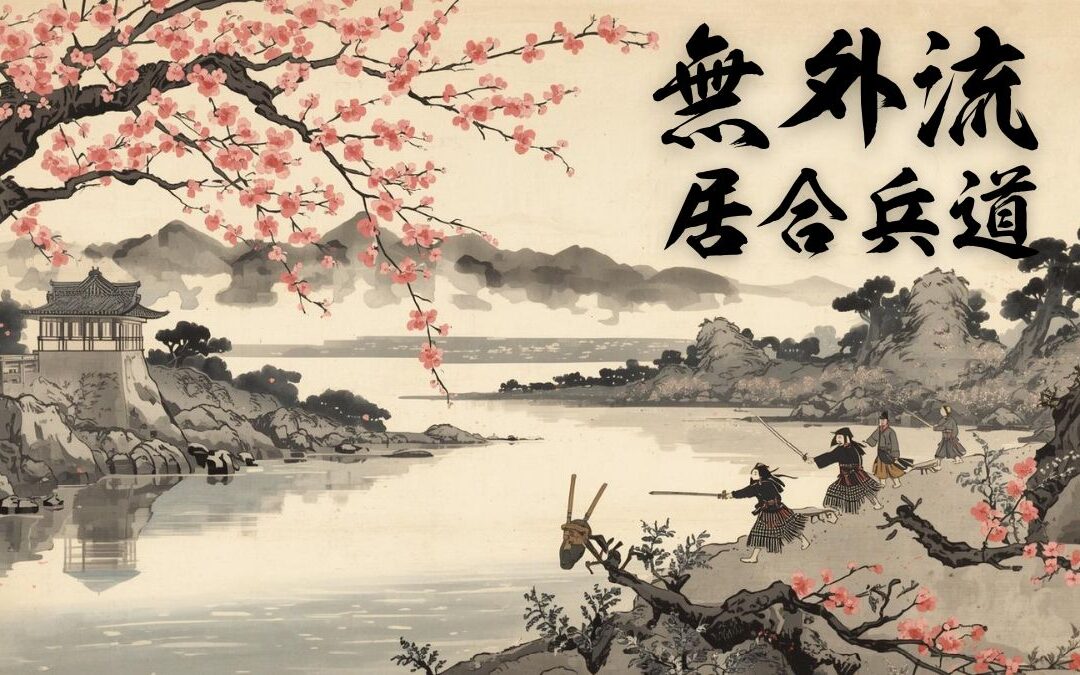
12,000 Views: Sharing the Path of Mugai-ryu Iaihyodo
Since returning from Japan, I’ve been overwhelmed by the curiosity and support from the community on Instagram.
To better document and share my journey in Mugai-ryu Iaihyodo, I decided to launch my YouTube channel—and the response has been incredible.
I want to say a massive thank you to everyone who has tuned in. Starting from scratch with a niche martial art can be a quiet journey, so seeing over 12,000 views on my weekly content is truly humbling.
A special thanks goes out to the Japanese viewers who regularly watch my videos and reach out via Instagram. Your insights and encouragement mean the world to me. I look forward to sharing more Mugai-ryu techniques and katas as I continue to learn and grow.
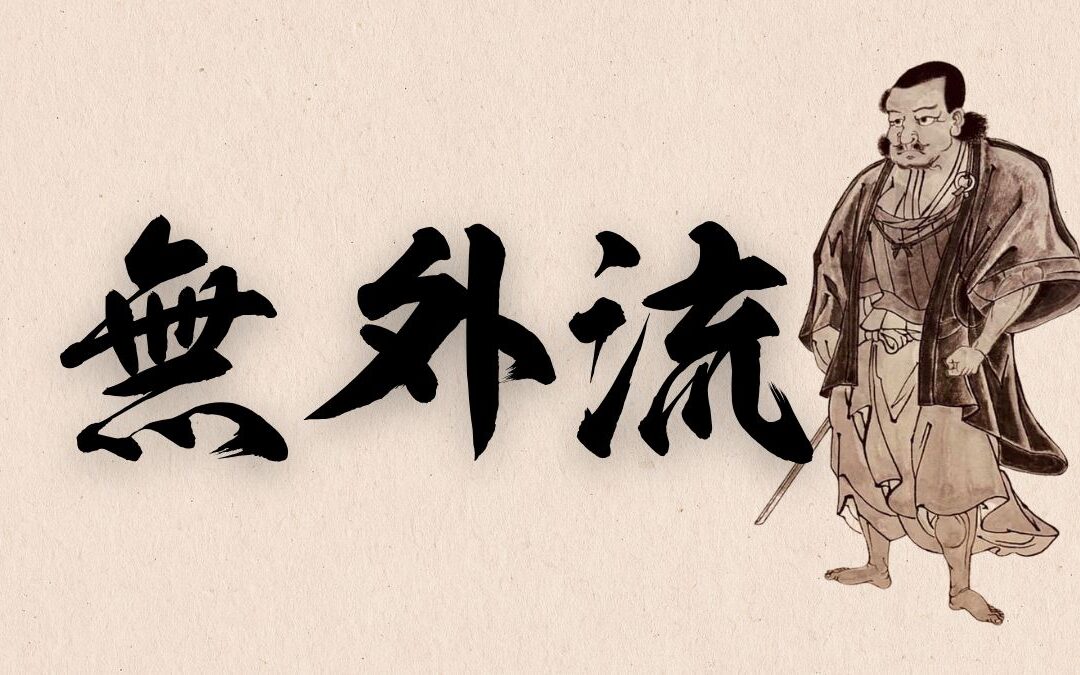
In the history of Japanese martial traditions (budō, 武道), few figures embody the union of swordsmanship and Zen Buddhism as completely as Tsuji Gettan Sukemochi (辻月丹資茂, 1648–1728), founder of Mugai-ryū (無外流).
Gettan’s life traces a rare and profound arc:
from samurai swordsman to Zen monk, from technical mastery (waza, 技) to realization of emptiness (mu, 無). His school is not merely a system of combat, but a physical expression of Zen insight, where the sword becomes a vehicle for awakening.
Edo Period and the Way of the Sword
Tsuji Gettan was born in 1648, early in the Edo period (江戸時代), a time of peace under the Tokugawa shogunate. With warfare largely absent, the samurai class faced an existential shift:
What is the purpose of the sword in an age without war?
This question gave rise to a new understanding of martial practice:
Swordsmanship as self-cultivation (shugyō, 修行)
Combat as a path toward ethical refinement
The integration of Zen (禅), Confucianism (儒教), and martial discipline
It was within this atmosphere that Gettan’s transformation became possible.
Early Life and Martial Training (武芸修行)
Tsuji Gettan Sukemochi was born into a samurai family (侍). From a young age, he was trained in classical sword arts (kenjutsu, 剣術), eventually studying several established schools, including:
Sekiguchi-ryū (関口流)
Yamaguchi-ryū (山口流)
These traditions emphasized:
Correct posture (shisei, 姿勢)
Efficient body mechanics
Decisive, realistic technique
Gettan sensei gained a reputation for calmness and precision rather than brute force. Yet even as his skill deepened, a realization emerged: technical excellence alone was incomplete.
The Inner Conflict: Technique Without Awakening
Like many elite swordsmen of his time, Gettan reached a point where further refinement of technique failed to bring clarity.
Questions arose:
What remains when technique disappears?
Who cuts when there is no thought?
Can the sword reveal ultimate truth (shinri, 真理)?
In Zen terms, Gettan faced the limit of form (kata, 形) without essence (ri, 理). This inner conflict pushed him beyond martial schools and toward Zen practice.
Encounter with Zen Buddhism (禅)
Tsuji Gettan became a disciple of the Rinzai Zen monk Sekitō Kisen (石頭希遷系臨済禅). Under his guidance, Gettan undertook severe spiritual training, including:
Zazen (坐禅) — seated meditation
Kōan practice (公案) — paradoxical Zen questions
Monastic discipline designed to exhaust ego and attachment
Through this process, Gettan confronted the root of fear, identity, and duality. Eventually, he attained satori (悟り), a direct realization of reality beyond conceptual thought.
Upon awakening, he received the Buddhist name Gettan (月丹):
月 (getsu / tsuki) — moon
丹 (tan) — cinnabar, elixir, essence
The name evokes the moon reflected in still water — pure awareness, unattached, illuminating without effort.
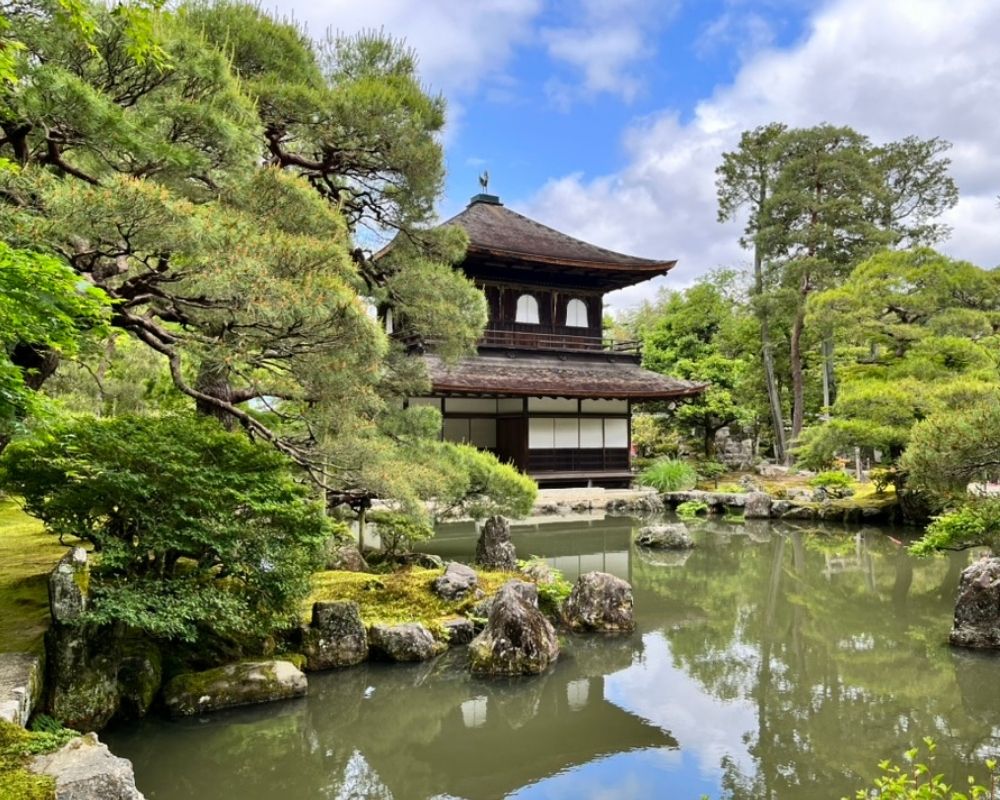
Ginkaku-ji (Kyoto) – Photo Liomugai
The Birth of Mugai-ryū (無外流)
After his Zen realization, Gettan returned to swordsmanship with transformed perception. From this union of Zen insight and martial experience, he founded Mugai-ryū.
The name of the school is profoundly philosophical: 無 (mu) — nothingness, emptiness, non-being
外 (gai) — outside, beyond
Mugai may be understood as: “That which exists beyond emptiness.” This does not imply nihilism, but freedom from duality — beyond self and other, life and death, victory and defeat.
Mugai-ryū specializes in iaijutsu (居合術), the art of drawing the sword and cutting in a single, decisive action.
Key characteristics include:
Simplicity (簡素, kanso) — no unnecessary movement
Directness (直截, chokusetu) — immediate resolution
Stillness of mind (静心, seishin) — action arising from silence
One cut, one life (一刀一命, ittō ichimei)
The kata are minimalistic, but unforgiving. They demand:
Perfect timing (hyōshi, 拍子)
Complete presence (zanshin, 残心)
Absence of ego (muga, 無我)
Teaching Beyond Technique: The Sword as a Zen Koan
As a teacher in Edo, Gettan attracted both samurai and scholars. However, he did not view Mugai-ryū merely as a fighting system.
For him:
Kata were moving kōan
Training was Zen practice in armor
The opponent was a mirror of the self
He emphasized key Zen-martial principles:
無心 (Mushin) — no-mind
不動心 (Fudōshin) — immovable mind
平常心 (Heijōshin) — everyday mind
True victory, Gettan taught, was victory over delusion.
In his later life, Tsuji Gettan increasingly withdrew from worldly ambition, focusing on teaching and Zen practice. He passed away in 1728, leaving behind:
Mugai-ryū Iaijutsu
A lineage of Zen-infused swordsmanship
A model of martial enlightenment
Mugai-ryū continues to thrive globally as a living expression of Zen. Speaking from experience, practicing it daily is more than just training; it is a vital asset for navigating the stresses of modern life.
In the face of chaos, most people react like a leaf in the wind—tossed by praise, broken by criticism, or paralyzed by fear. The Japanese martial tradition offers an alternative: Fudōshin (不動心).
Translated literally as “Immovable Mind,” Fudōshin is a state of psychological and spiritual equilibrium. It is not a state of “unfeeling” or being a statue; rather, it is the ability to remain centered and effective regardless of external circumstances.
The Anatomy of the Immovable Mind
The term is composed of three kanji characters:
Fu (不): Not / Non-
Dō (動): Move / Motion
Shin (心): Heart / Mind / Spirit
In Eastern philosophy, the heart and mind are often viewed as a single entity (Xin or Shin). Therefore, Fudōshin is as much about emotional stability as it is about intellectual focus.
The Metaphor of Water and the Mirror
To understand Fudōshin, Zen masters often use the metaphor of a still pond.
If the water is turbulent, it distorts the reflection of the moon.
If the water is still, it reflects the world exactly as it is.
When your mind is “moved” by anger or anxiety, your perception of reality becomes distorted. You react to your projection of the threat rather than the threat itself. Fudōshin allows you to see the “moon” clearly.
Fudōshin in the Heat of Battle
Historically, this concept was vital for the Samurai. In a duel, a split second of hesitation (caused by fear) or a split second of overconfidence (caused by ego) meant death.
The legendary swordsman Miyamoto Musashi alluded to Fudōshin in The Book of Five Rings, describing a “distracted mind” as a fatal flaw. He argued that the warrior’s spirit should be the same in the midst of a duel as it is in everyday life—calm, observant, and undeterred.
“Both in fighting and in everyday life you should be determined though calm. Meet the situation without tenseness yet not recklessly, your spirit settled yet unbiased.” — Miyamoto Musashi
The Four weak points of the Mind
To achieve Fudōshin, one must overcome the Shiso (the four sicknesses/distractions) that cause the mind to move:
Fear (Kyo): Physical or mental dread that freezes action.
Confusion (Waku): A lack of clarity or doubt in one’s path.
Hesitation (Gaku): Over-calculating or waiting too long to commit.
Surprise (驚 – Kyō): Being caught off guard by the unexpected.
When you master Fudōshin, the unexpected no longer surprises you, not because you predicted it, but because your internal foundation is so solid that no external event can shake it.
Fudō Myō-ō: The Visual Archetype
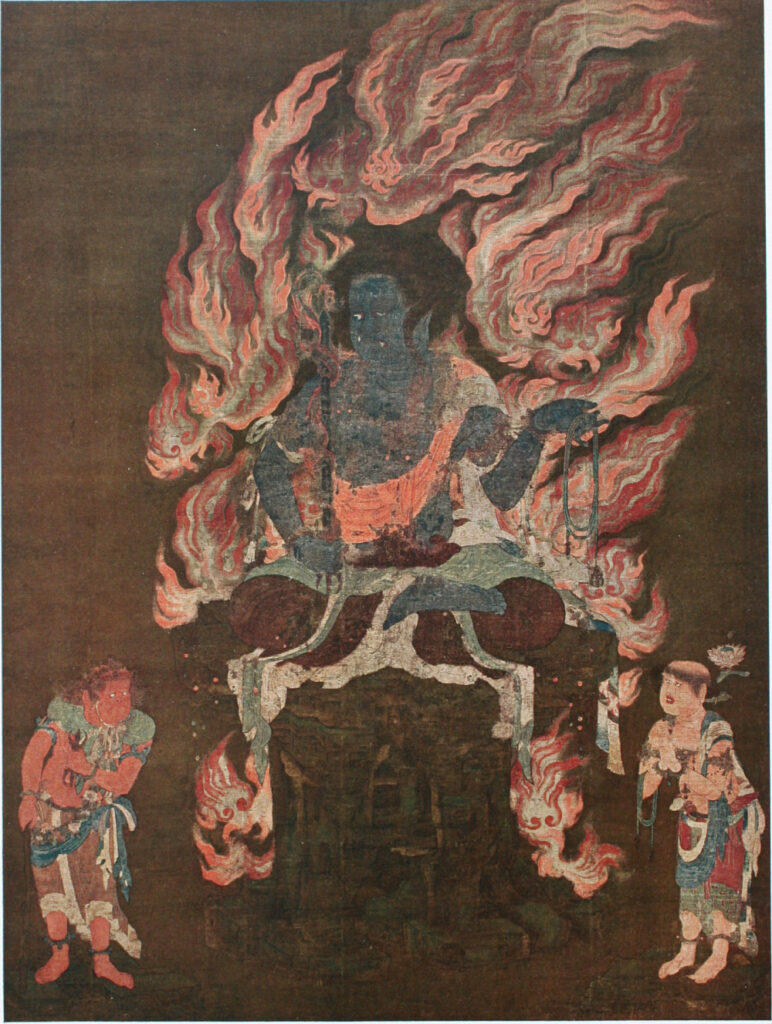
In Japanese Buddhism, the deity Fudō Myō-ō is the personification of this state. He is often depicted surrounded by flames, holding a sword in one hand and a rope in the other. He looks fierce and terrifying, yet he sits on a flat rock (symbolizing stability). The flames represent the burning of worldly desires and distractions, while his immovable stance represents the indestructible nature of the enlightened mind.
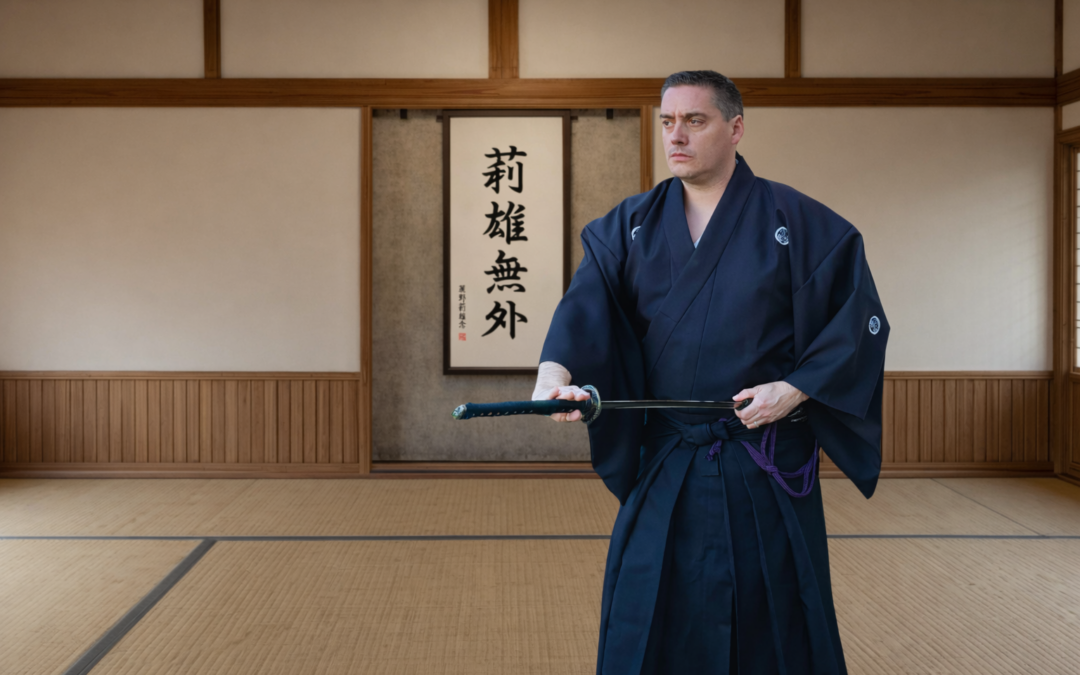
A few months ago, I received my first Mugai-ryū certificate. It was, of course, a great honor to be recognized by a school with such a profound samurai lineage. I found myself feeling that same spark of excitement my own students feel when they receive their Karate certificates. For a teacher, there is something deeply refreshing—and necessary—about returning to the beginning as a student.
While examining the calligraphy on the scroll, my eyes were caught by the specific way Iaido was written. Instead of the modern and widely used three characters (居合道), it was written with four: 居合兵道 (Iai Hyōdō).
Curiosity led me to my kanji dictionary. What I discovered was a world of difference contained in that single additional character—a meaning that defines the very soul of our school.
The Etymology of 居合兵道 (Iai Hyōdō)
As a lifelong student of the Japanese language, I find digging into the “hidden” meanings of kanji to be one of the most fascinating aspects of martial arts.
1. 居 (I) — Presence and Being
This character means to reside, to be present, or to remain. In swordsmanship, it refers to your state of being beforeaction arises. It implies composure, grounding, and total awareness—whether you are standing, seated, or moving.
In Mugai-ryū, this presence is never passive. It is an alert stillness; a readiness rooted in correct posture (Shisei), a correct mind (Kokoro), and the mastery of distance (Maai).
2. 合 (Ai) — To Harmonize and Unite
Ai signifies meeting or uniting. In the sword arts, it represents the exact instant where your timing, intent, and movement meet the opponent’s action.
In our school, Ai is more than just technical timing. It is the moment where perception and action become one. This reflects the Mugai-ryū emphasis on directness: no excess motion, no hesitation, and no delay. Together, 居合 (Iai)describes a readiness that seamlessly transforms into action.
3. 兵 (Hei) — The Soldier and the Blade
This is the most distinctive character in 居合兵道. Hei refers to weapons, armed conflict, or the soldier. Its inclusion is a bold statement: Mugai-ryū is fundamentally a martial system, not merely a discipline of aesthetic movement or personal refinement.
While modern Iaido often focuses on spiritual cultivation and etiquette, Mugai-ryū preserves a visceral connection to combat reality. The sword is treated as a decisive weapon, and our kata are condensed expressions of battlefield logic. We must not forget that for Shodan (1st Dan), Tameshigiri (test cutting) with a Shinken (live blade) is required. This character anchors our practice in Bu (martial function), preventing it from becoming a mere abstraction.
4. 道 (Dō) — The Lifelong Path
Finally, Dō places the art within the Japanese concept of the “Way”—a path of continuous study, discipline, and transformation.
Importantly, Mugai-ryū does not see a conflict between the “Way” and “Technique.” Instead, it asserts that the Way emerges through correct martial understanding. Self-mastery and clarity of mind are not achieved by avoiding the reality of the blade, but by facing the truths implied by 兵 (Hei).
The common translation of 居合兵道 would be The Warrior’s Way: Harmony in the Absolute Present. Now let’s go back to the essence of the school Tsuji Gettan the founder was a Zen Monk, so let’s review now the these Kamjis through the Zen paradygm
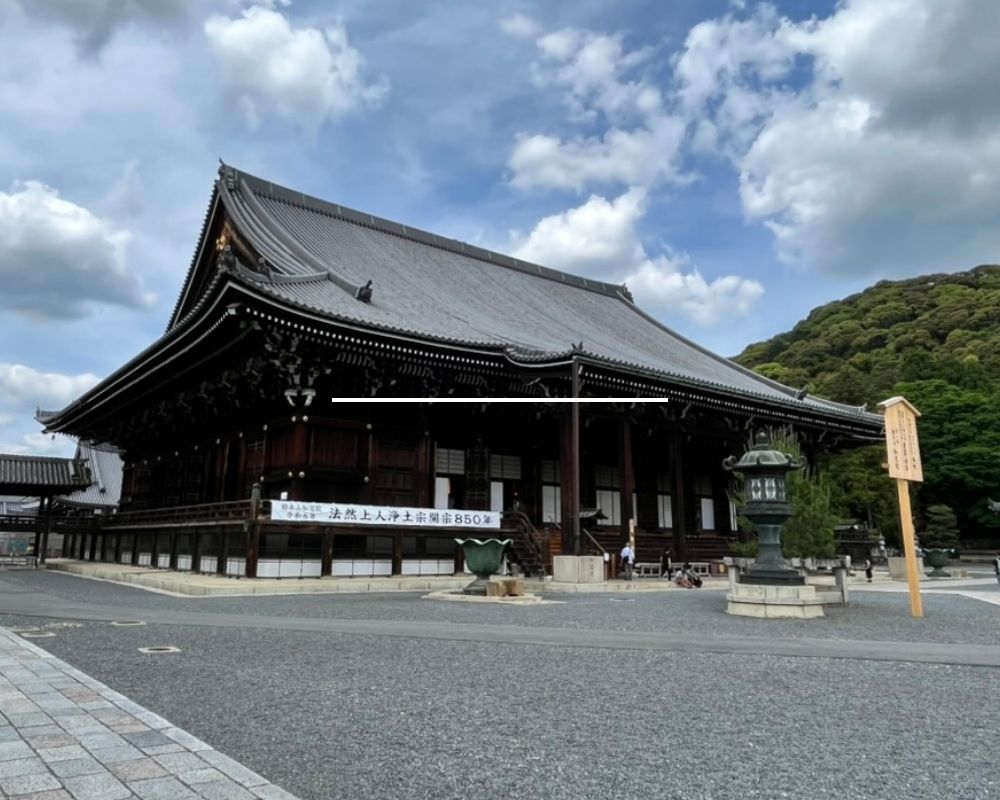
Zen Temple in Kyoto (2023)
The Zen Approach
If we translate these Kanjis iusing the Zen way of thinking we should translate Ia Hyodo by the following : The Way of the Warrior, Bound to the Eternal Now.
1. “The Way of the Warrior” (居合兵道 – Iai Hyōdō)
In a Budo context, “The Way” (Dō) is not a destination, but a lifelong process of refinement.
The Warrior: By using “Warrior” instead of just “Swordsman,” we acknowledge the Hyōdō (Military Strategy) aspect of Mugai-ryū. It implies that the practice is not merely aesthetic; it is rooted in the reality of the battlefield and the discipline of the Samurai.
The Commitment: It suggests a lifestyle of readiness, integrity, and focus that extends beyond the dojo floor.
2. “Bound to…” (合 – Ai)
This is a poetic rendering of Ai (Harmony/Union).
The Connection: To be “bound” suggests that you are not separate from your sword, your environment, or your opponent. There is no “gap” (ma) in your attention.
The Discipline: In Mugai-ryū, your movement is bound to your breath. If your breathing is chaotic, your cut will be weak. To be bound is to be perfectly synchronized.
3. “The Eternal Now” (居 – I)
This is the most “Zen” element of the translation, addressing the character I (to be present).
Beyond Time: In Iai, the past is a memory and the future is an uncertainty. The only reality is the precise millisecond the blade leaves the saya.
The “Eternal” Aspect: It suggests that if you are truly present in this one moment, you are connected to the universal truth. There is no room for hesitation (Suki), regret, or fear.
Practical Application: When performing Kihon Ichi, “The Eternal Now” means your mind does not wander to the Chiburi while you are still performing the Nukitsuke. Each micro-movement is the only thing that exists
Why Not Simply 居合道?
The simplified term 居合道 gained popularity in the 20th century, particularly through standardization efforts and modern budō organizations. While valid in its own context, it subtly shifts emphasis:
From martial effectiveness to spiritual cultivation
From combative function to formalized practice
From koryū specificity to generalized budō
Mugai-Ryū’s use of 居合兵道 resists this dilution. It preserves the school’s original identity as a classical martial tradition (koryū) rooted in the realities of armed conflict, while still recognizing the deeper personal path that such training offers.