
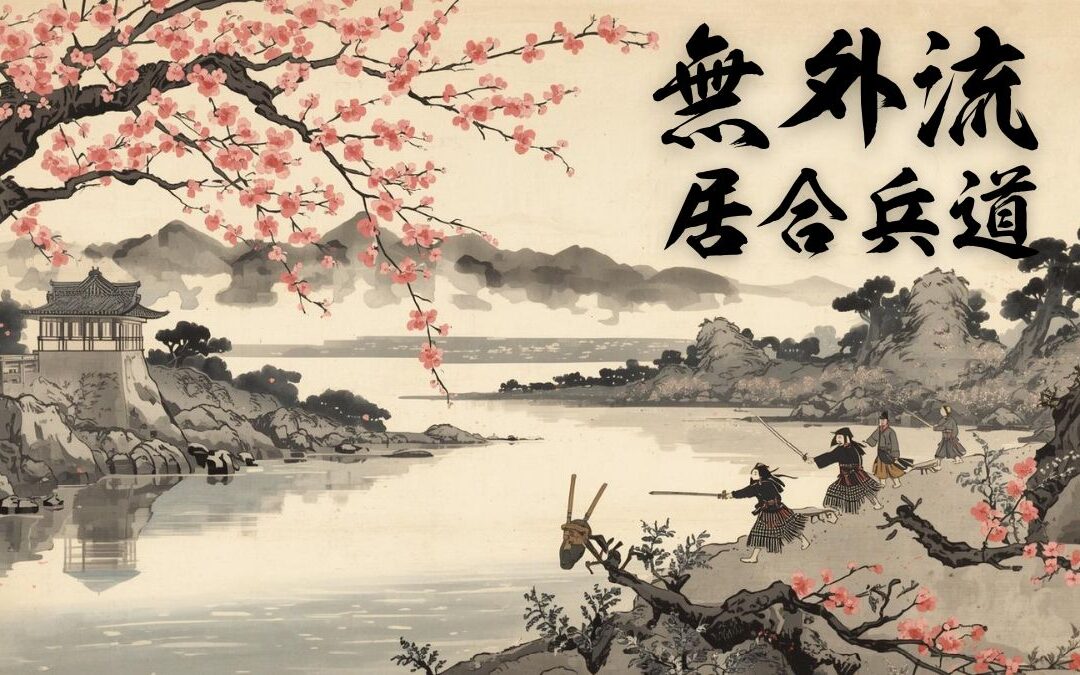
A few months ago, I received my first Mugai-ryū certificate. It was, of course, a great honor to be recognized by a school with such a profound samurai lineage. I found myself feeling that same spark of excitement my own students feel when they receive their Karate certificates. For a teacher, there is something deeply refreshing—and necessary—about returning to the beginning as a student.
While examining the calligraphy on the scroll, my eyes were caught by the specific way Iaido was written. Instead of the modern and widely used three characters (居合道), it was written with four: 居合兵道 (Iai Hyōdō).
Curiosity led me to my kanji dictionary. What I discovered was a world of difference contained in that single additional character—a meaning that defines the very soul of our school.
The Etymology of 居合兵道 (Iai Hyōdō)
As a lifelong student of the Japanese language, I find digging into the “hidden” meanings of kanji to be one of the most fascinating aspects of martial arts.
1. 居 (I) — Presence and Being
This character means to reside, to be present, or to remain. In swordsmanship, it refers to your state of being beforeaction arises. It implies composure, grounding, and total awareness—whether you are standing, seated, or moving.
In Mugai-ryū, this presence is never passive. It is an alert stillness; a readiness rooted in correct posture (Shisei), a correct mind (Kokoro), and the mastery of distance (Maai).
2. 合 (Ai) — To Harmonize and Unite
Ai signifies meeting or uniting. In the sword arts, it represents the exact instant where your timing, intent, and movement meet the opponent’s action.
In our school, Ai is more than just technical timing. It is the moment where perception and action become one. This reflects the Mugai-ryū emphasis on directness: no excess motion, no hesitation, and no delay. Together, 居合 (Iai)describes a readiness that seamlessly transforms into action.
3. 兵 (Hei) — The Soldier and the Blade
This is the most distinctive character in 居合兵道. Hei refers to weapons, armed conflict, or the soldier. Its inclusion is a bold statement: Mugai-ryū is fundamentally a martial system, not merely a discipline of aesthetic movement or personal refinement.
While modern Iaido often focuses on spiritual cultivation and etiquette, Mugai-ryū preserves a visceral connection to combat reality. The sword is treated as a decisive weapon, and our kata are condensed expressions of battlefield logic. We must not forget that for Shodan (1st Dan), Tameshigiri (test cutting) with a Shinken (live blade) is required. This character anchors our practice in Bu (martial function), preventing it from becoming a mere abstraction.
4. 道 (Dō) — The Lifelong Path
Finally, Dō places the art within the Japanese concept of the “Way”—a path of continuous study, discipline, and transformation.
Importantly, Mugai-ryū does not see a conflict between the “Way” and “Technique.” Instead, it asserts that the Way emerges through correct martial understanding. Self-mastery and clarity of mind are not achieved by avoiding the reality of the blade, but by facing the truths implied by 兵 (Hei).
The common translation of 居合兵道 would be The Warrior’s Way: Harmony in the Absolute Present.
Now let’s go back to the essence of the school Tsuji Gettan the founder was a Zen Monk, so let’s review now the these Kamjis through the Zen paradygm
The Zen Approach
If we translate these Kanjis iusing the Zen way of thinking we should translate Ia Hyodo by the following : The Way of the Warrior, Bound to the Eternal Now.
1. “The Way of the Warrior” (居合兵道 – Iai Hyōdō)
In a Budo context, “The Way” (Dō) is not a destination, but a lifelong process of refinement.
- The Warrior: By using “Warrior” instead of just “Swordsman,” we acknowledge the Hyōdō (Military Strategy) aspect of Mugai-ryū. It implies that the practice is not merely aesthetic; it is rooted in the reality of the battlefield and the discipline of the Samurai.
- The Commitment: It suggests a lifestyle of readiness, integrity, and focus that extends beyond the dojo floor.
2. “Bound to…” (合 – Ai)
This is a poetic rendering of Ai (Harmony/Union).
- The Connection: To be “bound” suggests that you are not separate from your sword, your environment, or your opponent. There is no “gap” (ma) in your attention.
- The Discipline: In Mugai-ryū, your movement is bound to your breath. If your breathing is chaotic, your cut will be weak. To be bound is to be perfectly synchronized.
3. “The Eternal Now” (居 – I)
This is the most “Zen” element of the translation, addressing the character I (to be present).
- Beyond Time: In Iai, the past is a memory and the future is an uncertainty. The only reality is the precise millisecond the blade leaves the saya.
- The “Eternal” Aspect: It suggests that if you are truly present in this one moment, you are connected to the universal truth. There is no room for hesitation (Suki), regret, or fear.
- Practical Application: When performing Kihon Ichi, “The Eternal Now” means your mind does not wander to the Chiburi while you are still performing the Nukitsuke. Each micro-movement is the only thing that exists
Why Not Simply 居合道?
The simplified term 居合道 gained popularity in the 20th century, particularly through standardization efforts and modern budō organizations. While valid in its own context, it subtly shifts emphasis:
- From martial effectiveness to spiritual cultivation
- From combative function to formalized practice
- From koryū specificity to generalized budō
Mugai-Ryū’s use of 居合兵道 resists this dilution.
It preserves the school’s original identity as a classical martial tradition (koryū) rooted in the realities of armed conflict, while still recognizing the deeper personal path that such training offers.
I hope you enjoyed this article.