In the face of chaos, most people react like a leaf in the wind—tossed by praise, broken by criticism, or paralyzed by fear. The Japanese martial tradition offers an alternative: Fudōshin (不動心).
Translated literally as “Immovable Mind,” Fudōshin is a state of psychological and spiritual equilibrium. It is not a state of “unfeeling” or being a statue; rather, it is the ability to remain centered and effective regardless of external circumstances.
The Anatomy of the Immovable Mind
The term is composed of three kanji characters:
- Fu (不): Not / Non-
- Dō (動): Move / Motion
- Shin (心): Heart / Mind / Spirit
In Eastern philosophy, the heart and mind are often viewed as a single entity (Xin or Shin). Therefore, Fudōshin is as much about emotional stability as it is about intellectual focus.
The Metaphor of Water and the Mirror
To understand Fudōshin, Zen masters often use the metaphor of a still pond.
- If the water is turbulent, it distorts the reflection of the moon.
- If the water is still, it reflects the world exactly as it is.
When your mind is “moved” by anger or anxiety, your perception of reality becomes distorted. You react to your projection of the threat rather than the threat itself. Fudōshin allows you to see the “moon” clearly.
Fudōshin in the Heat of Battle
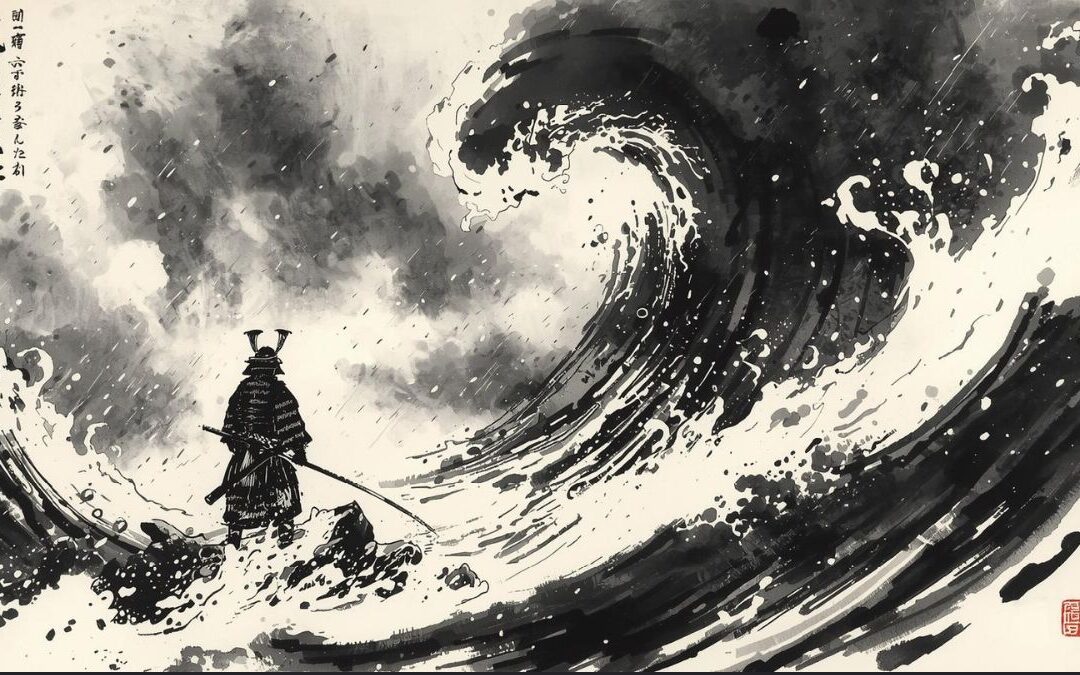
Historically, this concept was vital for the Samurai. In a duel, a split second of hesitation (caused by fear) or a split second of overconfidence (caused by ego) meant death.
The legendary swordsman Miyamoto Musashi alluded to Fudōshin in The Book of Five Rings, describing a “distracted mind” as a fatal flaw. He argued that the warrior’s spirit should be the same in the midst of a duel as it is in everyday life—calm, observant, and undeterred.
“Both in fighting and in everyday life you should be determined though calm. Meet the situation without tenseness yet not recklessly, your spirit settled yet unbiased.” — Miyamoto Musashi
The Four weak points of the Mind
To achieve Fudōshin, one must overcome the Shiso (the four sicknesses/distractions) that cause the mind to move:
- Fear (Kyo): Physical or mental dread that freezes action.
- Confusion (Waku): A lack of clarity or doubt in one’s path.
- Hesitation (Gaku): Over-calculating or waiting too long to commit.
- Surprise (驚 – Kyō): Being caught off guard by the unexpected.
When you master Fudōshin, the unexpected no longer surprises you, not because you predicted it, but because your internal foundation is so solid that no external event can shake it.
Fudō Myō-ō: The Visual Archetype
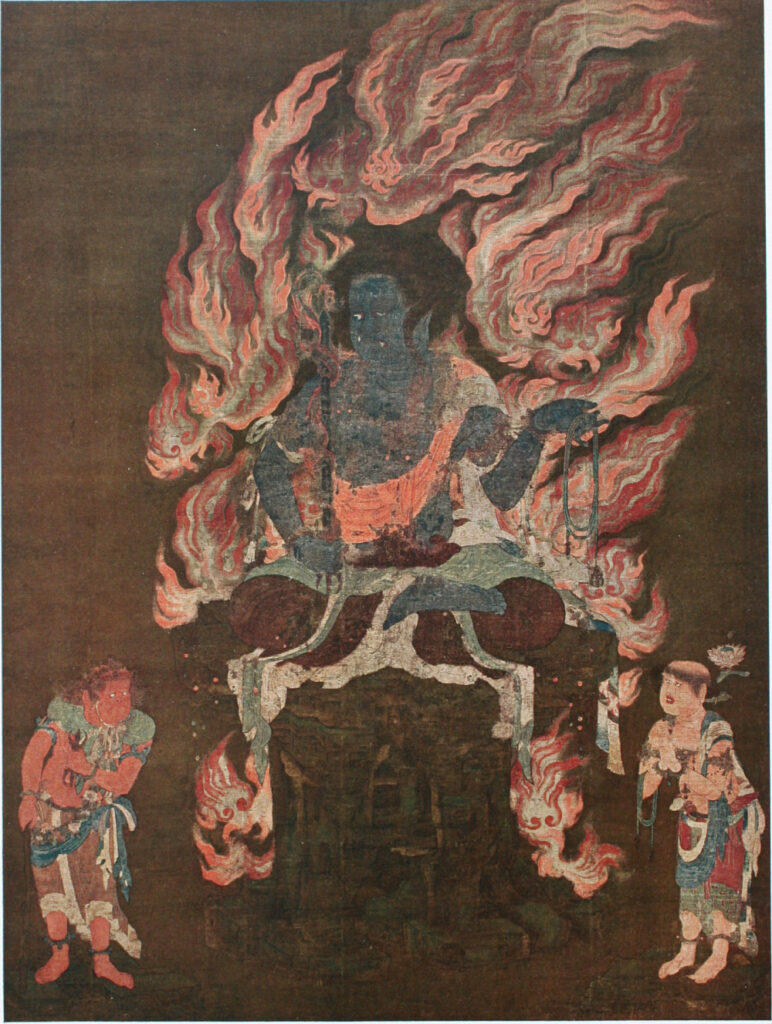
In Japanese Buddhism, the deity Fudō Myō-ō is the personification of this state. He is often depicted surrounded by flames, holding a sword in one hand and a rope in the other. He looks fierce and terrifying, yet he sits on a flat rock (symbolizing stability). The flames represent the burning of worldly desires and distractions, while his immovable stance represents the indestructible nature of the enlightened mind.