
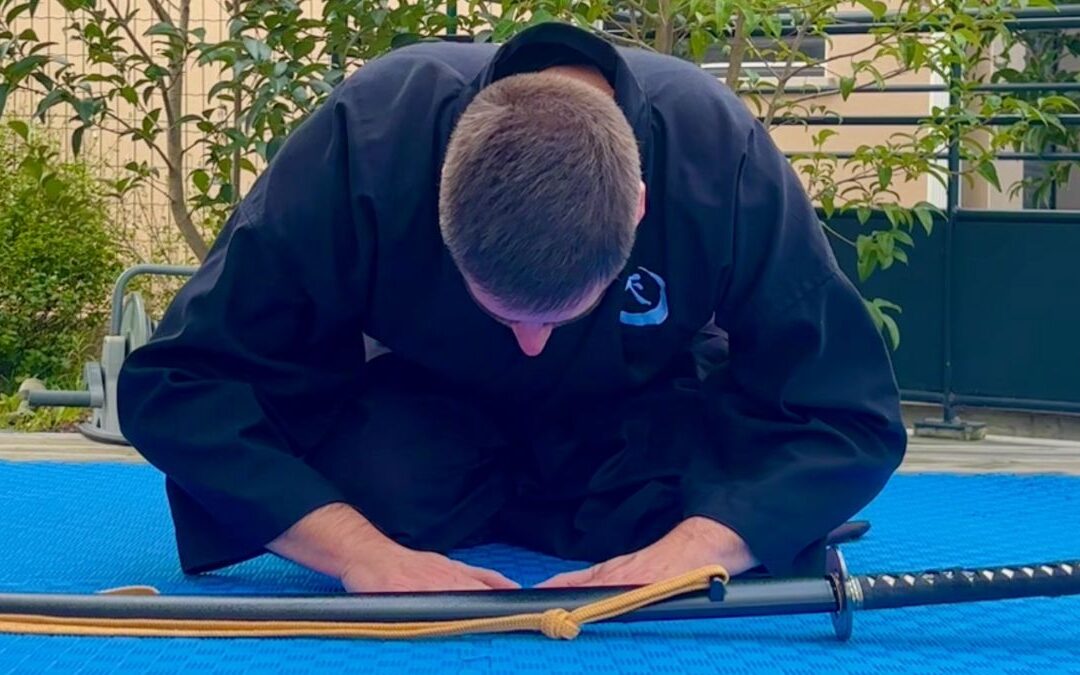
In the modern world, the act of bowing to a weapon can appear—at least to the uninitiated—as a curious form of reverence, even idolatry. Yet for a practitioner of Mugai-ryū or Battōdō, the ritual of Reigyō (礼行, etiquette in action) is not symbolic theater. It is one of the most practical and transformative elements of training.
When we kneel before our iaitō or shinken, we are not venerating an object. We are directing our attention inward, executing a deliberate strike against the most dangerous adversary we will ever encounter: the ego.
What is Reigyo?
In Japanese martial traditions, there is a well-known saying:
“Budō begins and ends with rei.”
Reigyō is often translated simply as “etiquette,” but this rendering barely scratches the surface. Reigyō is the embodied expression of respect, gratitude, awareness, and restraint. It is etiquette made physical—conduct that shapes the mind as much as the body.
In the context of sword practice, Reigyō is expressed through rituals such as:
- Tō-rei — the formal bow to the sword
- Shinzen-ni-rei — the bow to the shrine or the front of the dōjō
- Otaga ni rei — the bow to one’s training partners
These are not merely “rules of the dōjō.” Psychologically, they serve a precise function: they create a liminal space—a threshold between the disorder of daily life and the focused, potentially lethal discipline of the sword. Crossing this threshold prepares the practitioner to train with clarity, humility, and intent.
Why Bow to a Piece of Steel?
The sword is a paradox. Historically, it is an instrument of death. Philosophically, within many koryū traditions, it is a means of cutting away illusion—most notably one’s own. We bow to the sword for three essential reasons.
1. Acknowledging the Danger
The instant you stop respecting the blade is the instant you invite injury. Bowing is an explicit acknowledgment of danger—an admission that you are handling something capable of taking life.
This act cultivates mindfulness. It anchors you in the present moment. One cannot bow sincerely while the mind is wandering through errands, emails, or distractions. The bow demands presence.
2. Gratitude for the Path
The sword is an uncompromising teacher. It offers immediate and honest feedback: a flawed grip alters the tachikaze; a distracted mind causes the kata to unravel.
To bow is to express gratitude for this ruthless clarity. It is an acknowledgment that the practice itself—through success and failure alike—is shaping the practitioner.
3. Connection to Lineage
Mugai-ryū was founded in the late 17th century by Tsuji Gettan Sukemochi. When you perform the same tō-rei that has been enacted for more than three centuries, you momentarily step beyond your individual identity.
You become a link in a living chain of practitioners—each bound by the same forms, the same discipline, and the same silent understanding. The bow dissolves the illusion that you practice alone.
The Ego’s Greatest Enemy: Humility
The ego thrives on comparison. It wants to feel superior—to win, to look impressive, to master a technique faster than those around us. Left unchecked, it turns training into performance and progress into vanity. Reigyō stands as the antidote.
When you bow, you deliberately lower your head—the most vulnerable part of the body—beneath your heart. This is not a symbolic gesture; it is a physical declaration of humility. In that moment, you submit not to a person or an object, but to the art itself. The bow reminds us that the art is larger than the individual who practices it.
In Mugai-ryū, deeply influenced by Zen philosophy, the aim is to approach a state of Mu—emptiness, the absence of ego-driven interference. One cannot arrive at emptiness while being full of oneself. Each bow becomes a conscious act of self-emptying, a methodical clearing of pride so that technique may emerge unimpeded.
“The sword is not used to defeat others; it is a means to achieve self-mastery and to harmonize the spirit.”
Reigyo inside and outside the Dojo
The true measure of a swordsman is not how precisely they bow within the dōjō, but how faithfully they carry that spirit beyond its walls. If you can bow to a blade with sincerity, can you listen to a colleague with the same presence? Can you meet failure or criticism with the same Fudōshin—the immovable mind—you cultivate during a demanding kata?
Reigyō is not about surface-level politeness or empty formality.
It is about wakefulness.
Through bowing to the steel, we learn to move through the world with awareness, respect, and restraint. More importantly, we learn to recognize—and temper—the quiet voice of ego before it hardens into arrogance.
In this way, etiquette becomes discipline, discipline becomes character, and character becomes the true cutting edge of the sword.