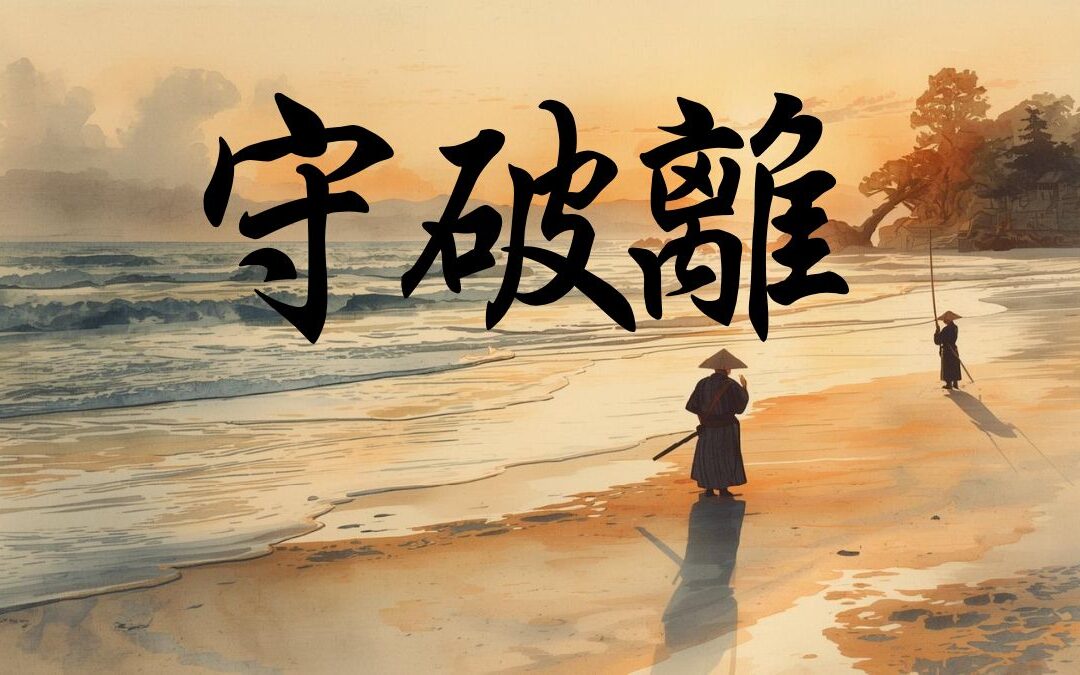
In the world of Japanese martial arts—and particularly within the discipline of Iaidō—mastery is not a destination to be reached, but a lifelong process of refinement. It is an ongoing evolution of body, mind, and spirit. This journey is elegantly expressed through the timeless concept of Shu–Ha–Ri (守破離).
Whether you are just beginning to tie your hakama or you have spent decades polishing your nukitsuke, understanding these three stages of learning is essential to genuine progress. Shu–Ha–Ri offers more than a pedagogical framework; it is a mirror held up to the practitioner’s inner development.
Originally articulated in the teachings of the legendary tea master Sen no Rikyū, and later embraced by generations of swordsmen, Shu–Ha–Ri describes the transformation of a student—from one who faithfully imitates the teacher, to one who ultimately embodies the art itself.
Phase 1 : Shu (守): Protect and Obey
The first stage, Shu, literally means “to protect” or “to preserve.” At this level, the student’s primary responsibility is to safeguard the tradition by receiving it intact.
The Mindset:
Absolute obedience—not blind submission, but humble receptivity. Shu is about protecting the purity of the teachings from the intrusion of ego, impatience, and premature interpretation.
In Practice:
In a Mugai-ryū dōjō, Shu means copying the sensei precisely. You do not ask, “Could I place my foot slightly differently?” You mirror the angle of the blade, the depth of the stance, the rhythm of the breath, and even the silence between movements.
The Goal:
To build an unshakable foundation. Repetition engrains the forms into the body until technique becomes instinctive. You are learning the alphabet of the sword—without which no meaningful expression is possible.
In a nutshell:
You cannot transcend the rules until you have fully internalized them.
Phase 2 : Ha (破): Detach and Break
The second stage, Ha, means “to break” or “to detach.” It is often the most misunderstood—and the most perilous—phase of the journey.
The Mindset:
Inquiry and discernment. After years of disciplined practice, the student begins to perceive the why behind the how. Curiosity replaces imitation, but respect remains.
In Practice:
You start to explore the underlying principles of Battōdō and how they adapt to different bodies, distances, or combative realities. You may study other ryūha, exchange insights with fellow practitioners, or observe how the same truth manifests through different forms.
The Goal:
Integration. Ha is not about rejecting the teachings of Shu, but stress-testing them. You “break” the mold to confirm that the essence of the technique remains intact when adapted. The form loosens, but the principles endure.

Phase 3 : Ri (離): Transcend and Depart
The final stage, Ri, means “to leave” or “to separate.” This is the realm of the master, where art and practitioner are no longer distinct.
The Mindset:
Naturalness. Action arises without deliberation. In Zen terms, this is Mushin—no-mind. There is no hesitation, no calculation, no inner commentary.
In Practice:
The practitioner no longer performs Mugai-ryū—they are Mugai-ryū. Movement is spontaneous, fluid, and perfectly attuned to the moment. The rigid instructions of the past dissolve into creative freedom grounded in deep understanding.
The Goal:
Harmony. The sword becomes an extension of the self, and the self moves in accord with the universe. Rules are no longer followed consciously; they are fulfilled effortlessly.
Shu Ha Ri modern life
This cycle extends far beyond the dōjō. For a business professional, the parallels are clear:
You first learn industry standards and best practices (Shu), then innovate and adapt them to your strengths (Ha), and eventually lead with an intuitive clarity that appears almost magical to outsiders (Ri).
In martial arts, Shu–Ha–Ri protects us from stagnation. It teaches the beginner patience, the advanced student discernment, and the master humility. Above all, it reminds us that the path of the samurai is not linear—it is spiral. We return to the basics again and again, each time with deeper understanding, broader perspective, and a quieter ego.
Mastery, in Iaidō as in life, is not about arriving somewhere.
It is about becoming.