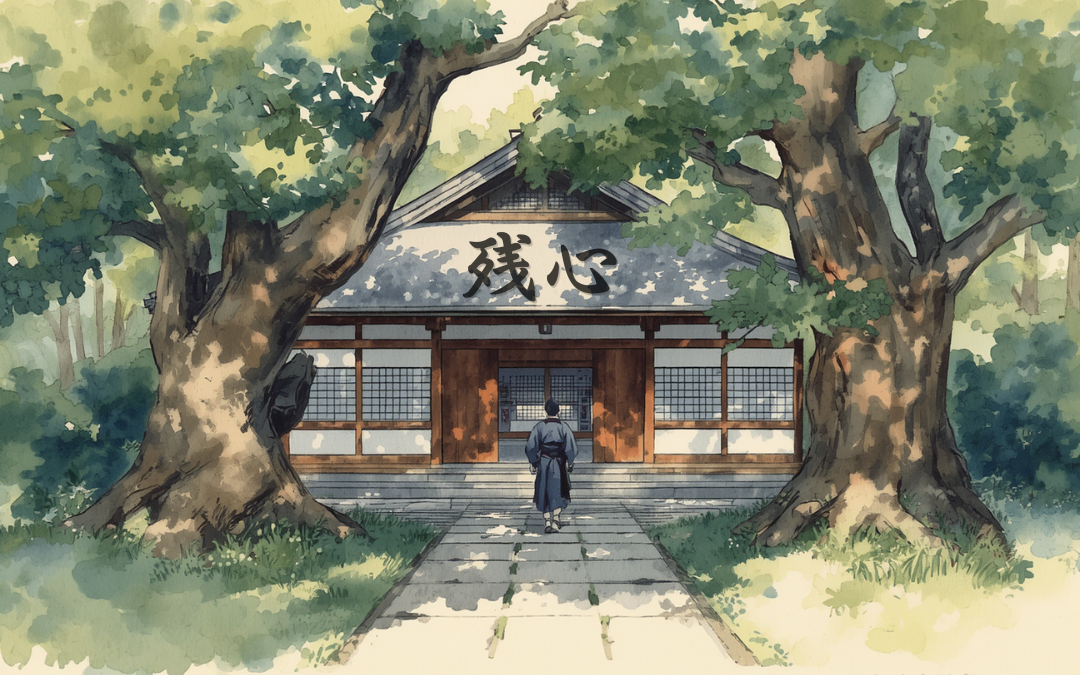
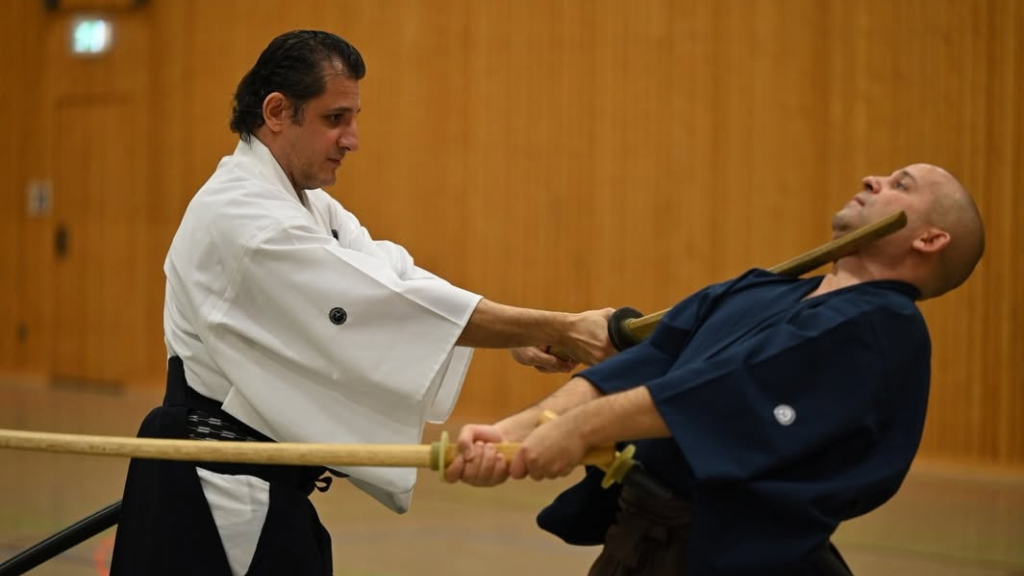
In the world of Japanese swordsmanship, the moment the blade completes its cut is not the end of the technique. It is, in many ways, the beginning of something far more profound. This is the realm of Zanshin (残心), often translated as the “lingering mind” or “remaining heart.” It is the awareness that persists after the action is complete—the state of total presence that ensures you are never caught off guard, physically or spiritually.
For a practitioner of Mugai-ryū Iaido or Battōdō, Zanshin is not just a technical requirement; it is a way of being. It is the difference between a swordsman who merely performs kata and one who embodies the essence of the art in every movement, every breath, and every thought.
Zanshin in the Dojo
In the dojo, Zanshin is most visibly expressed in the moments following a kata. After the final cut, the practitioner does not immediately relax. Instead, they maintain a state of alert stillness—the sword remains extended, the body poised, the mind sharp. This is not a pause; it is a continuation of the action, a silent declaration that the fight is not over until the opponent is truly neutralized and the environment is secure.
The Three Dimensions of Zanshin in Training:
Physical Zanshin
The body remains in a state of readiness. The feet are grounded, the posture upright, and the eyes continue to scan for potential threats. Even after the last cut, the practitioner does not drop their guard. This is the most tangible aspect of Zanshin, and it is often what beginners focus on first.
Mental Zanshin
The mind stays fully engaged. There is no mental “switching off” after the technique. Instead, the practitioner remains aware of their surroundings, their opponent (real or imagined), and their own internal state. This mental clarity is what allows a swordsman to respond instantly to any change in the situation.
Spiritual Zanshin
This is the deepest layer. It is the understanding that Zanshin is not just about physical or mental readiness, but about a **state of being**. It is the recognition that true mastery comes from a place of inner stillness, where the mind is free from distraction and the spirit is unshaken by fear or doubt.
Zanshin Beyond the Dojo
The beauty of Zanshin is that it is not confined to the dojo. The principles of lingering awareness and total presence can be applied to every aspect of life. In a world filled with distractions, Zanshin offers a way to move through life with intention and clarity.
Zanshin in Everyday Life:
In Conversations How often do we truly listen to the person in front of us? Zanshin teaches us to be fully present in conversations, to listen not just with our ears but with our entire being. It is the difference between hearing and understanding.
In Work Whether you are an artist, a teacher, or a business professional, Zanshin can transform how you approach your tasks. It is the ability to stay focused on the present moment, to give your full attention to the task at hand, and to remain aware of the broader context. It is the difference between working on autopilot and working with purpose.
In Relationships Zanshin reminds us to be present with our loved ones. It is the awareness that every interaction matters, that every word and gesture carries weight. It is the practice of showing up fully, without distraction, for the people who matter most.
In Moments of Stress Life is unpredictable, and challenges often arise when we least expect them. Zanshin is the ability to remain calm and centered in the face of adversity, to respond rather than react, and to maintain clarity even in the midst of chaos.
The Paradox of Zanshin
Zanshin is often described as a state of relaxed awareness. This might seem like a contradiction—how can one be both relaxed and alert? The answer lies in the nature of true presence. When the mind is free from tension, it is able to perceive more clearly. When the body is relaxed, it is able to move more efficiently. Zanshin is not about being on edge; it is about being fully alive in the present moment.
In the words of the great swordsman Miyamoto Musashi:
“Perceive that which cannot be seen with the eye.”
This is the essence of Zanshin. It is the ability to see beyond the obvious, to sense the unseen, and to remain connected to the world around you, even in stillness.
Cultivating Zanshin
So how does one develop Zanshin? Like all aspects of martial arts, it begins with practice—both on and off the mat.
Practical Exercises:
Mindful Breathing
Before and after training, take a few moments to focus on your breath. Inhale deeply, exhale slowly, and allow your mind to settle. This simple practice can help you cultivate the mental clarity that is essential for Zanshin.
Slow Kata Practice
Perform your kata at half-speed, paying close attention to every movement, every transition, and every breath. This helps to ingrain the habit of maintaining awareness throughout the entire sequence.
Meditation
Sit in *zazen* (seated meditation) for a few minutes each day. Focus on your breath and observe your thoughts without judgment. Over time, this practice will help you develop the inner stillness that is the foundation of Zanshin.
Daily Awareness Drills
Throughout the day, take a moment to pause and check in with yourself. Ask: *Am I fully present in this moment?* If not, gently bring your attention back to the here and now.
Zanshin as a Way of Life
Ultimately, Zanshin is more than a martial arts concept. It is a philosophy—a way of moving through the world with awareness, intention, and grace. Whether you are holding a sword, sitting in a meeting, or spending time with loved ones, Zanshin reminds you to be fully present, to stay connected to the moment, and to approach life with an open heart and a clear mind.
As you continue your journey in Mugai-ryū Iaido or Battōdō, I encourage you to explore Zanshin not just as a technical requirement, but as a guiding principle. Let it shape how you train, how you live, and how you interact with the world around you. In doing so, you will find that the lingering mind becomes not just a part of your practice, but a part of who you are.
What does Zanshin mean to you? How do you cultivate awareness in your own life? Share your thoughts in the comments below—I’d love to hear from you.
Follow my journey on YouTube and Instagram for more insights into the Way of the Sword.
The hakama (袴) is one of the most iconic pieces of traditional Japanese clothing. This wide, pleated trouser-skirt immediately evokes images of samurai, Shinto priests, and martial artists. But for an iaidoka—a practitioner of Iaido, the art of drawing the Japanese sword—the hakama is far more than an aesthetic tradition. It is a masterpiece of physical engineering, historical preservation, and moral guidance.
1. Tactical Engineering on the Dojo Floor
In Iaido, where movements must be executed with absolute fluidity and split-second precision, every element of the uniform serves a physical and ergonomic purpose:
Sword Stability (Saya): This is the most crucial daily technical function. The scabbard of the sword (saya) is slipped into the wide belt (obi), but it is the long cords (himo) of the hakama, tightly crossed and tied over it, that lock the assembly securely against the left hip. This layered system allows the practitioner to pivot the scabbard with high precision during drawing (nukitsuke) and sheathing (noto), preventing the weapon from slipping or wobbling.
Postural Alignment (Koshiita): The rear of the hakama features a rigid, trapezoidal plate called the koshiita. Pressed firmly against the lower back, it acts as a physical brace. This forces the practitioner to tuck the pelvis and maintain a perfectly straight spine, encouraging the constant engagement of the hara—the body’s physical and energetic center of gravity located just below the navel.
Freedom of Movement & Tactical Camouflage: The exceptionally wide cut of the hakama allows for complete freedom of movement during deep lunges and ground-based techniques, such as those starting from a kneeling position (seiza or tatehiza). Historically, the volume of the fabric also served a tactical purpose: it fully masked the samurai’s footwork, knee spacing, and weight transfers. To an opponent, it was nearly impossible to read the warrior’s stance or anticipate their first step.
2. A Millennial History: From Imperial Courts to the Samurai
Contrary to popular belief, the hakama’s origins are not strictly Japanese. Its evolution is the result of over a thousand years of cultural synthesis and adaptation:
Imperial Beginnings: The garment was originally inspired by the trousers worn at the Chinese imperial court during the Sui and Tang dynasties. Introduced to Japan during the Asuka and Nara periods, it was quickly adopted by the local aristocracy. By the Heian period, it had become an indispensable court garment for both men and women to assert their noble status.
The Warrior’s Shield: With the rise of the samurai class during the Kamakura period, the hakama transitioned from a courtly fashion into a functional asset. Crafted from durable fabrics like hemp, it protected the legs of horsemen from brush and friction during hunts and battles. This era saw the divergence of two primary styles: the umanori-bakama (divided trousers for riding horses) and the andon-bakama (an undivided lantern-skirt style).
The Bureaucratic Uniform: During the long peace of the Edo period, the hakama became the official ceremonial dress of the samurai bureaucracy. When paired with a sleeveless, broad-shouldered jacket (kataginu), it formed the kamishimo—the mandatory formal attire for appearing before the Shogun. To prevent surprise attacks at court, high-ranking lords were sometimes required to wear naga-bakama—trousers so incredibly long they trailed one or two feet behind the wearer, making quick, aggressive movements virtually impossible.
3. The Meiji Era: A Symbol of Female Empowerment
At the end of the 19th century, the Meiji restoration brought rapid Westernization to Japan, and men began abandoning the hakama in daily life in favor of Western three-piece suits. The garment might have vanished entirely if not for an unexpected revival led by women.
As Japan modernized its educational system, the first generation of female students and teachers found the traditional kimono too restrictive for physical activity and academic settings. Western dress of the era was also rejected due to the health risks associated with tight corsets.
Utako Shimoda, a prominent educator, women’s activist, and former lady-in-waiting to Empress Shōken, intervened. She adapted imperial court attire to design a practical, skirt-style hakama for her students. This reform wear quickly became a powerful visual symbol of the modern, educated, and independent Japanese woman.
Today, this rich history is kept alive every spring as thousands of female university graduates wear the hakama for their graduation ceremonies. It also remains the daily attire for Shinto priests and shrine maidens (miko).
4. The Philosophy of the Seven Pleats and the Bushido Spirit
The martial arts hakama is distinguished by its unique structure of seven deep pleats—five in the front and two in the back. The asymmetrical arrangement of the front pleats (two on the right, three on the left) is a classic example of Japanese asymmetry aesthetics.
In martial arts like Iaido, these seven pleats serve as a constant physical reminder of the seven cardinal virtues of the Bushido code:
Jin (Benevolence)
Gi (Honor or Justice)
Rei (Courtesy or Respect)
Chi (Wisdom)
Shin (Sincerity)
Chu (Loyalty)
Ko (Filial Piety)
Learning to fold the hakama properly after every training session is not merely a chore to preserve the fabric’s creases. It is considered an active extension of martial practice. The process teaches patience, mindfulness, and respect for one’s equipment. In many traditional schools, the highest-ranking student is even given the responsibility and honor of folding the teacher’s hakama as a deep token of respect.
If you want to know more you can our weekly podcast
I know how busy life can get. Between work, family, and training, it isn’t always easy to sit down and read long-form articles—even if you want to stay up to date with the latest insights.
To make my website posts more accessible when you are short on time, I have officially launched a brand-new audio companion: Liomugai: The Way of the Sword.
This is a brand-new venture for me, so consider this our first official start! The audio and production quality will naturally get better with time. Thank you for your patience and for joining me on this learning curve.
We are hitting the ground running with 5 episodes already available for you to listen to:
Episode 1: Introduction to Liomugai’s podcast
Episode 2: The Sacred and the Sharp: Whispers of Mount Fuji
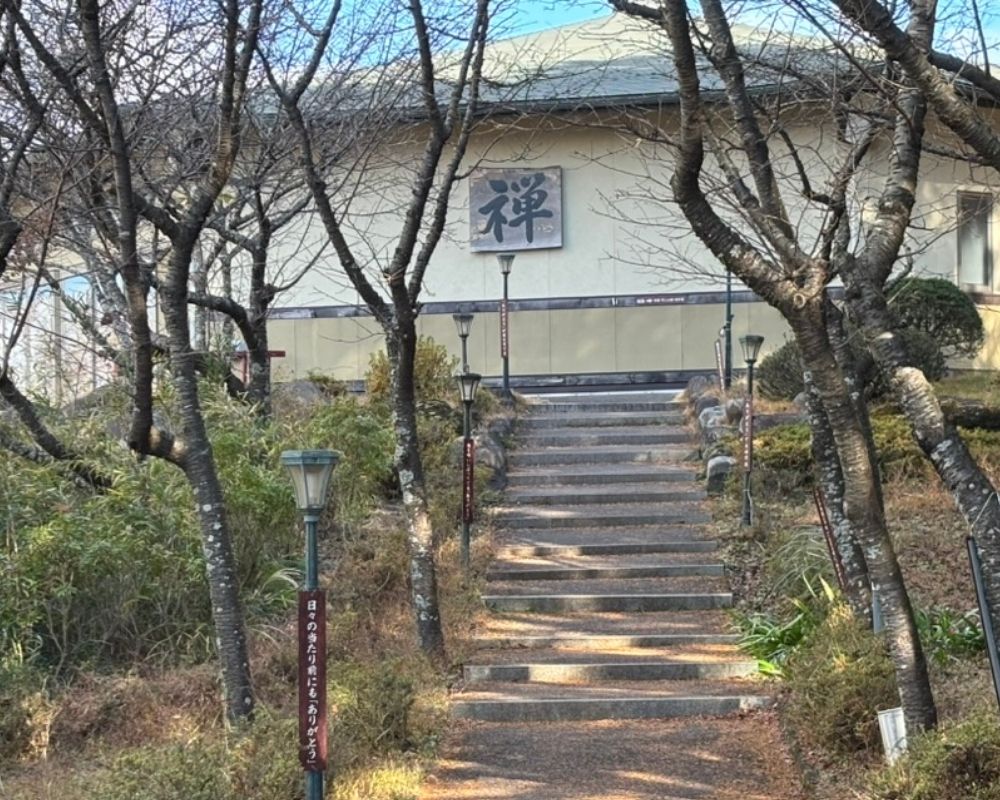
Episode 3: The Mugai-ryū and the Way of Zen
Episode 4: The Soul of Hiroshima and Miyajima
Episode 5: Muga : The Zen Heart of Mugai-ryū
And then a new episode will be available every Tuesday morning
Why listen?
Time-Friendly: Perfect for your daily commute, a walk, or while you’re prepping your gear.
Audio Companion: You won’t miss a single website post.
Deep Dives on the Go: Explore the philosophy, history, and mindset of the sword wherever you are.
Whether you prefer reading at your desk or listening through your headphones, you can now engage with the content in whatever way fits your schedule best.
If you enjoy the show, please consider hitting Subscribe and leaving a review on Apple Podcasts—it helps other martial arts and sword enthusiasts find us!
Thank you all for your support as we start this new chapter.
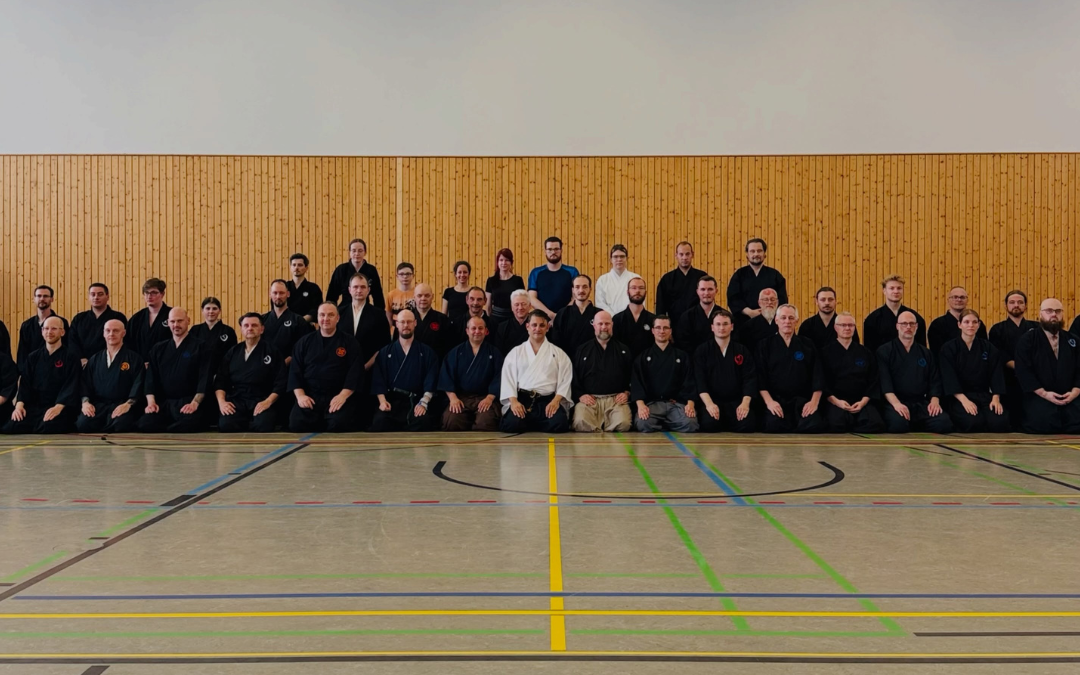
Last week, I had the honor of being invited by Luciano Morgenstern (Chairman of Mugai-ryū Europe and Representative of the Mugai-ryū Meishi Ha in Europe) to the summer seminar in Cologne, Germany. Despite the scorching heatwave sweeping across Europe, over 60 practitioners gathered for two days of intensive training.
The first day focused on technical work, as the gymnasium was sweltering under the summer sun. The senseis covered a wide range of topics, including maintaining flow, power generation, and the execution of all Mugai-ryū basic katas—with special attention to Ryōguruma, one of the most challenging forms for shodan candidates. The final hour was dedicated to exam preparation, a critical aspect of the seminar.
As I’ve mentioned in previous posts, To Rei (刀礼, sword etiquette) in Mugai-ryū is highly ritualized. For beginners, performing a test in front of such esteemed masters for the first time can be intimidating—an experience I know all too well. We wrapped up the day in Cologne’s city center at the Tenshinkai Dojo, where I was pleasantly surprised to find my name displayed on the wall alongside other students of Luciano Sensei. To cap off the evening, Sensei organized a barbecue, offering a wonderful opportunity to connect with everyone outside of training.
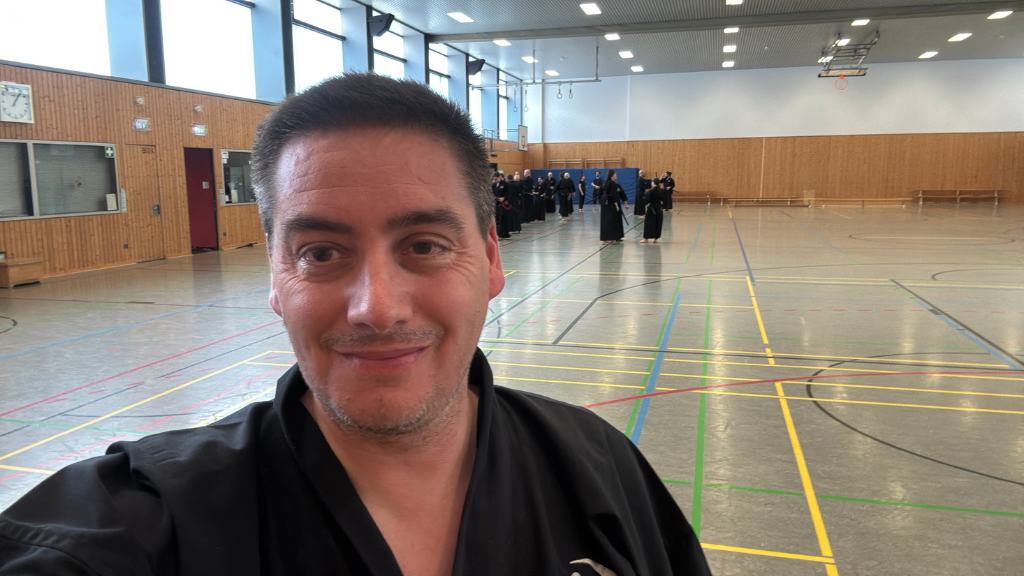
After 5hrs of training in Cologne
The second day began with one hour of Zazen (座禅, seated meditation), guided by a Zen monk. This set the tone for the most anticipated moment of the seminar: the examinations, ranging from sankyū to sandan. The atmosphere was intense and deeply emotional for all the candidates. What made it even more special was the presence of practitioners from other schools, including Genkō Nitō-ryū (two-sword fighting) and Tōsei-ryū (stick fighting). Observing these different traditions gave me a fascinating glimpse into the techniques and precision I’ll need to master as I progress through the ranks.
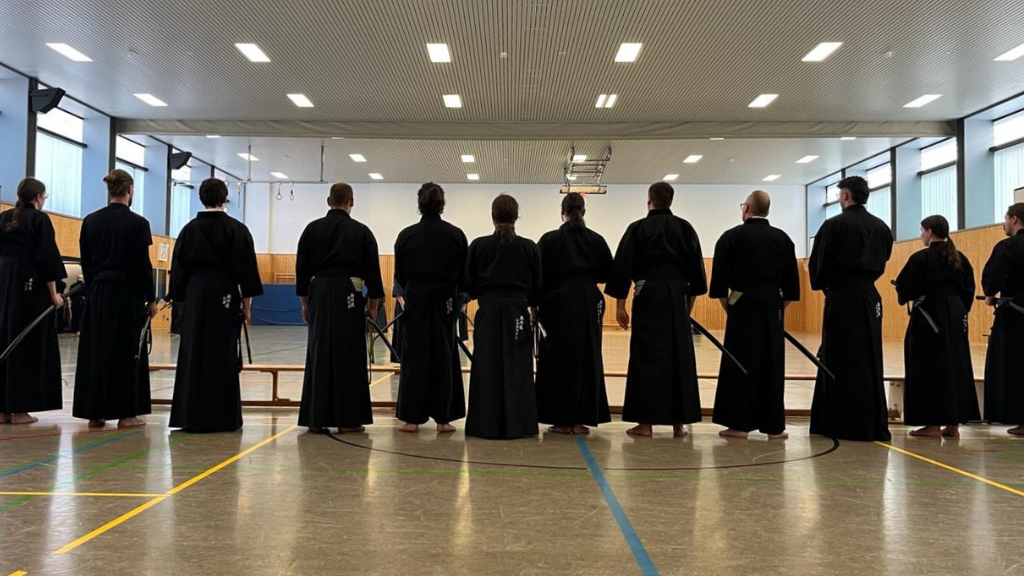
Candidates ready for test
Despite the oppressive heat, the weekend was a refreshing experience for the mind and spirit. It allowed me to assess my progress on my learning journey, but more importantly, it gave me the chance to meet this incredible community—a group of truly impressive individuals who share the same passion for the Way of the Sword.
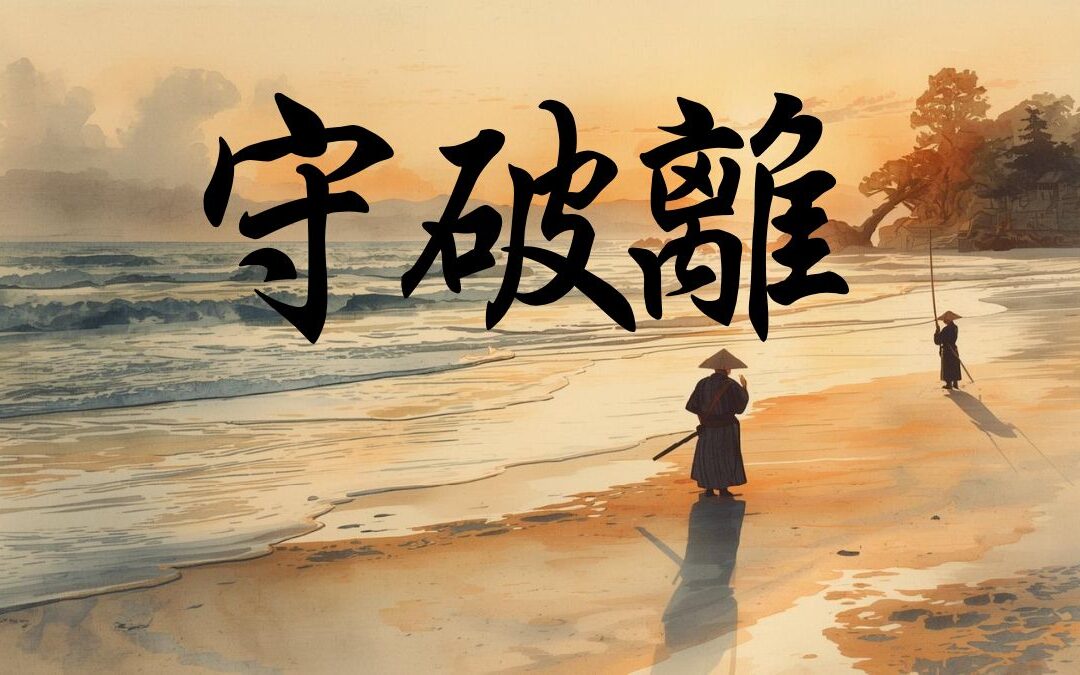
In the world of Japanese martial arts—and particularly within the discipline of Iaidō—mastery is not a destination to be reached, but a lifelong process of refinement. It is an ongoing evolution of body, mind, and spirit. This journey is elegantly expressed through the timeless concept of Shu–Ha–Ri (守破離).
Whether you are just beginning to tie your hakama or you have spent decades polishing your nukitsuke, understanding these three stages of learning is essential to genuine progress. Shu–Ha–Ri offers more than a pedagogical framework; it is a mirror held up to the practitioner’s inner development.
Originally articulated in the teachings of the legendary tea master Sen no Rikyū, and later embraced by generations of swordsmen, Shu–Ha–Ri describes the transformation of a student—from one who faithfully imitates the teacher, to one who ultimately embodies the art itself.
Phase 1 : Shu (守): Protect and Obey
The first stage, Shu, literally means “to protect” or “to preserve.” At this level, the student’s primary responsibility is to safeguard the tradition by receiving it intact.
The Mindset: Absolute obedience—not blind submission, but humble receptivity. Shu is about protecting the purity of the teachings from the intrusion of ego, impatience, and premature interpretation.
In Practice: In a Mugai-ryū dōjō, Shu means copying the sensei precisely. You do not ask, “Could I place my foot slightly differently?” You mirror the angle of the blade, the depth of the stance, the rhythm of the breath, and even the silence between movements.
The Goal: To build an unshakable foundation. Repetition engrains the forms into the body until technique becomes instinctive. You are learning the alphabet of the sword—without which no meaningful expression is possible.
In a nutshell: You cannot transcend the rules until you have fully internalized them.
Phase 2 : Ha (破): Detach and Break
The second stage, Ha, means “to break” or “to detach.” It is often the most misunderstood—and the most perilous—phase of the journey.
The Mindset: Inquiry and discernment. After years of disciplined practice, the student begins to perceive the why behind the how. Curiosity replaces imitation, but respect remains.
In Practice: You start to explore the underlying principles of Battōdō and how they adapt to different bodies, distances, or combative realities. You may study other ryūha, exchange insights with fellow practitioners, or observe how the same truth manifests through different forms.
The Goal: Integration. Ha is not about rejecting the teachings of Shu, but stress-testing them. You “break” the mold to confirm that the essence of the technique remains intact when adapted. The form loosens, but the principles endure.
Shu Ha Ri concept can be found in all martial arts and not only …
Phase 3 : Ri (離): Transcend and Depart
The final stage, Ri, means “to leave” or “to separate.” This is the realm of the master, where art and practitioner are no longer distinct.
The Mindset: Naturalness. Action arises without deliberation. In Zen terms, this is Mushin—no-mind. There is no hesitation, no calculation, no inner commentary.
In Practice: The practitioner no longer performs Mugai-ryū—they are Mugai-ryū. Movement is spontaneous, fluid, and perfectly attuned to the moment. The rigid instructions of the past dissolve into creative freedom grounded in deep understanding.
The Goal: Harmony. The sword becomes an extension of the self, and the self moves in accord with the universe. Rules are no longer followed consciously; they are fulfilled effortlessly.
Shu Ha Ri modern life
This cycle extends far beyond the dōjō. For a business professional, the parallels are clear: You first learn industry standards and best practices (Shu), then innovate and adapt them to your strengths (Ha), and eventually lead with an intuitive clarity that appears almost magical to outsiders (Ri).
In martial arts, Shu–Ha–Ri protects us from stagnation. It teaches the beginner patience, the advanced student discernment, and the master humility. Above all, it reminds us that the path of the samurai is not linear—it is spiral. We return to the basics again and again, each time with deeper understanding, broader perspective, and a quieter ego.
Mastery, in Iaidō as in life, is not about arriving somewhere. It is about becoming.
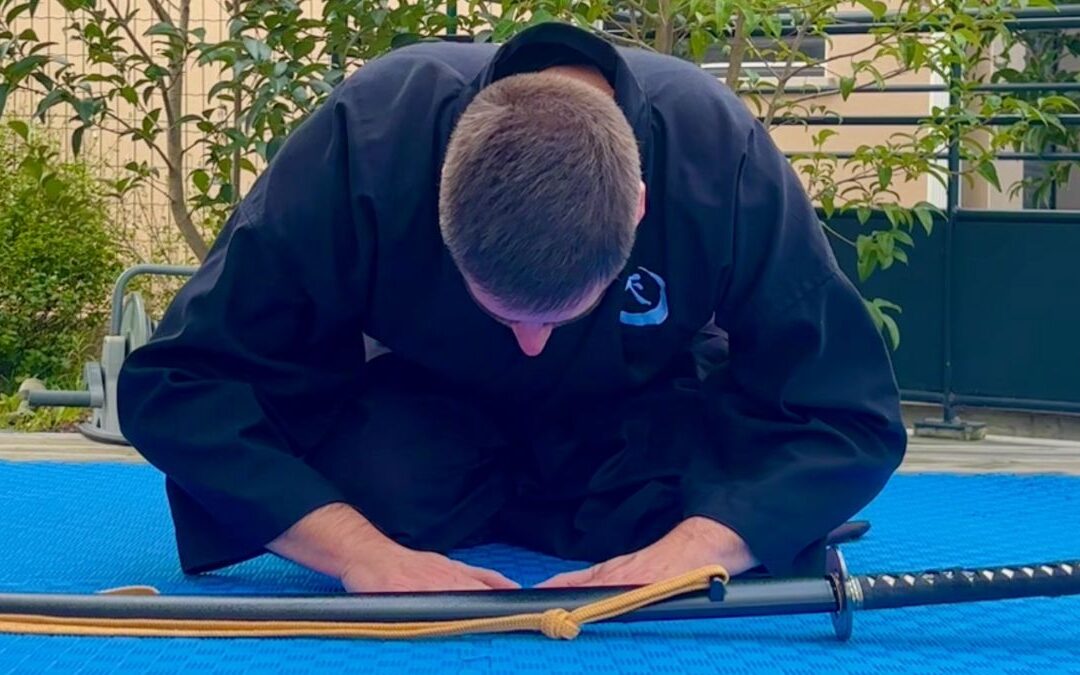
In the modern world, the act of bowing to a weapon can appear—at least to the uninitiated—as a curious form of reverence, even idolatry. Yet for a practitioner of Mugai-ryū or Battōdō, the ritual of Reigyō (礼行, etiquette in action) is not symbolic theater. It is one of the most practical and transformative elements of training.
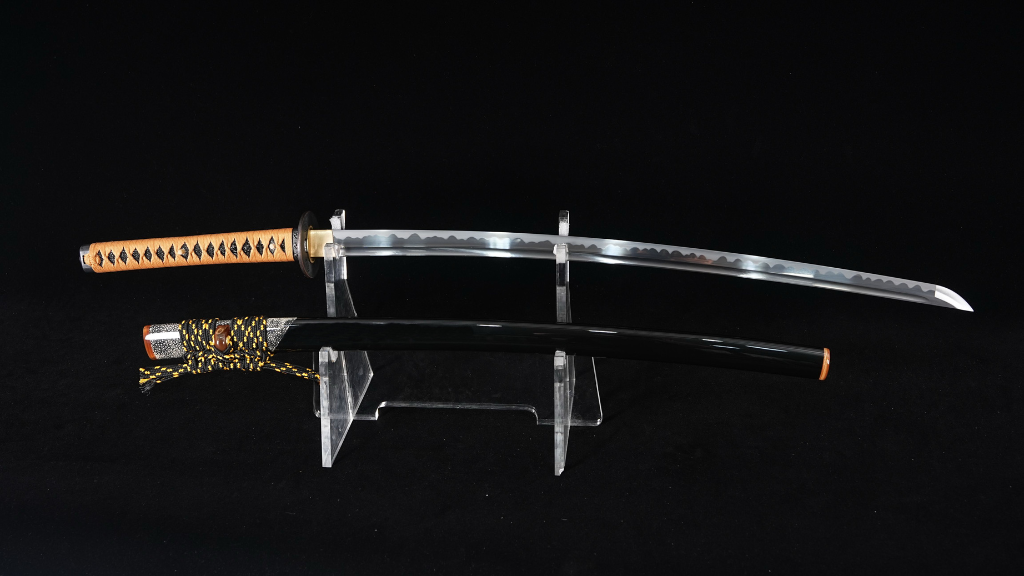
When we kneel before our iaitō or shinken, we are not venerating an object. We are directing our attention inward, executing a deliberate strike against the most dangerous adversary we will ever encounter: the ego.
What is Reigyo?
In Japanese martial traditions, there is a well-known saying: “Budō begins and ends with rei.”
Reigyō is often translated simply as “etiquette,” but this rendering barely scratches the surface. Reigyō is the embodied expression of respect, gratitude, awareness, and restraint. It is etiquette made physical—conduct that shapes the mind as much as the body.
In the context of sword practice, Reigyō is expressed through rituals such as:
Tō-rei — the formal bow to the sword
Shinzen-ni-rei — the bow to the shrine or the front of the dōjō
Otaga ni rei — the bow to one’s training partners
These are not merely “rules of the dōjō.” Psychologically, they serve a precise function: they create a liminal space—a threshold between the disorder of daily life and the focused, potentially lethal discipline of the sword. Crossing this threshold prepares the practitioner to train with clarity, humility, and intent.
Why Bow to a Piece of Steel?
The sword is a paradox. Historically, it is an instrument of death. Philosophically, within many koryū traditions, it is a means of cutting away illusion—most notably one’s own. We bow to the sword for three essential reasons.
1. Acknowledging the Danger
The instant you stop respecting the blade is the instant you invite injury. Bowing is an explicit acknowledgment of danger—an admission that you are handling something capable of taking life.
This act cultivates mindfulness. It anchors you in the present moment. One cannot bow sincerely while the mind is wandering through errands, emails, or distractions. The bow demands presence.
2. Gratitude for the Path
The sword is an uncompromising teacher. It offers immediate and honest feedback: a flawed grip alters the tachikaze; a distracted mind causes the kata to unravel.
To bow is to express gratitude for this ruthless clarity. It is an acknowledgment that the practice itself—through success and failure alike—is shaping the practitioner.
3. Connection to Lineage
Mugai-ryū was founded in the late 17th century by Tsuji Gettan Sukemochi. When you perform the same tō-rei that has been enacted for more than three centuries, you momentarily step beyond your individual identity.
You become a link in a living chain of practitioners—each bound by the same forms, the same discipline, and the same silent understanding. The bow dissolves the illusion that you practice alone.
Zen Philosophy is promoting as well a non ego way
The Ego’s Greatest Enemy: Humility
The ego thrives on comparison. It wants to feel superior—to win, to look impressive, to master a technique faster than those around us. Left unchecked, it turns training into performance and progress into vanity. Reigyō stands as the antidote.
When you bow, you deliberately lower your head—the most vulnerable part of the body—beneath your heart. This is not a symbolic gesture; it is a physical declaration of humility. In that moment, you submit not to a person or an object, but to the art itself. The bow reminds us that the art is larger than the individual who practices it.
In Mugai-ryū, deeply influenced by Zen philosophy, the aim is to approach a state of Mu—emptiness, the absence of ego-driven interference. One cannot arrive at emptiness while being full of oneself. Each bow becomes a conscious act of self-emptying, a methodical clearing of pride so that technique may emerge unimpeded.
“The sword is not used to defeat others; it is a means to achieve self-mastery and to harmonize the spirit.”
Reigyo inside and outside the Dojo
The true measure of a swordsman is not how precisely they bow within the dōjō, but how faithfully they carry that spirit beyond its walls. If you can bow to a blade with sincerity, can you listen to a colleague with the same presence? Can you meet failure or criticism with the same Fudōshin—the immovable mind—you cultivate during a demanding kata?
Reigyō is not about surface-level politeness or empty formality. It is about wakefulness. Through bowing to the steel, we learn to move through the world with awareness, respect, and restraint. More importantly, we learn to recognize—and temper—the quiet voice of ego before it hardens into arrogance.
In this way, etiquette becomes discipline, discipline becomes character, and character becomes the true cutting edge of the sword.