Whenever I visit my Japanese family’s hometown near Mount Fuji, there’s one place I always try to go back to. It’s not a big city, not a famous temple, and not one of the crowded viewpoints of Fuji.
It’s a quiet waterfall hidden in the forest called Shiraito Falls.
The first time my family took me there, I didn’t really know what to expect. Japan has many waterfalls, after all. But as we walked down the forest path and I heard the sound of water echoing through the trees, I realized this place felt different.
Shiraito Falls isn’t dramatic or overwhelming. Instead, it’s peaceful, delicate, and strangely mesmerizing—the kind of place where you end up standing still for a long time without even noticing.
The Short Walk to the Falls
Getting to Shiraito Falls is part of the experience.
From the parking area, you follow a small path that slowly winds downhill through the trees. It’s not a long walk, but the atmosphere gradually changes as you go.
The air becomes cooler. The forest feels thicker. And the sound of water begins to grow louder with every step.
My family always walks slowly here, pointing out little things along the way—moss growing on rocks, small streams crossing the path, and sometimes the distant shape of Mount Fuji visible between the trees.
Then suddenly the path opens up.
And there it is.
Waterfall Made of “White Threads”
The first time you see Shiraito Falls, the shape of it might surprise you.
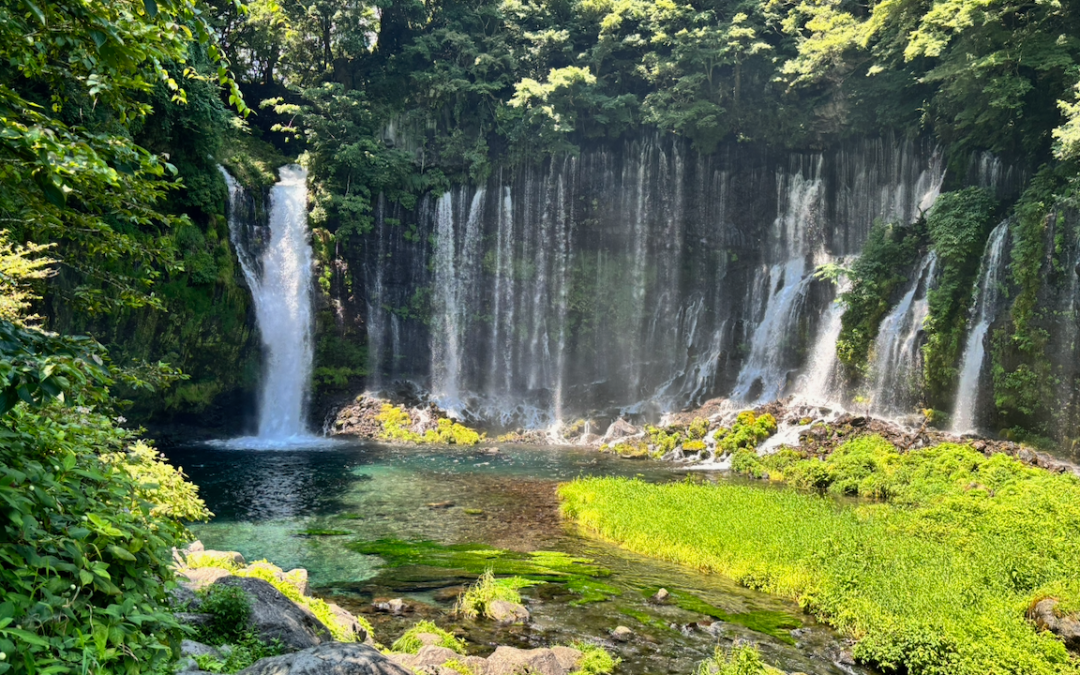
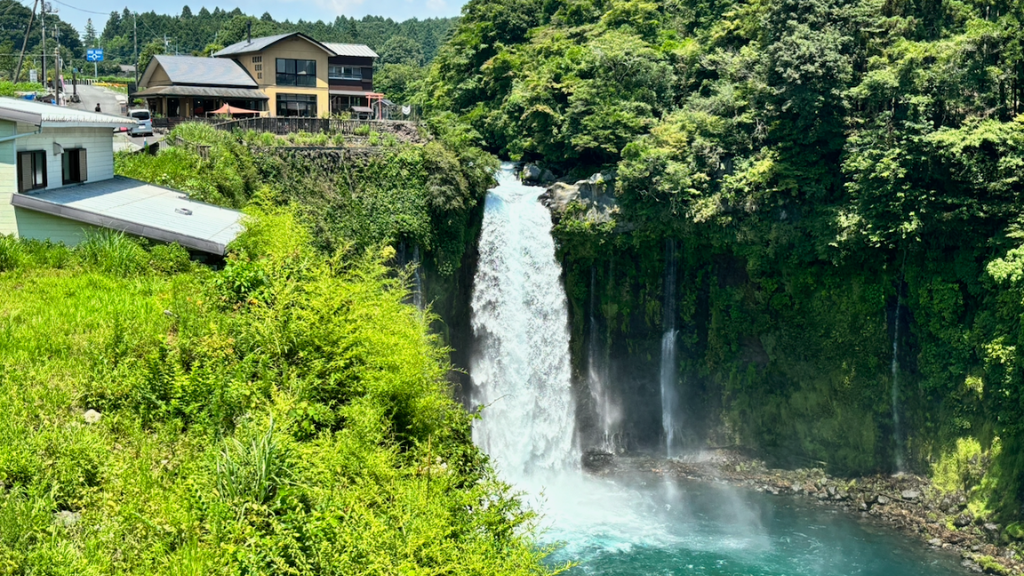
Most waterfalls crash down from a single point. This one doesn’t. Instead, water flows out from hundreds of small openings along a curved cliff face.
The streams fall gently down the dark rock, forming thin white lines across the entire wall. From a distance, it really does look like hundreds of threads hanging in the air.
That’s exactly where the name comes from—“Shiraito” means “white threads.”
The waterfall stretches about 150 meters wide, but it’s not especially tall. The beauty isn’t in its height or power. It’s in the delicate way the water flows.
Every stream moves slightly differently, creating a constantly shifting pattern.
I remember standing there the first time and thinking it almost looked like nature was quietly weaving something.
Water From Mount Fuji
Another thing that makes Shiraito Falls special is where the water comes from.
The water actually starts its journey on Mount Fuji. Rain and snow on the mountain slowly seep into the volcanic layers of rock and soil. Over time—sometimes years—it travels underground before finally emerging from the cliff at Shiraito.
So when you’re standing there watching the water fall, you’re really seeing water that has been slowly filtered through the mountain itself.
It’s incredibly clear and pure. When the sunlight hits the mist rising from the basin, you can sometimes see faint rainbows forming in the air.
In Shinto, the traditional belief system of Japan, natural places like mountains, forests, rivers, and waterfalls are believed to be inhabited by spiritual presences called kami.
These aren’t “gods” in the way many Western religions think of them. They’re more like sacred energies or spirits connected to the natural world.
Waterfalls are especially meaningful because flowing water represents purification.
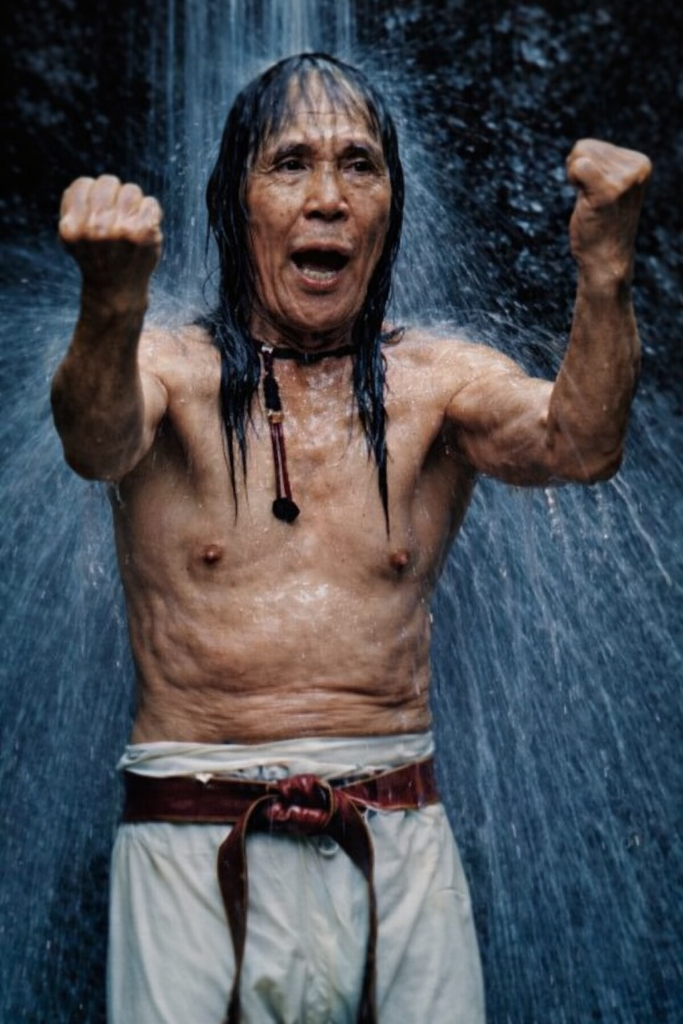
For centuries, people practiced a ritual called misogi, where they stood under cold waterfalls or in rivers to cleanse their body and spirit. The rushing water symbolically washes away impurities.
Shiraito Falls has long been connected to spiritual practices linked to Mount Fuji. Pilgrims and mountain ascetics would visit places like this as part of their training before climbing the sacred mountain.
Whenever friends ask me what they should see around Mount Fuji, they usually expect recommendations for famous viewpoints or big tourist attractions.
I always recommend them to go to walk around the Tanuki Lake and to visit Shiraito Falls.
In my Japanese family, the falls are a place of deep significance, visited to honor life’s most important moments.
These pilgrimages are more than just trips; they are key milestones that connect our generations. My own martial path—from my teenage years in Goju-ryu to my current role as a Uechi-ryu teacher—is deeply tied to this imagery.
I often recall the legendary Gogen Yamaguchi practicing misogi under the cascade, a powerful symbol of the discipline I strive to follow.