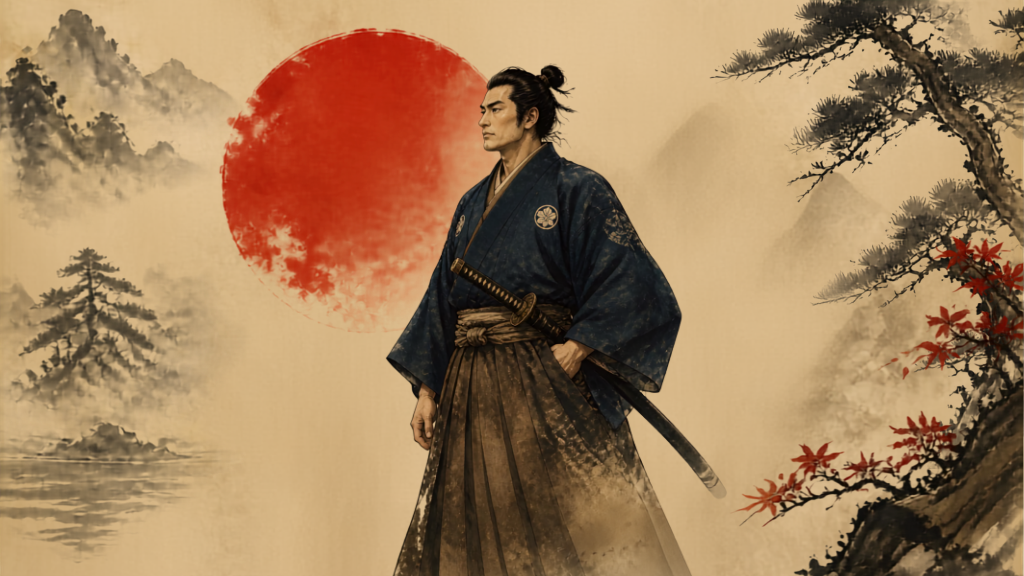
The hakama (袴) is one of the most iconic pieces of traditional Japanese clothing. This wide, pleated trouser-skirt immediately evokes images of samurai, Shinto priests, and martial artists. But for an iaidoka—a practitioner of Iaido, the art of drawing the Japanese sword—the hakama is far more than an aesthetic tradition. It is a masterpiece of physical engineering, historical preservation, and moral guidance.
1. Tactical Engineering on the Dojo Floor
In Iaido, where movements must be executed with absolute fluidity and split-second precision, every element of the uniform serves a physical and ergonomic purpose:
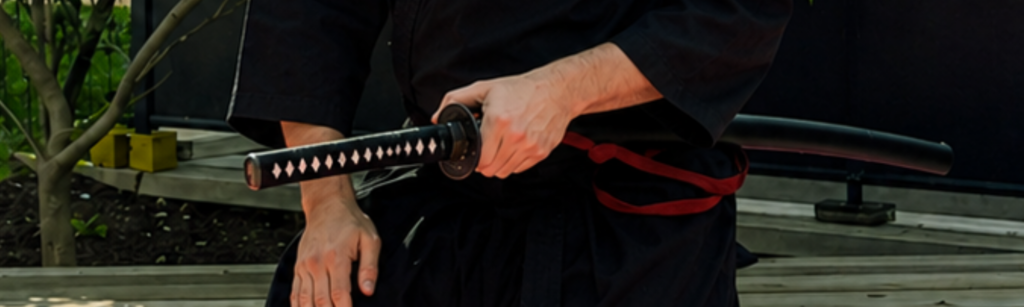
Sword Stability (Saya): This is the most crucial daily technical function. The scabbard of the sword (saya) is slipped into the wide belt (obi), but it is the long cords (himo) of the hakama, tightly crossed and tied over it, that lock the assembly securely against the left hip. This layered system allows the practitioner to pivot the scabbard with high precision during drawing (nukitsuke) and sheathing (noto), preventing the weapon from slipping or wobbling.
Postural Alignment (Koshiita): The rear of the hakama features a rigid, trapezoidal plate called the koshiita. Pressed firmly against the lower back, it acts as a physical brace. This forces the practitioner to tuck the pelvis and maintain a perfectly straight spine, encouraging the constant engagement of the hara—the body’s physical and energetic center of gravity located just below the navel.
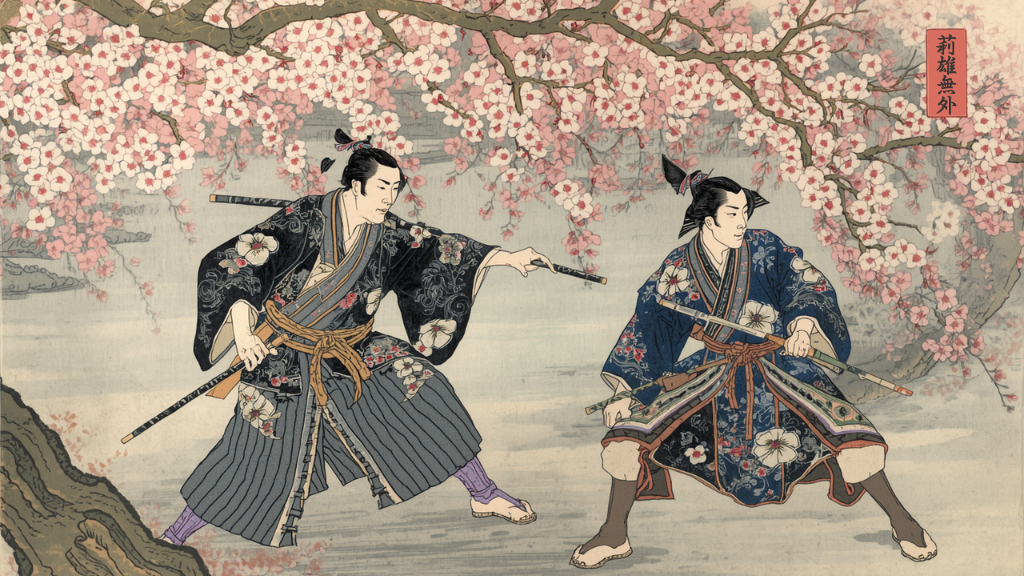
Freedom of Movement & Tactical Camouflage: The exceptionally wide cut of the hakama allows for complete freedom of movement during deep lunges and ground-based techniques, such as those starting from a kneeling position (seiza or tatehiza). Historically, the volume of the fabric also served a tactical purpose: it fully masked the samurai’s footwork, knee spacing, and weight transfers. To an opponent, it was nearly impossible to read the warrior’s stance or anticipate their first step.
2. A Millennial History: From Imperial Courts to the Samurai
Contrary to popular belief, the hakama’s origins are not strictly Japanese. Its evolution is the result of over a thousand years of cultural synthesis and adaptation:
Imperial Beginnings: The garment was originally inspired by the trousers worn at the Chinese imperial court during the Sui and Tang dynasties. Introduced to Japan during the Asuka and Nara periods, it was quickly adopted by the local aristocracy. By the Heian period, it had become an indispensable court garment for both men and women to assert their noble status.
The Warrior’s Shield: With the rise of the samurai class during the Kamakura period, the hakama transitioned from a courtly fashion into a functional asset. Crafted from durable fabrics like hemp, it protected the legs of horsemen from brush and friction during hunts and battles. This era saw the divergence of two primary styles: the umanori-bakama (divided trousers for riding horses) and the andon-bakama (an undivided lantern-skirt style).
The Bureaucratic Uniform: During the long peace of the Edo period, the hakama became the official ceremonial dress of the samurai bureaucracy. When paired with a sleeveless, broad-shouldered jacket (kataginu), it formed the kamishimo—the mandatory formal attire for appearing before the Shogun. To prevent surprise attacks at court, high-ranking lords were sometimes required to wear naga-bakama—trousers so incredibly long they trailed one or two feet behind the wearer, making quick, aggressive movements virtually impossible.
3. The Meiji Era: A Symbol of Female Empowerment
At the end of the 19th century, the Meiji restoration brought rapid Westernization to Japan, and men began abandoning the hakama in daily life in favor of Western three-piece suits. The garment might have vanished entirely if not for an unexpected revival led by women.
As Japan modernized its educational system, the first generation of female students and teachers found the traditional kimono too restrictive for physical activity and academic settings. Western dress of the era was also rejected due to the health risks associated with tight corsets.
Utako Shimoda, a prominent educator, women’s activist, and former lady-in-waiting to Empress Shōken, intervened. She adapted imperial court attire to design a practical, skirt-style hakama for her students. This reform wear quickly became a powerful visual symbol of the modern, educated, and independent Japanese woman.
Today, this rich history is kept alive every spring as thousands of female university graduates wear the hakama for their graduation ceremonies. It also remains the daily attire for Shinto priests and shrine maidens (miko).
4. The Philosophy of the Seven Pleats and the Bushido Spirit
The martial arts hakama is distinguished by its unique structure of seven deep pleats—five in the front and two in the back. The asymmetrical arrangement of the front pleats (two on the right, three on the left) is a classic example of Japanese asymmetry aesthetics.
In martial arts like Iaido, these seven pleats serve as a constant physical reminder of the seven cardinal virtues of the Bushido code:
Jin (Benevolence)
Gi (Honor or Justice)
Rei (Courtesy or Respect)
Chi (Wisdom)
Shin (Sincerity)
Chu (Loyalty)
Ko (Filial Piety)
Learning to fold the hakama properly after every training session is not merely a chore to preserve the fabric’s creases. It is considered an active extension of martial practice. The process teaches patience, mindfulness, and respect for one’s equipment. In many traditional schools, the highest-ranking student is even given the responsibility and honor of folding the teacher’s hakama as a deep token of respect.
If you want to know more you can our weekly podcast
I know how busy life can get. Between work, family, and training, it isn’t always easy to sit down and read long-form articles—even if you want to stay up to date with the latest insights.
To make my website posts more accessible when you are short on time, I have officially launched a brand-new audio companion: Liomugai: The Way of the Sword.
This is a brand-new venture for me, so consider this our first official start! The audio and production quality will naturally get better with time. Thank you for your patience and for joining me on this learning curve.
We are hitting the ground running with 5 episodes already available for you to listen to:
Episode 1: Introduction to Liomugai’s podcast
Episode 2: The Sacred and the Sharp: Whispers of Mount Fuji
Episode 3: The Mugai-ryū and the Way of Zen
Episode 4: The Soul of Hiroshima and Miyajima
Episode 5: Muga : The Zen Heart of Mugai-ryū
And then a new episode will be available every Tuesday morning
Why listen?
Time-Friendly: Perfect for your daily commute, a walk, or while you’re prepping your gear.
Audio Companion: You won’t miss a single website post.
Deep Dives on the Go: Explore the philosophy, history, and mindset of the sword wherever you are.
Whether you prefer reading at your desk or listening through your headphones, you can now engage with the content in whatever way fits your schedule best.
If you enjoy the show, please consider hitting Subscribe and leaving a review on Apple Podcasts—it helps other martial arts and sword enthusiasts find us!
Thank you all for your support as we start this new chapter.
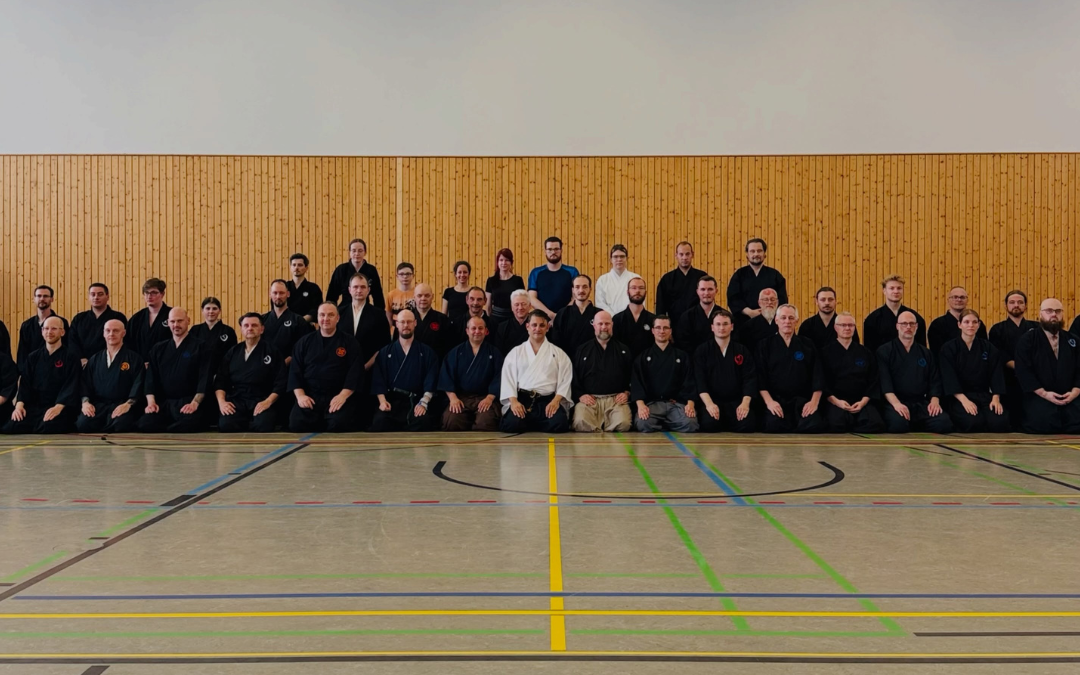
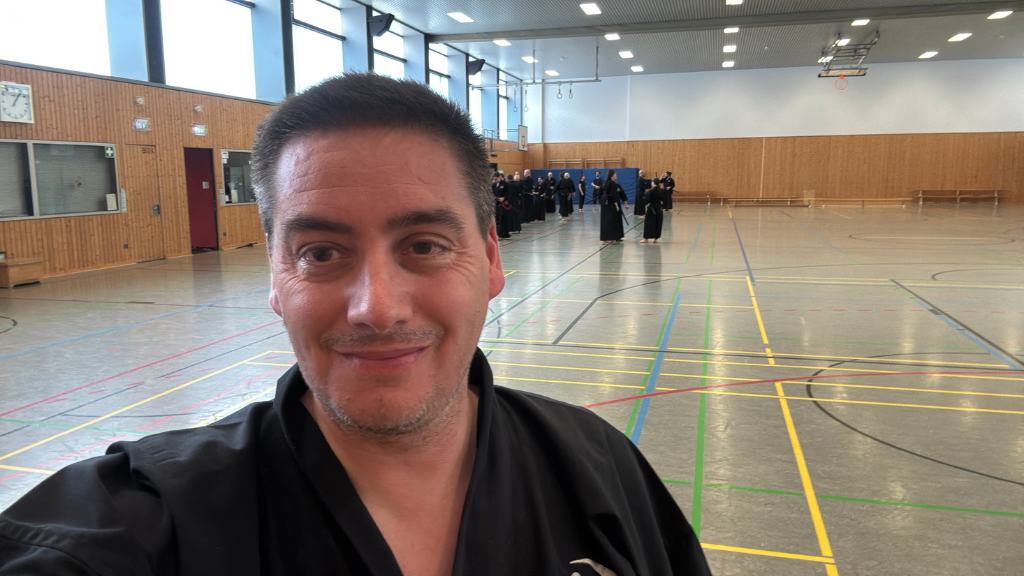
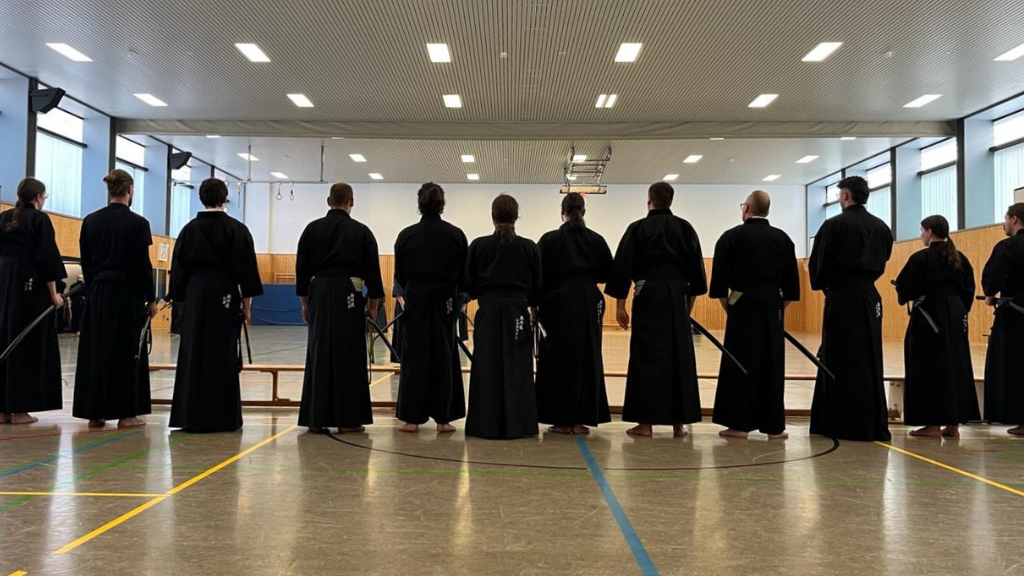
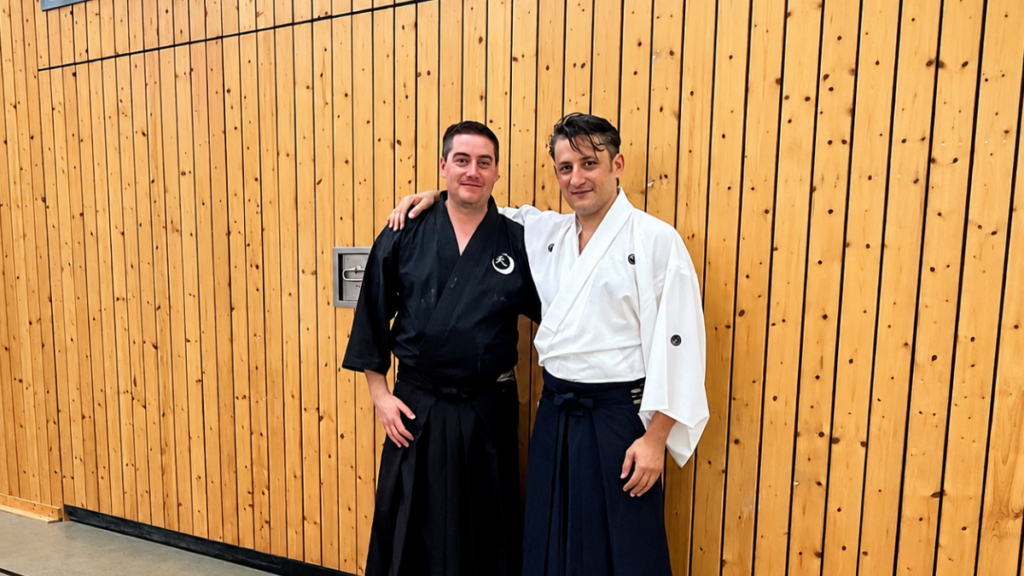
Last week, I had the honor of being invited by Luciano Morgenstern (Chairman of Mugai-ryū Europe and Representative of the Mugai-ryū Meishi Ha in Europe) to the summer seminar in Cologne, Germany. Despite the scorching heatwave sweeping across Europe, over 60 practitioners gathered for two days of intensive training.
The first day focused on technical work, as the gymnasium was sweltering under the summer sun. The senseis covered a wide range of topics, including maintaining flow, power generation, and the execution of all Mugai-ryū basic katas—with special attention to Ryōguruma, one of the most challenging forms for shodan candidates. The final hour was dedicated to exam preparation, a critical aspect of the seminar.
As I’ve mentioned in previous posts, To Rei (刀礼, sword etiquette) in Mugai-ryū is highly ritualized. For beginners, performing a test in front of such esteemed masters for the first time can be intimidating—an experience I know all too well. We wrapped up the day in Cologne’s city center at the Tenshinkai Dojo, where I was pleasantly surprised to find my name displayed on the wall alongside other students of Luciano Sensei. To cap off the evening, Sensei organized a barbecue, offering a wonderful opportunity to connect with everyone outside of training.
After 5hrs of training in Cologne
The second day began with one hour of Zazen (座禅, seated meditation), guided by a Zen monk. This set the tone for the most anticipated moment of the seminar: the examinations, ranging from sankyū to sandan. The atmosphere was intense and deeply emotional for all the candidates. What made it even more special was the presence of practitioners from other schools, including Genkō Nitō-ryū (two-sword fighting) and Tōsei-ryū (stick fighting). Observing these different traditions gave me a fascinating glimpse into the techniques and precision I’ll need to master as I progress through the ranks.
Candidates ready for test
Despite the oppressive heat, the weekend was a refreshing experience for the mind and spirit. It allowed me to assess my progress on my learning journey, but more importantly, it gave me the chance to meet this incredible community—a group of truly impressive individuals who share the same passion for the Way of the Sword.
Why In-Yō (Yin-Yang) is About Collaboration, Not Opposition
Every practitioner of the Japanese sword eventually encounters the concept of In-Yō (陰陽)—the Japanese reading of Yin and Yang. Frequently, it is explained as a simple list of opposites: dark and light, soft and hard, passive and active.
But if we treat In-Yō merely as a switch we flip back and forth, we miss its true power.
In-Yō is not a battle between two opposing forces. It is a relationship of absolute codependency and mutual support. In Iaido, Battodo, and Kenjutsu, In and Yō do not compete; they serve each other. One generates the other; one protects the other. To master the sword, we must stop seeing them as opposites and start seeing them as a single, unified engine.
Here is how this vital partnership supports every layer of our training.
1. Iaido: The Hidden Seed of Movement
Iaido is often described as the transition from stillness to explosive action. But true mastery reveals that the stillness (In) is actively supporting the action (Yō), and vice versa.
Stillness Generates Action: When you sit in seiza or stand in shizentai, your exterior is calm and hidden (In). But this isn’t dead inertia. Deep within that stillness, your focus is sharpening and your breath is dropping to your core. This quietude is the literal launchpad for your nukitsuke (drawing cut). Without the profound calmness of In, your explosive Yō will be tense, erratic, and telegraphed.
Action Returns to Protect Stillness: Conversely, after the decisive cut (Yō), you return the blade to the scabbard via noto. This return to In is protected by zanshin—a state of heightened, active awareness (Yō). The physical passivity of sheathing the sword is only safe because it is cradled by an active, vigilant mind.
The Interlocking Reality: You cannot have a fast draw without a relaxed starting posture. The “soft” In gives birth to, and structurally supports, the “hard” Yō.
2. Battodo: The Mechanics of Supported Power
In Battodo, we test our form against physical targets like tatami omote. Here, the illusion of pure power (Yō) is shattered. We quickly learn that power is completely dependent on its opposite: softness and structural relaxation (In).
Softness Drives the Hard Edge: If you try to cut a target using pure muscle power (pure Yō), your body tightens, your shoulders rise, and your blade will likely stall or bend in the mat. True power requires the muscles of the arms and shoulders to remain incredibly loose, heavy, and receptive (In). This softness allows the blade to achieve maximum velocity.
The Partnership of Tenouchi: Look closely at your grip (tenouchi). If your hands are clamped tightly onto the tsuka (hilt) throughout the entire swing, the cut fails. Instead, the grip must be soft and yielding (In) during the arc of the swing, tightening into a firm, supportive squeeze (Yō) only at the exact microsecond of impact, before immediately melting back into In.
The Interlocking Reality: The “hard” impact of the sword is entirely fueled by the “soft” velocity of the swing. Yō cannot do its job of cutting the target unless In provides the relaxed speed. They are two sides of the same physical coin.
3. Kenjutsu: Tactically Feeding the Opponent
When facing a live partner in Kenjutsu, In-Yō becomes a tactical dance of mutual support. A strike is never just a strike; it is an invitation, and a defense is never just a block; it is the birth of an attack.
Yielding to Redirect: When an opponent launches a fierce, aggressive attack (Yō), meeting it with equal brute force creates a collision that risks breaking your blade. Instead, you accept their force by yielding, slipping, or absorbing their strike with a receptive posture (In). By being the “soft” to their “hard,” you control their balance.
Creating the Void: By offering your opponent an opening—showing them emptiness (In)—you actively draw out their attack (Yō). The moment they commit their energy to that void, they exhaust themselves, leaving a vacuum. Your defense instantly becomes the offense.
The Interlocking Reality: In partner work, you use your In to manipulate their Yō, and your Yō to exploit their In. You flow between them seamlessly because you recognize that their attack is actually giving you the exact energy you need to defeat them.
The Unified Body and Mind
When In and Yō support each other perfectly, your martial arts become effortless. You begin to realize this balance is present in every fundamental mechanic:
Your Posture: Your upper body, shoulders, and chest are relaxed, open, and calm (In), while your lower body, hips, and feet are rooted, powerful, and driven into the floor (Yō). The upper body cannot be free to move unless the lower body provides a rock-solid foundation.
Your Breath: The inhalation (In) gathers energy and centers your mass, directly preparing the body for the exhalation (Yō) which expresses that energy through the tip of the sword. One cannot exist without the other.
Ultimately, In-Yō teaches us that we do not try to eliminate weakness to become strong, nor do we eliminate stillness to become fast. We use our stillness to feed our speed, and our relaxation to power our strength.
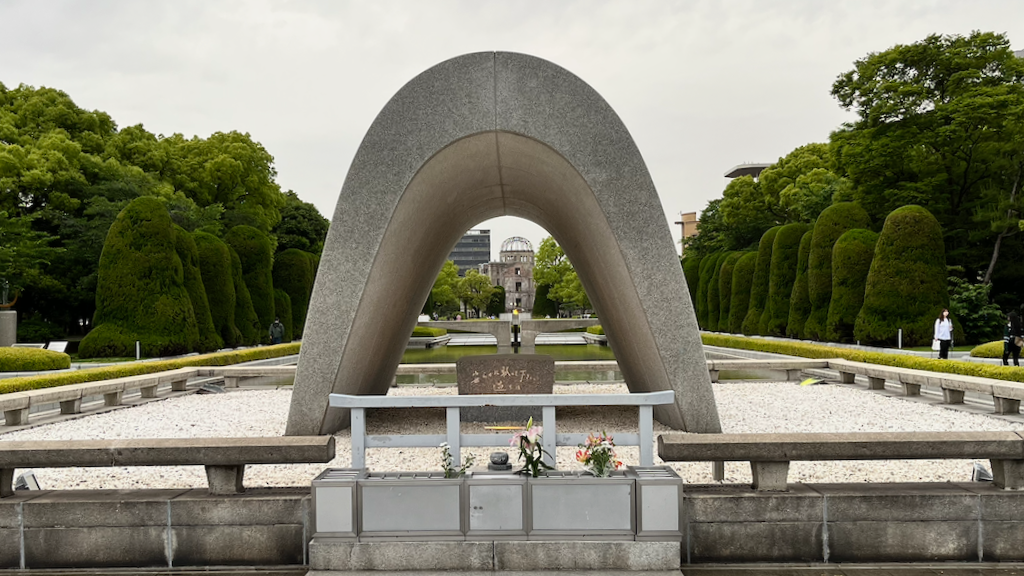
In a recent post, I shared my experience in Hiroshima, along with a suggested one-day itinerary for travelers short on time. A city that embodies resilience and rebirth, Hiroshima still bears the marks of humanity’s darkest capabilities—yet stands today as a powerful symbol of peace.
Just a short journey away, crossing the bay by ferry, lies one of Japan’s most enchanting places: the sacred island of Itsukushima, better known as Miyajima, which literally means “Shrine Island.”
A Floating Sanctuary
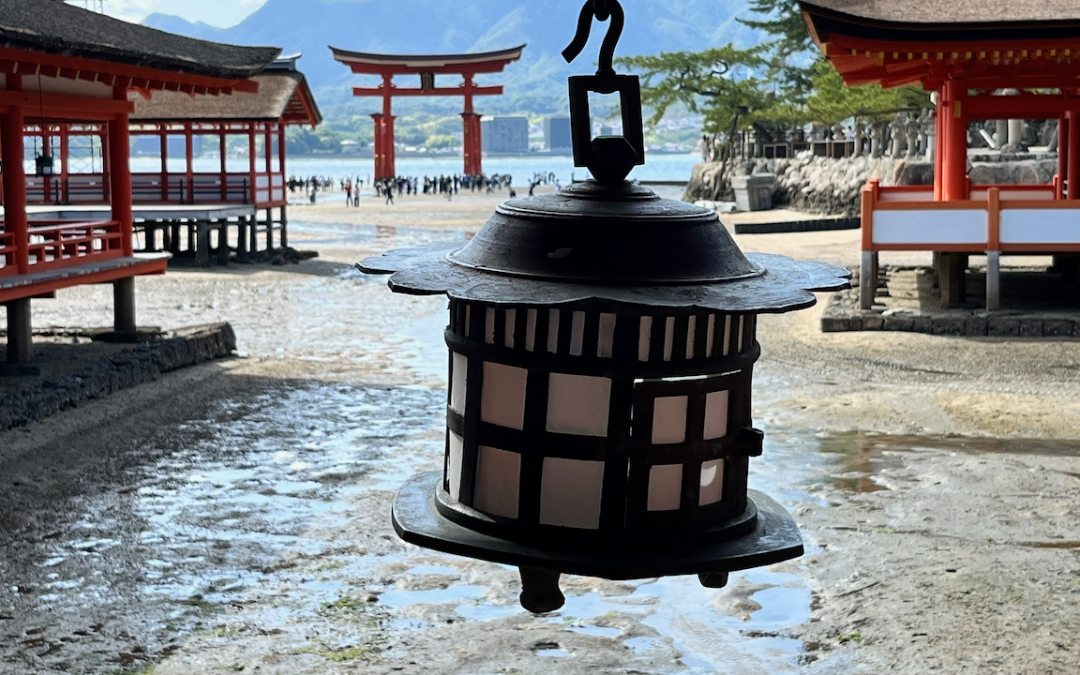
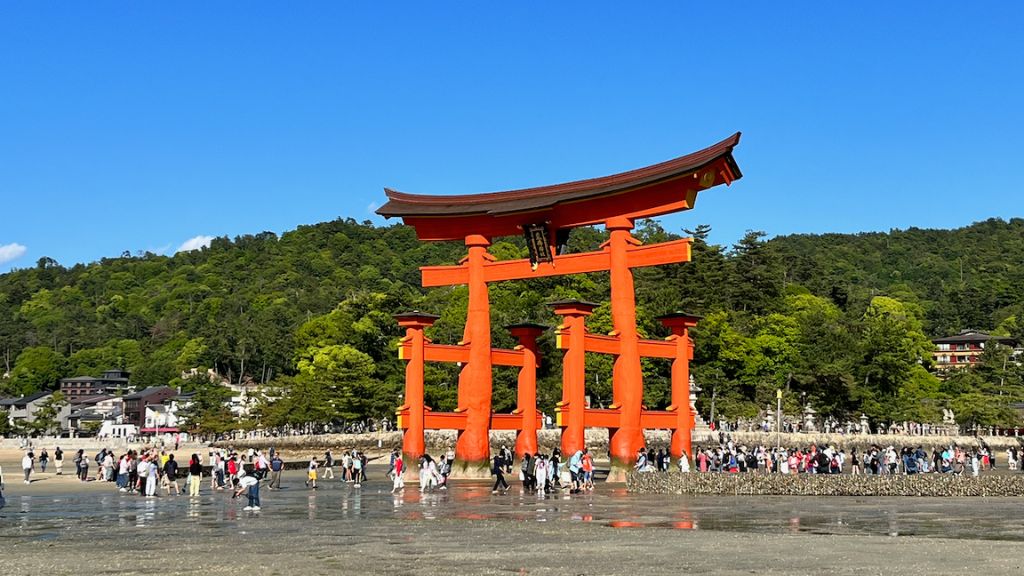
Known worldwide for its immense torii gate rising from the sea, this Shinto shrine was originally built in the 6th century and took its current form under the influence of Taira no Kiyomori (1118–1181).
For centuries, the island was considered so sacred that births and deaths were forbidden, in order to preserve its spiritual purity.
⛩️ The Great Torii of Itsukushima
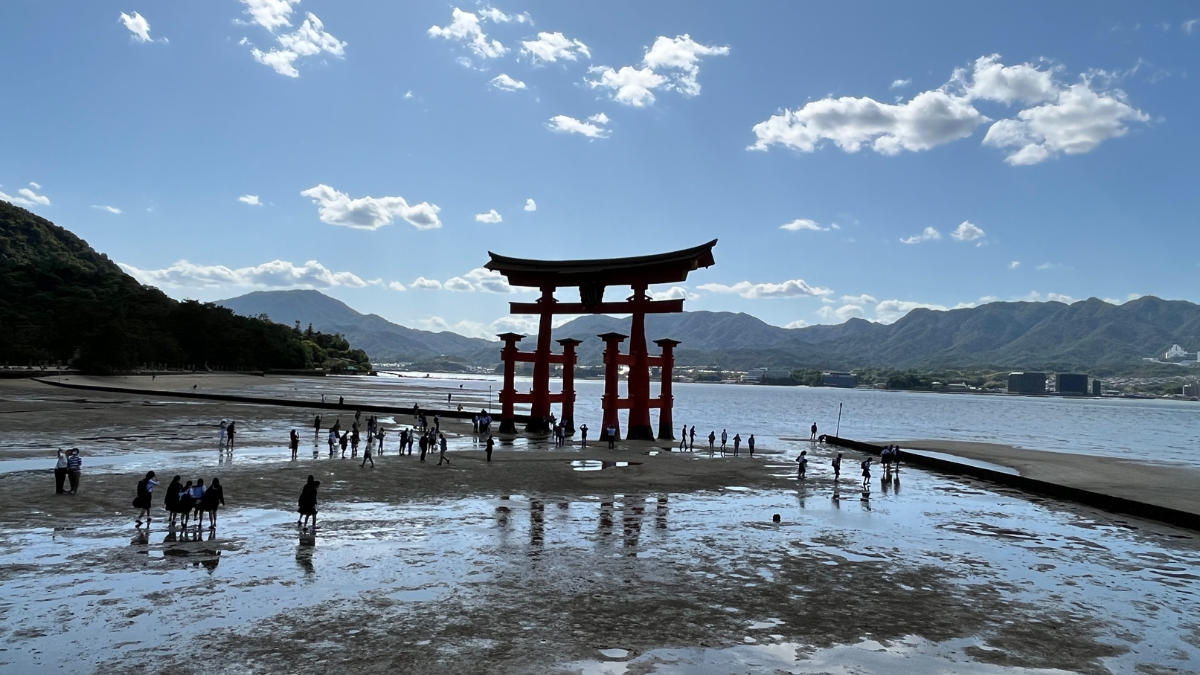
The island’s undisputed icon, the Great Torii offers two completely different experiences depending on the tide:
High tide: The gate appears to float on water—mystical and almost surreal.
Low tide: You can walk right up to its base and admire its monumental scale (and even spot tiny shells clinging to its pillars).
If you have the time, stay for sunset. The sky fills with shades of orange and pink, blending with the shimmering sea and the vermilion reflection of the torii—a truly unforgettable sight.
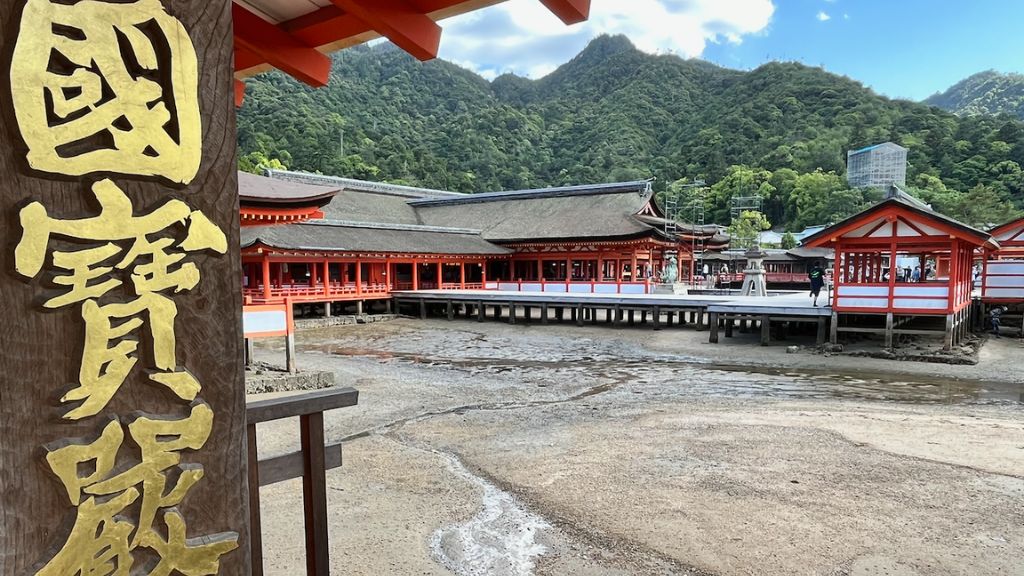
Equally magical is watching the tide slowly rise while standing on the shrine’s wooden walkways, with the gentle sensation of floating above the water.
The Gods’ Messengers… on Four Legs
In Shinto belief, deer are sacred animals believed to act as messengers between humans and the gods.
They may look adorable—but don’t be fooled by their innocent eyes! After generations of interacting with visitors, they’ve learned that they rule the island… and won’t hesitate to check your pockets for snacks.
Itsukushima Shrine: A Masterpiece of Architecture
Listed as a UNESCO World Heritage Site, this Shinto shrine is dedicated to the three daughters of Susanoo-no-Mikoto, the god of storms.
Why is it built on water? To respect the sacred nature of the island, the shrine was constructed on stilts within the tidal zone—allowing worshippers to “float” above the divine ground without setting foot on it.
The floating torii: Rather than being anchored deep into the seabed, it stands purely under its own weight (around 60 tons), a true feat of traditional engineering.
Mount Misen: The Spiritual Heights
While the lower part of the island is deeply rooted in Shinto, the upper slopes tell a different story—one of Buddhism.
In 806, the monk Kukai (also known as Kobo Daishi), founder of the Shingon school, established a spiritual training center here. Near the summit of Mount Misen burns an eternal flame, said to have been alive for over 1,200 years and this flame was used to ignite the Flame of Peace in Hiroshima’s Peace Memorial Park.
If you want to know more, do not hesitate to listen the dedicated episode on Liomugai’s podcast :