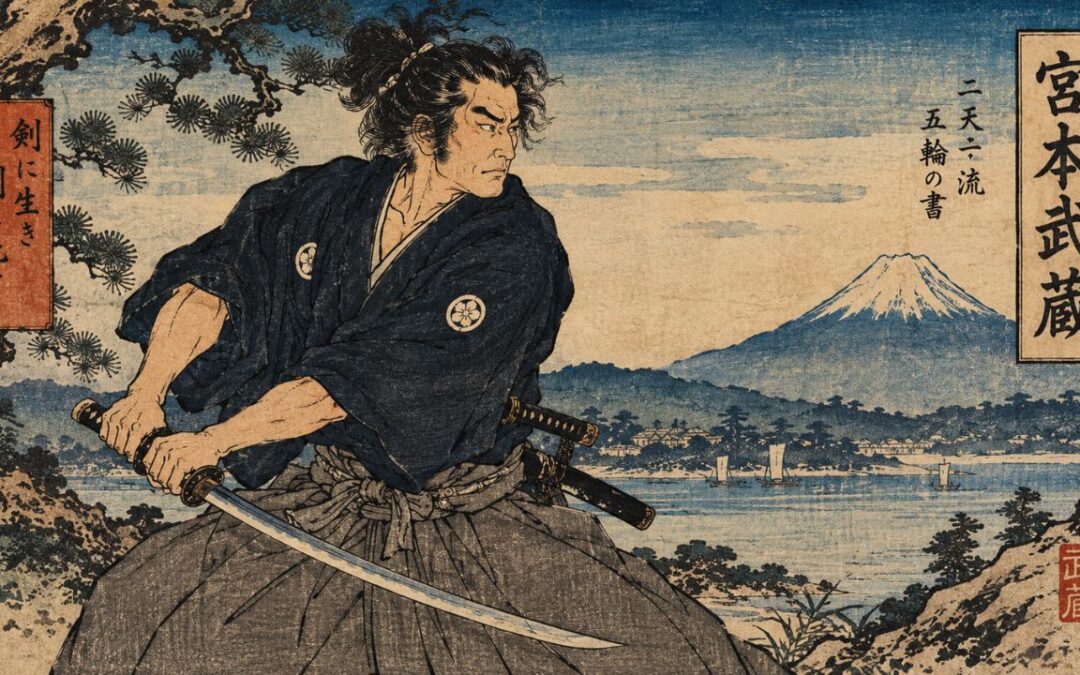
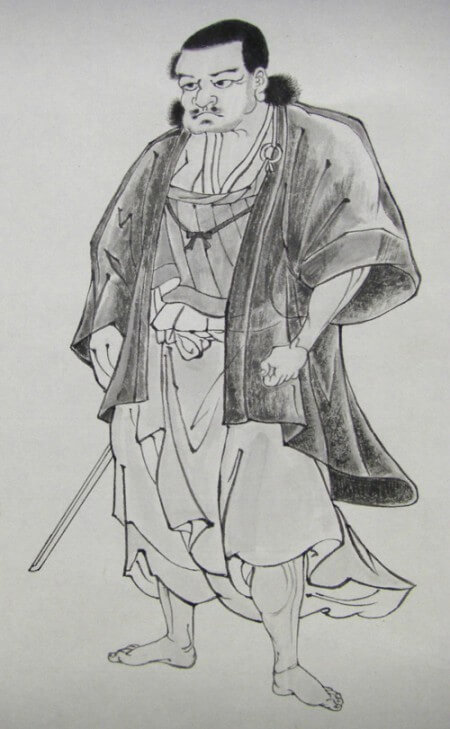
Miyamoto Musashi and The Book of Five Rings: Strategy, Zen, and the Mastery of Life
Miyamoto Musashi (c. 1583 – June 13, 1645) stands as one of the most enigmatic and revered figures in Japanese history. Celebrated as a kensei (“sword saint”), he was an undefeated rōnin, a master strategist, an accomplished ink painter, a calligrapher, and a philosopher. Over a lifetime spanning the turbulent late Sengoku and early Edo periods, Musashi fought in over sixty duels without suffering a single defeat.
Shortly before his death in 1645 inside the Reigandō cave, Musashi distilled his lifetime of experience into a seminal treatise on kenjutsu and strategy: Go Rin No Sho (The Book of Five Rings). Far from being a mere manual on swordplay, this text serves as a universal framework for discipline, adaptability, and psychological clarity.
The Legend of the Lone Samurai
Born Shinmen Bennosuke around 1583 in Mimasaka or Harima Province, Musashi was introduced to martial arts at a young age by his father, Shinmen Munisai, an accomplished swordsman and master of the jitte. Musashi’s martial journey began early: he fought and won his first duel at just twelve or thirteen years old against Arima Kihei, a swordsman of the Kashima Shintō-ryū style.
By the age of twenty-eight, Musashi had engaged in scores of life-or-death duels across Japan, including famous clashes against the Yoshioka clan in Kyoto and the staff master Musō Gonnosuke.
The Duel on Ganryū Island
Musashi’s most famous encounter took place on April 13, 1612, against Sasaki Kojirō on Ganryū Island off the coast of Shimonoseki. Kojirō was renowned for his skill with the nodachi—a particularly long sword.
Demonstrating his mastery of psychological warfare and improvisation, Musashi deliberately arrived late for the duel. During the boat ride to the island, he carved a custom wooden practice sword (bokken) out of a spare boat oar. When Kojirō confronted him in frustration, Musashi delivered a single, decisive vertical strike that crushed Kojirō’s skull, securing his place in martial legend.
Niten Ichi-ryū: Two Heavens as One
Musashi revolutionized Japanese swordsmanship by founding the Niten Ichi-ryū (or Ni-Ten Ichi-Ryu) school, which translates to “Two Heavens as One.” While traditional samurai held their long sword (katana) with both hands, Musashi advocated wielding both the katana and the short sword (wakizashi) simultaneously.
He believed that a warrior should train to be equally proficient with both hands, maximizing balance and efficiency while avoiding over-reliance on any single weapon.
Deciphering The Book of Five Rings
In 1643, suffering from failing health, Musashi retired to the Reigandō (Spirit Rock Cave) in Kumamoto to live as a hermit. There, he wrote The Book of Five Rings, dividing his strategic philosophy into five distinct volumes named after the classical Buddhist elements (godai): Earth, Water, Fire, Wind, and Void.
1. The Book of Earth (地の巻)
The Book of Earth lays the foundation of Musashi’s strategy. He compares mastering strategy to building a house, where one must understand the tools, materials, and structural principles.
Key insights from the Book of Earth include:
Background Timing and Rhythm: Musashi notes that rhythm governs all human endeavors—from music and dancing to archery, commercial trading, and martial conflict. Discerning the “background timing” of an opponent or environment is essential for victory.
Broad Knowledge: Musashi famously asserts: “If you know the Way broadly, you will see it in everything.” Mastering one discipline deeply illuminates the principles of all others.
The Nine Core Principles: Musashi concludes this chapter with nine rules for practical living, starting with “Do not think dishonestly” and ending with his famous maxim: “Do nothing which is of no use.”
2. The Book of Water (水の巻)
Water symbolizes flexibility and adaptability. Water conforms to whatever vessel contains it—be it a pitcher, a riverbed, or a narrow channel.
Musashi teaches that a warrior’s mind and body must embody this fluid nature:
Spiritual Balance: In the midst of combat, your spiritual bearing should be no different from normal life—determined yet calm, neither tense nor slack.
The Five Attitudes: Musashi outlines five primary sword stances (Upper, Middle, Lower, Right Side, Left Side), but stresses that these must seamlessly transition into “No Attitude” or “Existing–Non Existing,” allowing actions to flow naturally without rigid adherence to form.
3. The Book of Fire (火の巻)
The Book of Fire addresses the heat and aggression of combat, applying equally to one-on-one duels and battles involving thousands of troops.
Musashi highlights tactical positioning and initiative:
Taking the High Ground: Always position yourself where the sun, moon, or physical structures do not obstruct your sight or blind you, forcing your opponent into unfavorable terrain or shadows.
Forestalling the Enemy (Sen): Musashi details three ways to take the initiative—attacking directly (Ken No Sen), waiting for the opponent to strike to exploit a opening (Tai No Sen), or engaging simultaneously to override their momentum (Tai Tai No Sen).
4. The Book of Wind (風の巻)
In Japanese, the character for “wind” (fū) also means “style” or “custom.” In this chapter, Musashi critiques contemporary schools of swordsmanship.
He warns against common pitfalls:
Over-reliance on Weapons: Musashi criticizes schools that favor extra-long swords, pointing out that relying on length or specialized gear creates vulnerability when space is constrained.
Avoidance of Rigid Technique: True strategy does not consist of flashy maneuvers or secret tricks; it relies on direct, efficient action aimed at achieving victory with minimum unnecessary risk.
5. The Book of Void (空の巻)
The final and most philosophical volume, the Book of Void (Ku), reflects Zen Buddhist influences regarding Śūnyatā (emptiness).
Beyond Conscious Thought: The Void represents a state of absolute freedom where a master acts spontaneously through refined intuition, unburdened by hesitation, doubt, or ego.
Perceiving the Unseen: Musashi writes: “By knowing things that exist, you can know that which does not exist.” In the Void lies ultimate clarity, where technique becomes second nature and action aligns perfectly with reality.
The Universal Legacy of Musashi
Beyond his swordsmanship, Musashi was a master of ink painting (sumi-e) and calligraphy, creating celebrated works such as Shrike Perched on a Withered Branch. In his final days, he also penned the Dokkōdō (“The Path of Aloneness”), twenty-one short precepts for self-reliant living.
Today, The Book of Five Rings is studied worldwide not only by martial artists, but also by business leaders, athletes, and strategists seeking timeless lessons on focus, situational awareness, and personal mastery.
> “Do nothing which is of no use.” — Miyamoto Musashi
I know how busy life can get. Between work, family, and training, it isn’t always easy to sit down and read long-form articles—even if you want to stay up to date with the latest insights.
To make my website posts more accessible when you are short on time, I have officially launched a brand-new audio companion: Liomugai: The Way of the Sword.
This is a brand-new venture for me, so consider this our first official start! The audio and production quality will naturally get better with time. Thank you for your patience and for joining me on this learning curve.
We are hitting the ground running with 5 episodes already available for you to listen to:
Episode 1: Introduction to Liomugai’s podcast
Episode 2: The Sacred and the Sharp: Whispers of Mount Fuji
Episode 3: The Mugai-ryū and the Way of Zen
Episode 4: The Soul of Hiroshima and Miyajima
Episode 5: Muga : The Zen Heart of Mugai-ryū
And then a new episode will be available every Tuesday morning
Why listen?
Time-Friendly: Perfect for your daily commute, a walk, or while you’re prepping your gear.
Audio Companion: You won’t miss a single website post.
Deep Dives on the Go: Explore the philosophy, history, and mindset of the sword wherever you are.
Whether you prefer reading at your desk or listening through your headphones, you can now engage with the content in whatever way fits your schedule best.
If you enjoy the show, please consider hitting Subscribe and leaving a review on Apple Podcasts—it helps other martial arts and sword enthusiasts find us!
Thank you all for your support as we start this new chapter.
Living in the Shadow of Fuji: A Personal Reflection on Fujisan Hongū Sengen Taisha
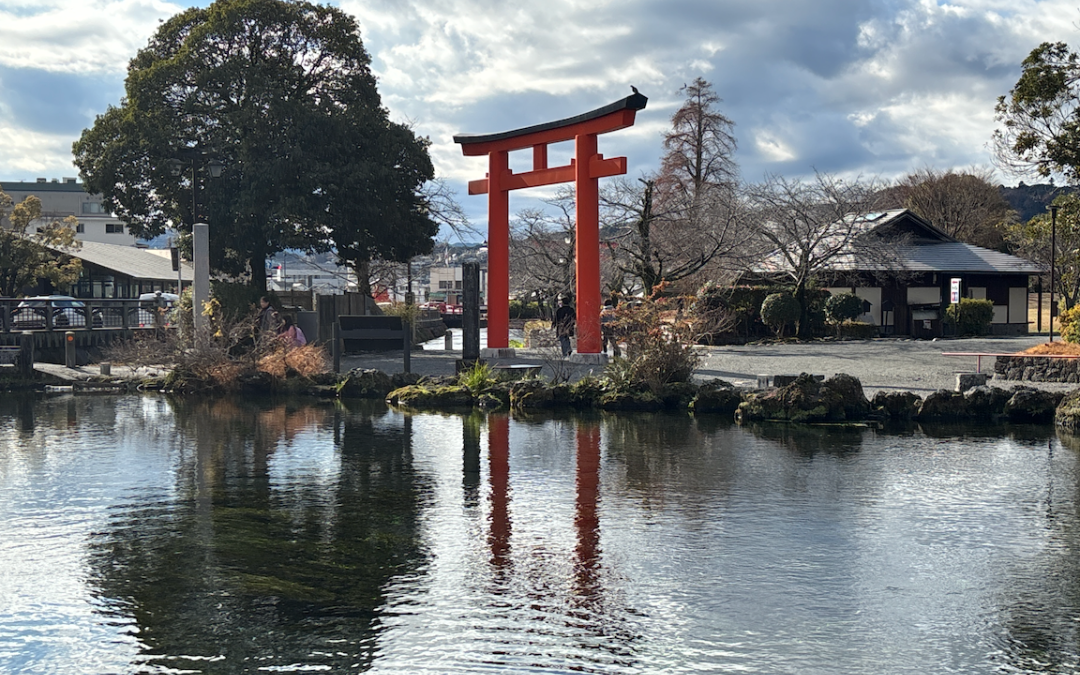
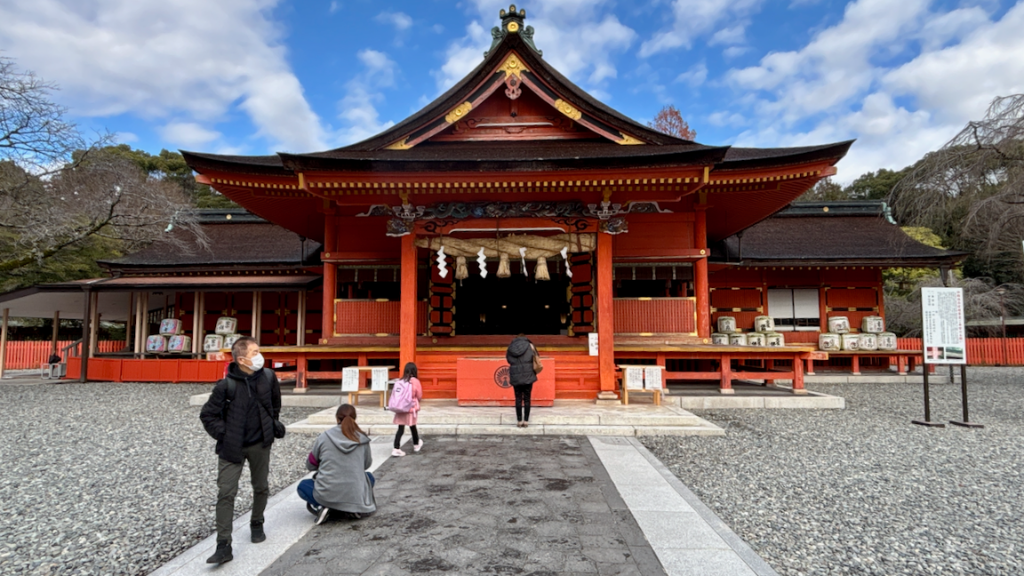
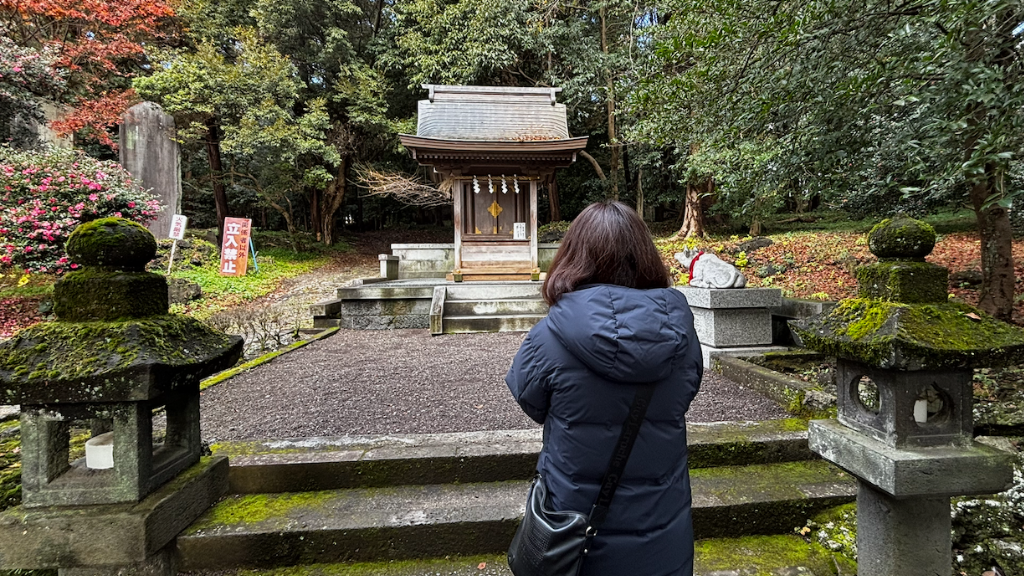
There’s something quietly profound about living near a place that has been sacred for over a thousand years. For my Japanese family, home is not just defined by streets and houses—it is shaped by the ever-present silhouette of Mount Fuji. Close to this holly mountain, you can find the Fujisan Hongū Sengen Taisha (富士山本宮浅間大社), a shrine that has watched over generations beneath the ever-present silhouette of Mount Fuji.
A Shrine That Breathes With the Mountain
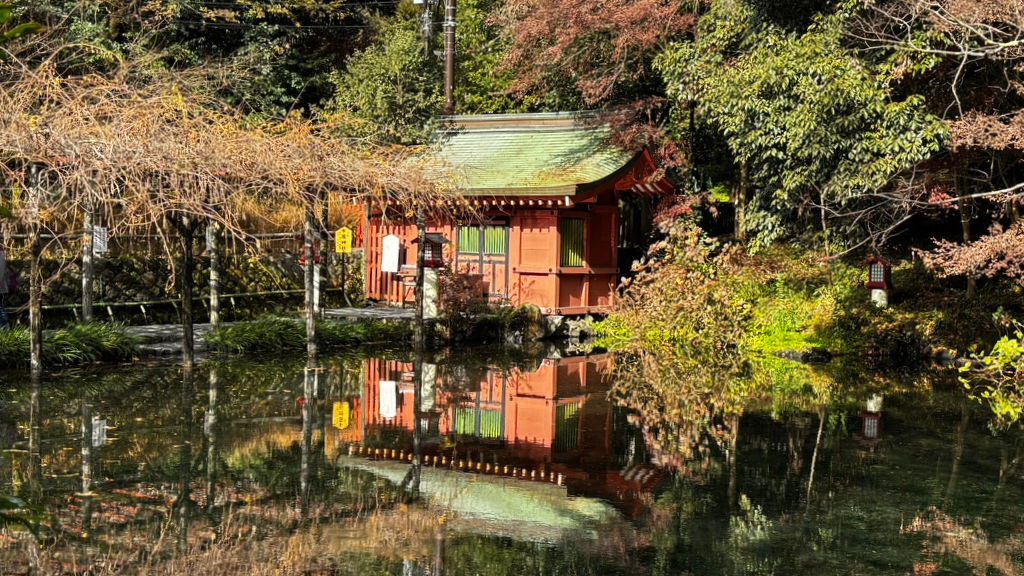
Unlike many historical sites that feel distant from everyday life, Fujisan Hongū Sengen Taisha is deeply woven into the rhythm of the community. Visits to the shrine aren’t reserved for special occasions—they happen naturally. A quiet walk, a New Year prayer, or a moment of reflection by the clear waters of Wakutama Pond all become part of daily life.
Growing up around this environment (or even just visiting often), you begin to understand that Mount Fuji is not simply scenery. It is a presence. In the Shinto worldview, it is alive—home to the kami, especially Konohanasakuya-hime, whose story embodies both beauty and fragility.
From Fear to Reverence
Historically, Mount Fuji was feared for its eruptions. The shrine itself was established as a way to calm and honor the spirit of the mountain by Tokugawa Ieyasu. Today, that history still lingers, but it has transformed into something more balanced: a deep respect rather than fear.
Living nearby, you don’t constantly think about volcanic danger. Instead, you notice the changing light on Fuji’s slopes, the seasonal festivals, and the steady flow of visitors beginning their pilgrimage. The mountain becomes both ordinary and extraordinary at the same time.
The Meaning of Everyday Ritual
One of the most striking things about having such a sacred place close to home is how spirituality becomes subtle. It’s not always grand or ceremonial.
It might be:
Pausing briefly at the shrine gate before heading into town
Washing hands at the purification basin without thinking twice
Watching the still surface of Wakutama Pond reflect the sky
These small actions echo centuries of tradition, connecting the present moment to something much older.
A Personal Connection
For my family, the shrine is not just a cultural landmark—it’s part of our identity. It’s where celebrations begin, where prayers are made, and where we return in moments of uncertainty.
Being close to Fujisan Hongū Sengen Taisha means growing up with an unspoken understanding: nature is not separate from us. It deserves respect, attention, and humility.
And perhaps that’s the most powerful lesson this place offers—not just to visitors or pilgrims, but to those lucky enough to call it part of home.
Closing Thoughts
In a fast-moving world, places like Fujisan Hongū Sengen Taisha remind us to slow down. To look up at the mountain. To listen to the quiet. To recognize that some connections—between people, place, and spirit—are meant to last far longer than a lifetime.
Living near Fuji isn’t just about proximity. It’s about perspective.
You want to know more about The Mounf Fuji, the dedicated episode of my podcast Liomugai The Way of Sword and Budo has been built for that :
Most travelers visit Hiroshima to witness the scars of history—an essential pilgrimage for anyone visiting Japan. Walking through the city is an experience beyond “emotional”; it is difficult to pin down a single feeling when the mood shifts like a tide. Yet, as a practitioner of Budo, I found that a single day here offers something deeper: a profound lesson in Resilience (see my post on Fudōshin) and the evolution from the “Sword that Kills” to the “Sword that Gives Life.” If you have 24 hours in this rebuilt metropolis, here is how to navigate its complex emotional and historical layers.
If you have 24 hours in this rebuilt metropolis, here is how to navigate the emotional and historical layers of Hiroshima.
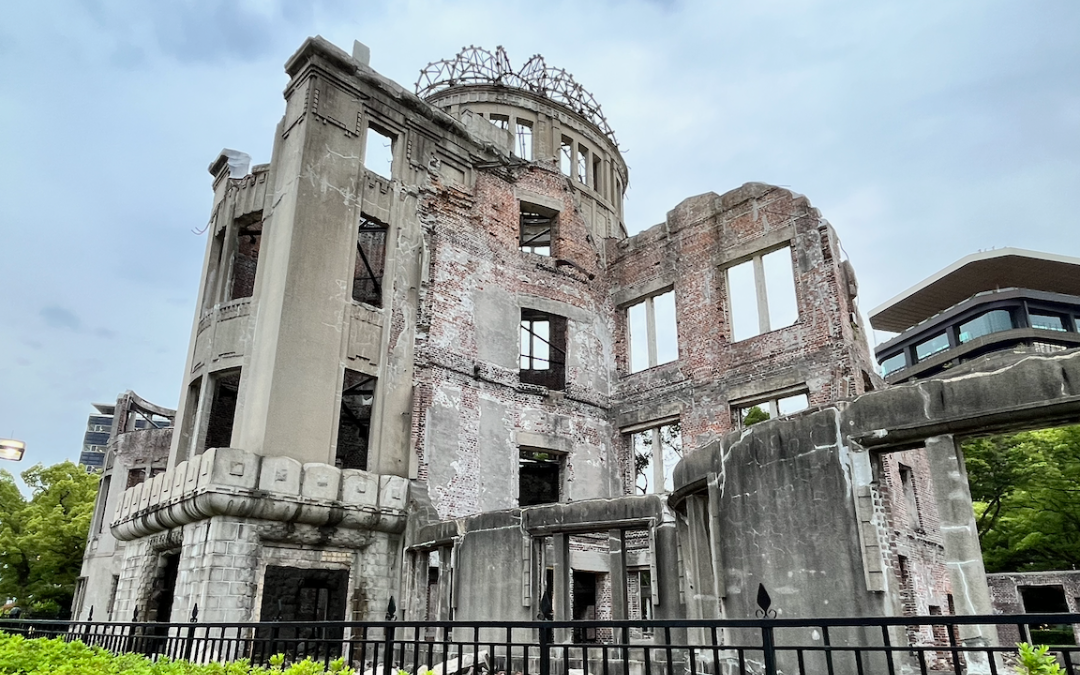
1. The Genbaku Dome: A Frozen Moment in Time
I started my journey at the A-Bomb Dome. It is a heavy, visceral sight. This structure—the former Prefectural Industrial Promotion Hall—was nearly at the epicenter of the 1945 explosion. Though the rest of Hiroshima was flattened, these columns refused to fall. Eighty years later, the Dome remains frozen in time: a stark reminder of total destruction and an icon of human resilience.
My Tip: Arrive early (before 8:30 AM). The morning light hitting the exposed red bricks against the quiet flow of the Motoyasu River creates a space for silent contemplation before the crowds arrive.
2. The Peace Memorial Park: The Heart of Remembrance
Crossing the bridge from the Dome, you enter the Peace Memorial Park. This isn’t just a park; it’s a sacred space designed by the legendary architect Kenzo Tange.
The Cenotaph and the Flame of Peace
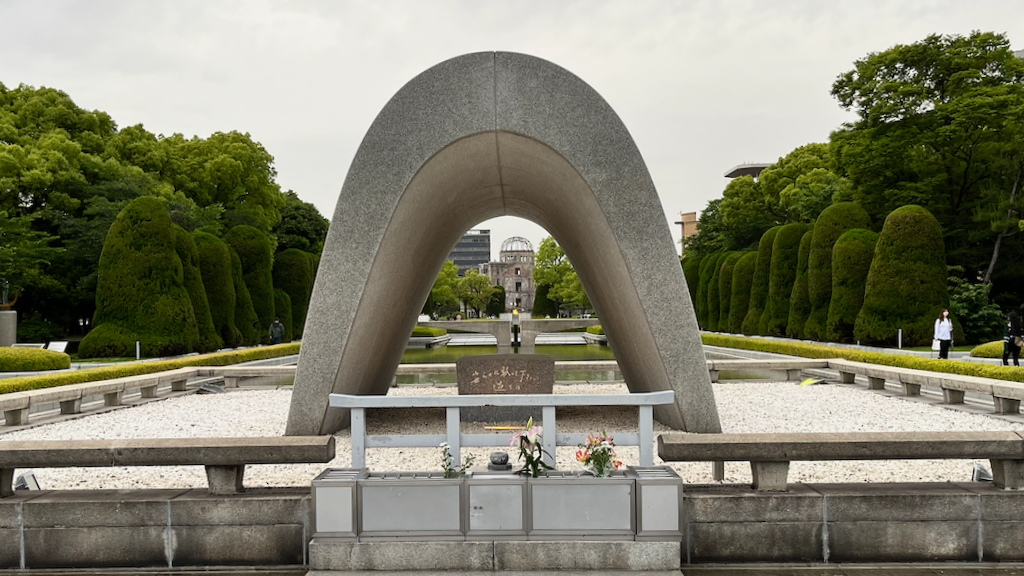
I spent a long time at the Cenotaph for the A-Bomb Victims. Its saddle-like shape is designed to shield the souls of the deceased. If you stand at the center, you can look through the arch to see the Flame of Peace.
The Vow: This flame will burn until every nuclear weapon on earth has been dismantled.
As a martial artist, this site resonates with the concept of Katsujinken (活人剣)—the “Life-Giving Sword.” It reminds us that the ultimate goal of mastery is not conflict, but the preservation of peace.
3. Lunch: Hiroshima-style Okonomiyaki
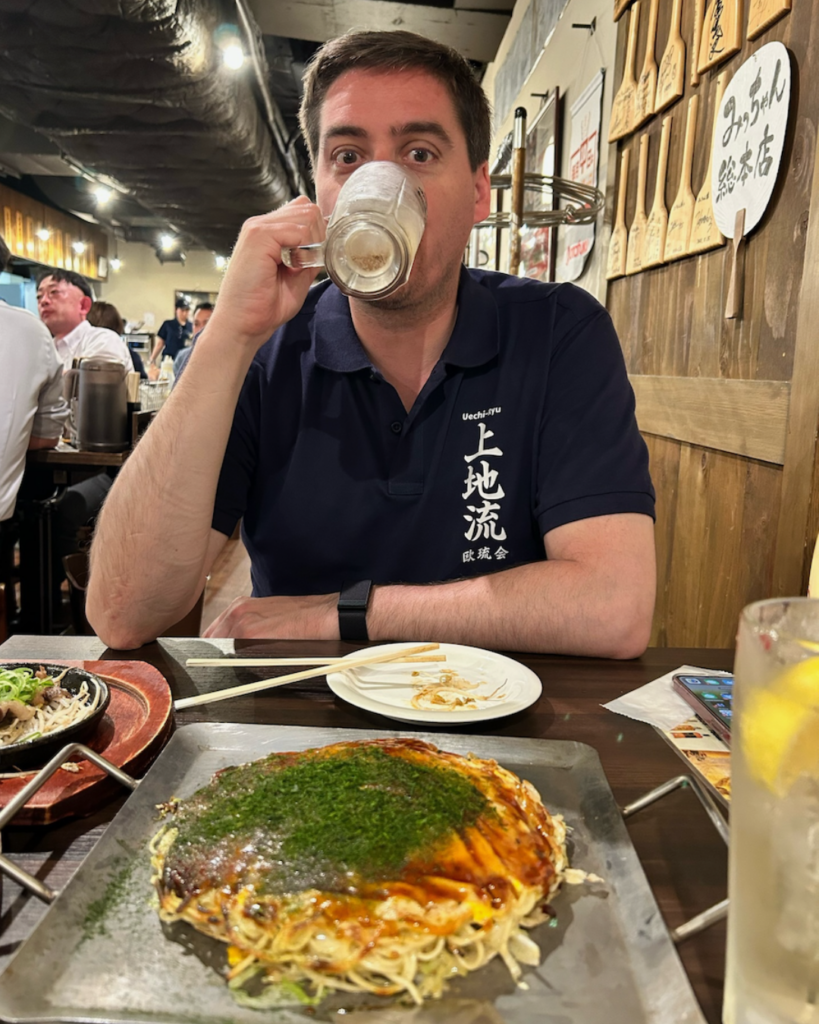
You cannot visit Hiroshima without trying their soul food. Unlike the Osaka version, Hiroshima Okonomiyaki is layered, featuring noodles (soba or udon) and a generous portion of cabbage.
My Tip: Head to Okonomimura (Okonomi Village), a building with three floors of small stalls. It’s the perfect “Ha” (break) in your day to refuel.
4. Hiroshima Castle: The Return of the Carp
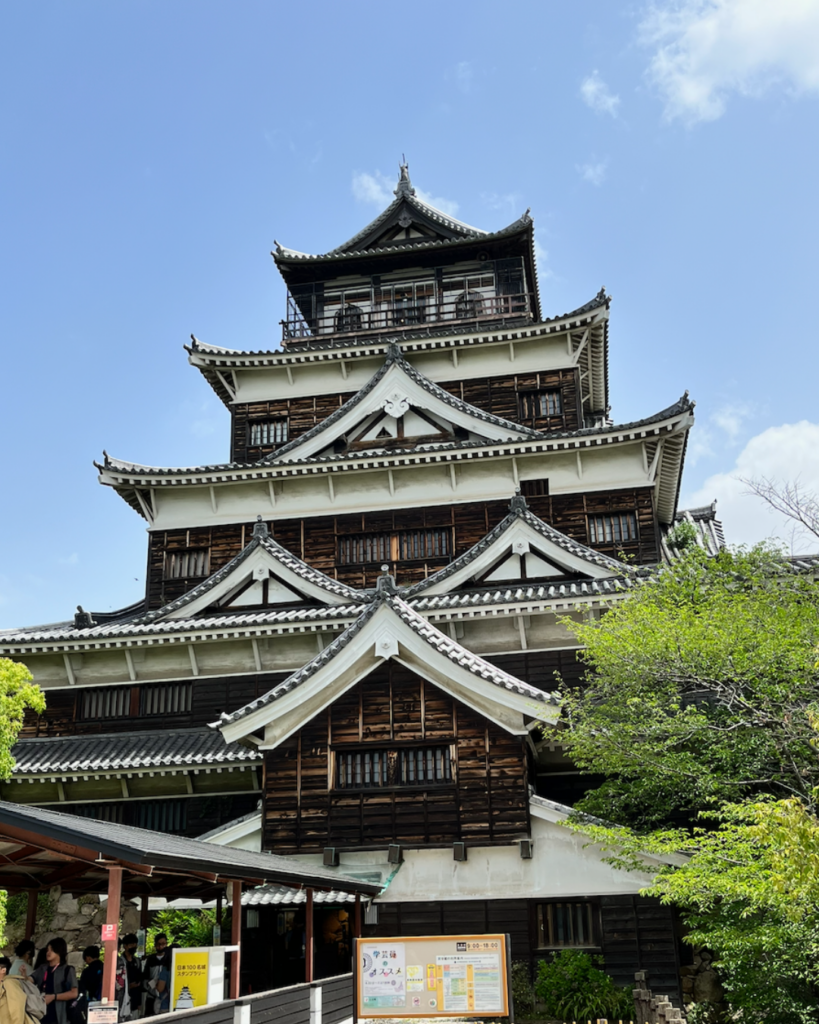
After the emotional weight of the morning, I walked 15 minutes north to Hiroshima Castle (Rijō or “Carp Castle”).
Originally built in 1589, the castle was a total loss in 1945. However, its 1958 reconstruction is a stunning tribute to the city’s samurai origins.
What to Look For:
The Survival Trees (A-Bombed Trees): Inside the castle walls, look for the Eucalyptus and Willow trees. Despite being charred by the heat of the blast, they survived and continue to grow today. They are living symbols of the samurai spirit—unyielding and rooted.
The Museum: The interior of the keep houses an excellent collection of Edo-period armor and katanas. For an Iaidoka, seeing the local craftsmanship and the history of the Asano clan is a must.
The View: Climb to the 5th floor for a panoramic view of the city. Seeing the modern skyline from a traditional fortress gives you a true sense of Japan’s ability to honor the past while embracing the future.
Practical Information for Your Visit
Location
Suggested Time
Entry Fee
Genbaku Dome
30 mins
Free
Peace Museum
2 hours
200 JPY
Hiroshima Castle
1.5 hours
370 JPY
How to get around: Use the Hiroden (the iconic streetcars). They are a living piece of history—some of the trams running today actually survived the 1945 bombing and were back on the tracks just three days later.
My day in Hiroshima followed the rhythm of Jo-Ha-Kyū:
Jo (Begin): The somber, slow realization at the Dome.
Ha (Break): The movement through the park and the vibrant energy of the city streets.
Kyū (Fast/End): The ascent to the top of the Castle, looking out over a city that refused to die.
If you are intreseted in the Budo Jo Ha Kyū concept, please have a look on my dedicated post.
Hiroshima is more than a tragic history; it is a vibrant, green, and welcoming city that embodies the very essence of Budo: the strength to remain calm and kind, no matter what storms have passed.
If you want to know more do not hesitate to listen Liomugai’s podcast :
In the world of Japanese martial arts, few schools embody the profound connection between Zen philosophy and the blade as deeply as Mugai-ryū Iaihyōdō. At the very heart of this ancient swordsmanship tradition lies a powerful poem, or kanshi, penned by its founder, Tsuji Gettan Sukemochi. This isn’t just a piece of poetry; it’s a spiritual blueprint, an articulation of enlightenment that continues to guide practitioners today.
Tsuji Getttan
The Founder’s Journey to “Nothing Outside”
Tsuji Gettan Sukemochi (1649–1728) was a master swordsman in his own right, but he felt there was something missing – a deeper understanding beyond mere technique. He sought this through intense Zen training under Zen Master Sekitan Zenshi at Kyūkō-ji Temple.
It was during this period of rigorous meditation that Gettan achieved satori (enlightenment). The realization he gained profoundly impacted his martial art. He named his school “Mugai-ryū,” which translates to “Nothing Outside” or “No Other.” This name, and the poem he composed, encapsulates the Zen concept that true understanding and power come from within, not from external forces or superficial forms.
The Poem: A Glimpse into Enlightenment
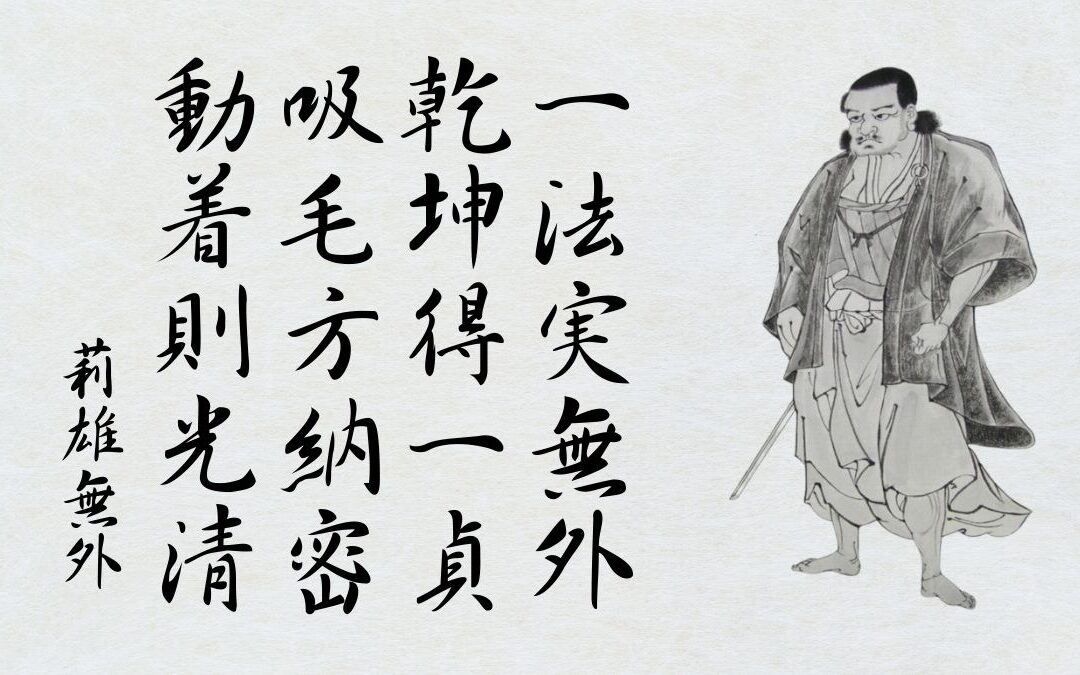
The most famous and widely quoted lines of Tsuji Gettan’s enlightenment poem are:
一法実無外 (Ippō jitsu mugai) 乾坤得一貞 (Kenkon toku ittei) 明頭乗萬機 (Meitō manki ni jōzu) 活物示全身 (Kappatsu zenshin o shimesu)
A common translation brings its profound meaning to light:
“One Truth, nothing outside.”“Heaven and Earth obtain this one uprightness.”“With an enlightened mind, ride upon all phenomena.”“A living being reveals its whole body.”
A more poetic translation (I personally prefer this one) :
“The quest for Oneness is the sole gateway to the path of Truth. Throughout the vast cosmos, and across the infinite reach of time, stands the Just—timeless and unshakeable. By the absolute power of this Unity, the breath born within the heart bestows the might of the blade upon a single hair, transforming even the smallest stir into a surging fountain of light.“
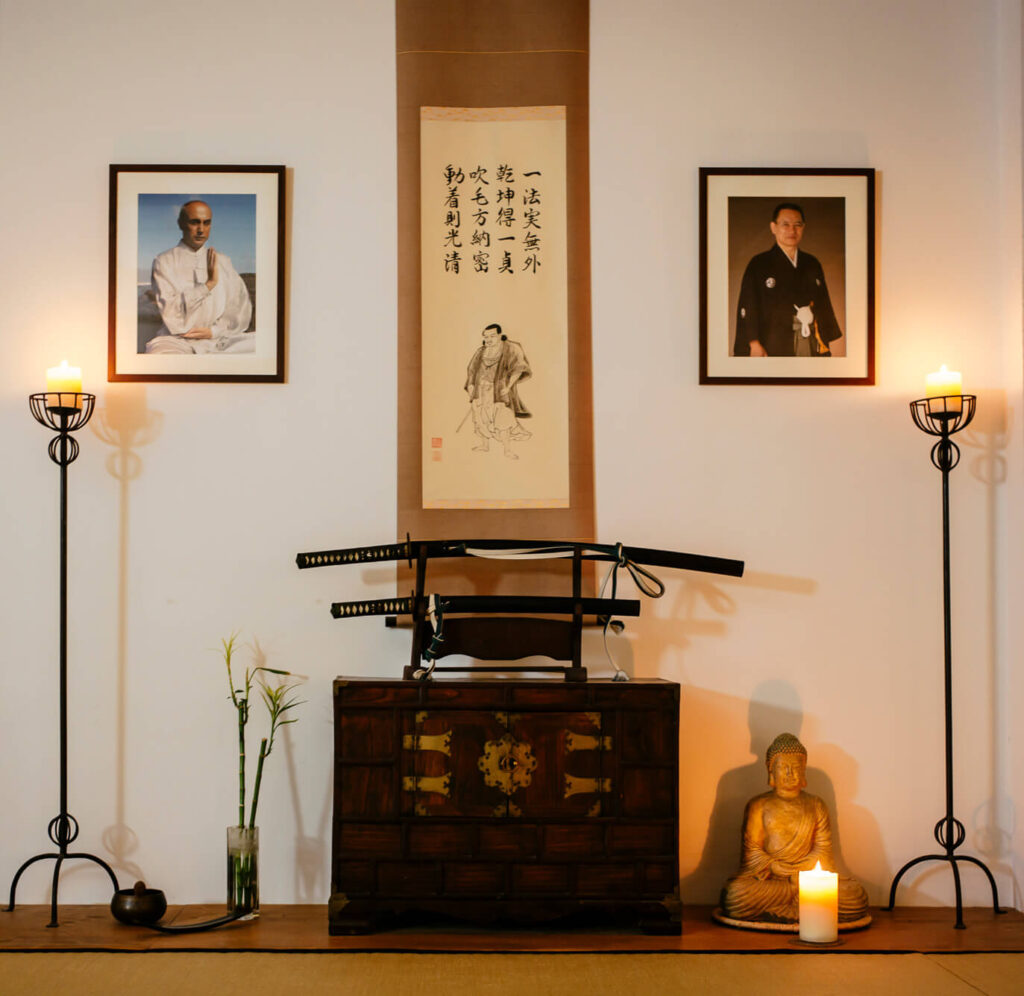
Kakejiku embedding the Poem in Tenshinkai Dojo in Cologne (Germany)
Breaking Down the Core Philosophy
Let’s deep into each line of this poem:
“One Truth, nothing outside.” (Ippō jitsu mugai): This is the core of Mugai-ryū. It speaks to the unity of all things and the absence of any external “other” to fear or contend with. The ultimate truth is found within oneself. When facing an opponent, this means seeing them not as a separate entity, but as part of the same interconnected reality.
“Heaven and Earth obtain this one uprightness.” (Kenkon toku ittei): This line emphasizes the universal principle of harmony and integrity. It suggests that when one aligns with this “One Truth,” their posture, mind, and spirit become perfectly upright and unwavering, mirroring the natural order of the universe.
“With an enlightened mind, ride upon all phenomena.” (Meitō manki ni jōzu): This is where Zen meets the sword in action. “Riding upon all phenomena” implies a state of fluid, effortless adaptability. An enlightened mind isn’t disturbed by external events; instead, it moves with them, anticipating and responding instinctively without hesitation or attachment.
“A living being reveals its whole body.” (Kappatsu zenshin o shimesu): This final line speaks to spontaneous, total commitment. When one truly embodies the “One Truth,” their entire being—mind, body, and spirit—moves as a single, unified force. There is no partiality, no hesitation; the practitioner acts with complete authenticity and presence, revealing their “whole body” in every movement.