
Why In-Yō (Yin-Yang) is About Collaboration, Not Opposition
Every practitioner of the Japanese sword eventually encounters the concept of In-Yō (陰陽)—the Japanese reading of Yin and Yang. Frequently, it is explained as a simple list of opposites: dark and light, soft and hard, passive and active.
But if we treat In-Yō merely as a switch we flip back and forth, we miss its true power.
In-Yō is not a battle between two opposing forces. It is a relationship of absolute codependency and mutual support. In Iaido, Battodo, and Kenjutsu, In and Yō do not compete; they serve each other. One generates the other; one protects the other. To master the sword, we must stop seeing them as opposites and start seeing them as a single, unified engine.
Here is how this vital partnership supports every layer of our training.
1. Iaido: The Hidden Seed of Movement
Iaido is often described as the transition from stillness to explosive action. But true mastery reveals that the stillness (In) is actively supporting the action (Yō), and vice versa.
- Stillness Generates Action: When you sit in seiza or stand in shizentai, your exterior is calm and hidden (In). But this isn’t dead inertia. Deep within that stillness, your focus is sharpening and your breath is dropping to your core. This quietude is the literal launchpad for your nukitsuke (drawing cut). Without the profound calmness of In, your explosive Yō will be tense, erratic, and telegraphed.
- Action Returns to Protect Stillness: Conversely, after the decisive cut (Yō), you return the blade to the scabbard via noto. This return to In is protected by zanshin—a state of heightened, active awareness (Yō). The physical passivity of sheathing the sword is only safe because it is cradled by an active, vigilant mind.
- The Interlocking Reality: You cannot have a fast draw without a relaxed starting posture. The “soft” In gives birth to, and structurally supports, the “hard” Yō.
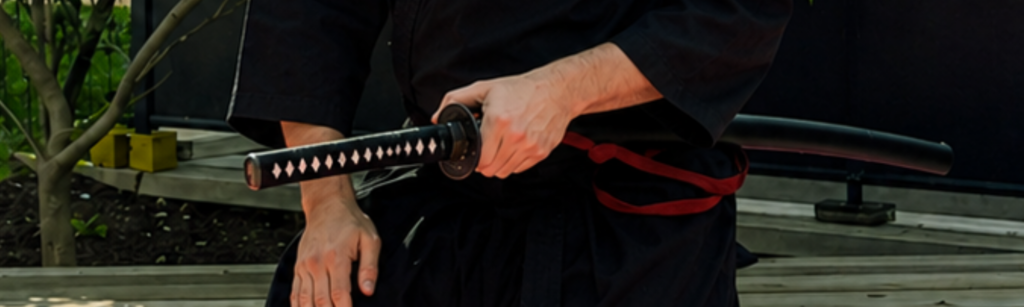
2. Battodo: The Mechanics of Supported Power
In Battodo, we test our form against physical targets like tatami omote. Here, the illusion of pure power (Yō) is shattered. We quickly learn that power is completely dependent on its opposite: softness and structural relaxation (In).
- Softness Drives the Hard Edge: If you try to cut a target using pure muscle power (pure Yō), your body tightens, your shoulders rise, and your blade will likely stall or bend in the mat. True power requires the muscles of the arms and shoulders to remain incredibly loose, heavy, and receptive (In). This softness allows the blade to achieve maximum velocity.
- The Partnership of Tenouchi: Look closely at your grip (tenouchi). If your hands are clamped tightly onto the tsuka (hilt) throughout the entire swing, the cut fails. Instead, the grip must be soft and yielding (In) during the arc of the swing, tightening into a firm, supportive squeeze (Yō) only at the exact microsecond of impact, before immediately melting back into In.
- The Interlocking Reality: The “hard” impact of the sword is entirely fueled by the “soft” velocity of the swing. Yō cannot do its job of cutting the target unless In provides the relaxed speed. They are two sides of the same physical coin.
3. Kenjutsu: Tactically Feeding the Opponent
When facing a live partner in Kenjutsu, In-Yō becomes a tactical dance of mutual support. A strike is never just a strike; it is an invitation, and a defense is never just a block; it is the birth of an attack.
- Yielding to Redirect: When an opponent launches a fierce, aggressive attack (Yō), meeting it with equal brute force creates a collision that risks breaking your blade. Instead, you accept their force by yielding, slipping, or absorbing their strike with a receptive posture (In). By being the “soft” to their “hard,” you control their balance.
- Creating the Void: By offering your opponent an opening—showing them emptiness (In)—you actively draw out their attack (Yō). The moment they commit their energy to that void, they exhaust themselves, leaving a vacuum. Your defense instantly becomes the offense.
- The Interlocking Reality: In partner work, you use your In to manipulate their Yō, and your Yō to exploit their In. You flow between them seamlessly because you recognize that their attack is actually giving you the exact energy you need to defeat them.
The Unified Body and Mind
When In and Yō support each other perfectly, your martial arts become effortless. You begin to realize this balance is present in every fundamental mechanic:
- Your Posture: Your upper body, shoulders, and chest are relaxed, open, and calm (In), while your lower body, hips, and feet are rooted, powerful, and driven into the floor (Yō). The upper body cannot be free to move unless the lower body provides a rock-solid foundation.
- Your Breath: The inhalation (In) gathers energy and centers your mass, directly preparing the body for the exhalation (Yō) which expresses that energy through the tip of the sword. One cannot exist without the other.
Ultimately, In-Yō teaches us that we do not try to eliminate weakness to become strong, nor do we eliminate stillness to become fast.
We use our stillness to feed our speed, and our relaxation to power our strength.
Gyokko Kata
Putting into motion in-yo Concept