
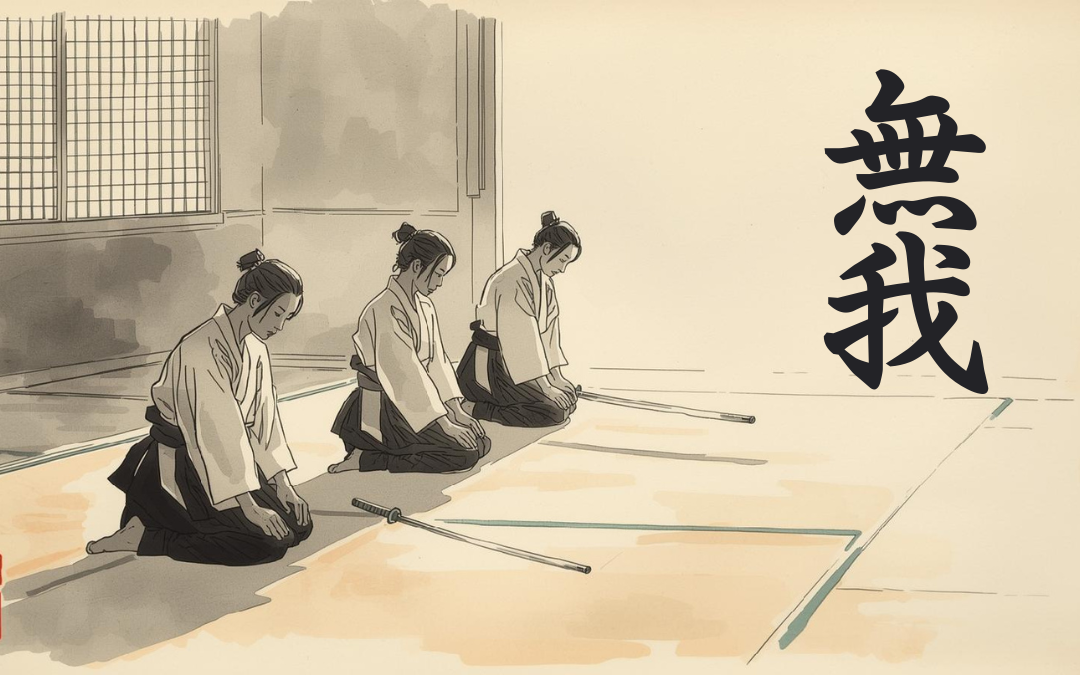
In the practice of Iaido (居合道), Battodo (抜刀道), and Kenjutsu (剣術), we often focus on the physical alignment of the blade or the precision of a cut. But for the practitioner of Mugai-ryū (無外流), the ultimate challenge lies within the mind. At the core of our lineage is the concept of Muga (無我).
The Origin: A Poem of Enlightenment
The name of our school itself is rooted in a profound spiritual realization. The founder, Tsuji Gettan Sukemochi (辻月丹資茂), reached enlightenment after years of deep Zen meditation at the Kyōun-ji (慶運寺) temple.
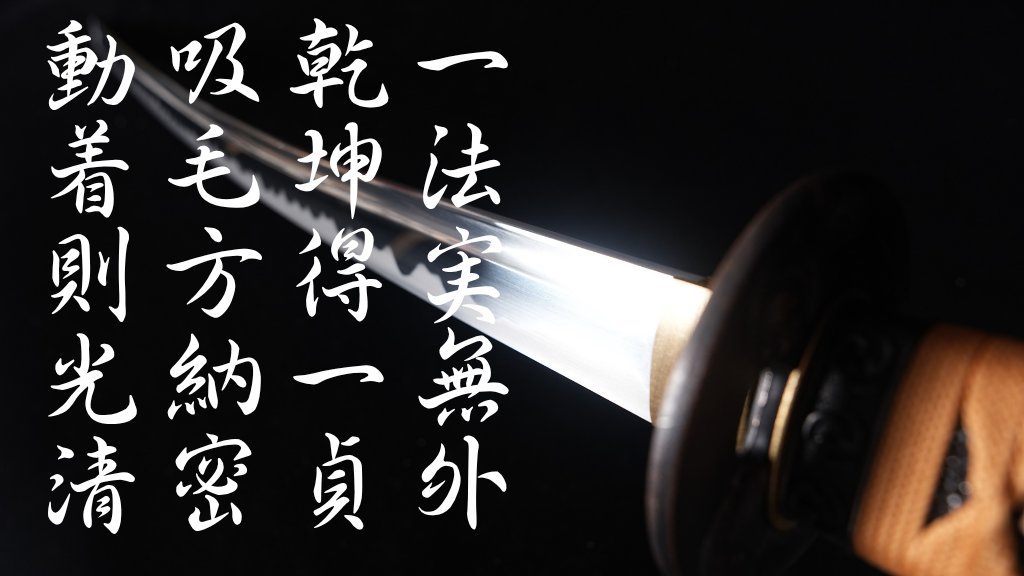
The name “Mugai” comes from a verse in a poem he received from his master:
Ippō mugai nashi (一法無外)
Nyoze dō dō dō (如是道同)
This translates to: “There is no law outside the One Truth; It is everywhere the same.”
The word Mugai (無外) means “Nothing Outside.”
It implies that there is no separation between the self and the universe. From this flows Muga (無我) — the state of Non-Self.
What is Muga (無我)?
In Japanese, Mu (無) means “nothingness” or “void,” and Ga (我) means “self” or “ego.”
In our daily lives, our Ego (我) is always busy. It judges our performance, fears failure, and seeks praise. In Budō (武道), this ego is an obstacle. It creates tension in the shoulders and hesitation in the spirit.Muga is the process of stripping away this “I.” When the ego is absent, there is no “me” trying to cut; there is only the movement happening in perfect synchronicity.
Muga in Battodo (抜刀道): The Pure Cut
In Battodo, when facing a Wara (藁 – straw mat), the ego often whispers: “Don’t miss,” or “Make a perfect angle.” This thought creates a physical “hitch.”
By seeking Muga, we aim for Mushin (無心 – empty mind). In this state, the Tenouchi (手の内 – the grip) and the Maai (間合い – the distance) are not calculated by the brain, but felt by the soul. The sword becomes an extension of your nervous system, and the cut becomes an effortless expression of reality.
Muga in Kenjutsu (剣術): The Absence of the Opponent
While Iaido is often a solitary pursuit, it is in Kenjutsu (the art of the sword in combat) that Muga undergoes its most intense test. When facing an opponent in Kumitachi (組太刀), the ego naturally reacts with fear or aggression.
In a state of Muga, the opponent is no longer viewed as an enemy to be defeated, but as a mirror. You do not “react” to a strike; instead, your body moves in Shizen-tai (自然体 – natural posture) before a conscious thought even arises. This is the expression of Munami (無波 – “no waves”), where the mind remains undisturbed. By losing the “Self” (Ga), you also lose the “Other.” The dualism of winning and losing simply ceases to exist.
My conclusion with the Ken Zen Ichi Nyo (剣禅一如) Concept
My Liomugai journey is a journey toward this “Non-Self.”
Each Kata (型) is an opportunity to shed a layer of vanity.
We do not polish the steel to see our reflection; we polish it to understand the void behind the reflection.
As the old saying goes: Ken Zen Ichi Nyo (剣禅一如) — The Sword and Zen are one. Through the discipline of the blade, we find the silence within.
If you want to know more, I’v built a dedicated episode on my Podcast : Liomugai The Way of Sword and Budo :
Hi 🙏🏼 I’m Japan mad martial are mad I’m after the traditional 3 sword set for practicing techniques, can you point me in the right direction please 🙏🏼 I lived in Sendai in 2006!also Tokyo but mostly Sendai
Hello and thank you for your comment, please use the contact form to write me directly and we can exchange after by email; it will be easier
Talk soon
Liomugai