
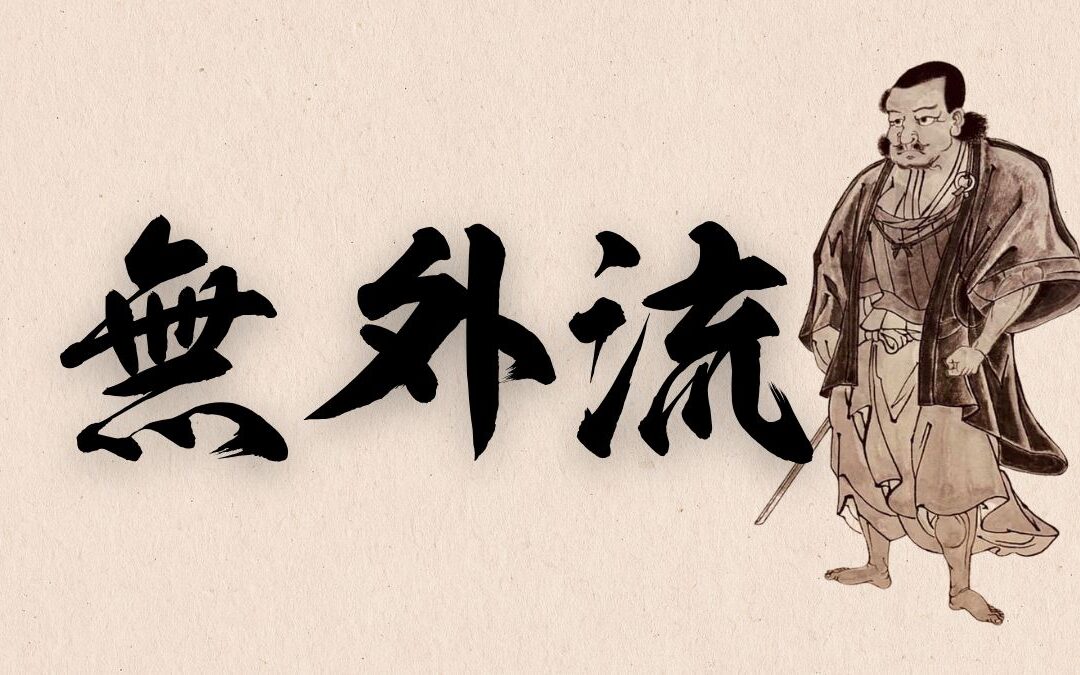
In the history of Japanese martial traditions (budō, 武道), few figures embody the union of swordsmanship and Zen Buddhism as completely as Tsuji Gettan Sukemochi (辻月丹資茂, 1648–1728), founder of Mugai-ryū (無外流).
Gettan’s life traces a rare and profound arc:
from samurai swordsman to Zen monk, from technical mastery (waza, 技) to realization of emptiness (mu, 無). His school is not merely a system of combat, but a physical expression of Zen insight, where the sword becomes a vehicle for awakening.
Edo Period and the Way of the Sword
Tsuji Gettan was born in 1648, early in the Edo period (江戸時代), a time of peace under the Tokugawa shogunate. With warfare largely absent, the samurai class faced an existential shift:
What is the purpose of the sword in an age without war?
This question gave rise to a new understanding of martial practice:
- Swordsmanship as self-cultivation (shugyō, 修行)
- Combat as a path toward ethical refinement
- The integration of Zen (禅), Confucianism (儒教), and martial discipline
It was within this atmosphere that Gettan’s transformation became possible.
Early Life and Martial Training (武芸修行)
Tsuji Gettan Sukemochi was born into a samurai family (侍). From a young age, he was trained in classical sword arts (kenjutsu, 剣術), eventually studying several established schools, including:
- Sekiguchi-ryū (関口流)
- Yamaguchi-ryū (山口流)
These traditions emphasized:
- Correct posture (shisei, 姿勢)
- Efficient body mechanics
- Decisive, realistic technique
Gettan sensei gained a reputation for calmness and precision rather than brute force. Yet even as his skill deepened, a realization emerged: technical excellence alone was incomplete.
The Inner Conflict: Technique Without Awakening
Like many elite swordsmen of his time, Gettan reached a point where further refinement of technique failed to bring clarity.
Questions arose:
- What remains when technique disappears?
- Who cuts when there is no thought?
- Can the sword reveal ultimate truth (shinri, 真理)?
In Zen terms, Gettan faced the limit of form (kata, 形) without essence (ri, 理). This inner conflict pushed him beyond martial schools and toward Zen practice.
Encounter with Zen Buddhism (禅)
Tsuji Gettan became a disciple of the Rinzai Zen monk Sekitō Kisen (石頭希遷系臨済禅). Under his guidance, Gettan undertook severe spiritual training, including:
- Zazen (坐禅) — seated meditation
- Kōan practice (公案) — paradoxical Zen questions
- Monastic discipline designed to exhaust ego and attachment
Through this process, Gettan confronted the root of fear, identity, and duality. Eventually, he attained satori (悟り), a direct realization of reality beyond conceptual thought.
Upon awakening, he received the Buddhist name Gettan (月丹):
- 月 (getsu / tsuki) — moon
- 丹 (tan) — cinnabar, elixir, essence
The name evokes the moon reflected in still water — pure awareness, unattached, illuminating without effort.
The Birth of Mugai-ryū (無外流)
After his Zen realization, Gettan returned to swordsmanship with transformed perception. From this union of Zen insight and martial experience, he founded Mugai-ryū.
The name of the school is profoundly philosophical:
無 (mu) — nothingness, emptiness, non-being
外 (gai) — outside, beyond
Mugai may be understood as: “That which exists beyond emptiness.”
This does not imply nihilism, but freedom from duality — beyond self and other, life and death, victory and defeat.
Mugai-ryū specializes in iaijutsu (居合術), the art of drawing the sword and cutting in a single, decisive action.
Key characteristics include:
- Simplicity (簡素, kanso) — no unnecessary movement
- Directness (直截, chokusetu) — immediate resolution
- Stillness of mind (静心, seishin) — action arising from silence
- One cut, one life (一刀一命, ittō ichimei)
The kata are minimalistic, but unforgiving. They demand:
- Perfect timing (hyōshi, 拍子)
- Complete presence (zanshin, 残心)
- Absence of ego (muga, 無我)
Teaching Beyond Technique: The Sword as a Zen Koan
As a teacher in Edo, Gettan attracted both samurai and scholars. However, he did not view Mugai-ryū merely as a fighting system.
For him:
- Kata were moving kōan
- Training was Zen practice in armor
- The opponent was a mirror of the self
He emphasized key Zen-martial principles:
- 無心 (Mushin) — no-mind
- 不動心 (Fudōshin) — immovable mind
- 平常心 (Heijōshin) — everyday mind
True victory, Gettan taught, was victory over delusion.
In his later life, Tsuji Gettan increasingly withdrew from worldly ambition, focusing on teaching and Zen practice.
He passed away in 1728, leaving behind:
- Mugai-ryū Iaijutsu
- A lineage of Zen-infused swordsmanship
- A model of martial enlightenment
Mugai-ryū continues to thrive globally as a living expression of Zen.
Speaking from experience, practicing it daily is more than just training; it is a vital asset for navigating the stresses of modern life.