
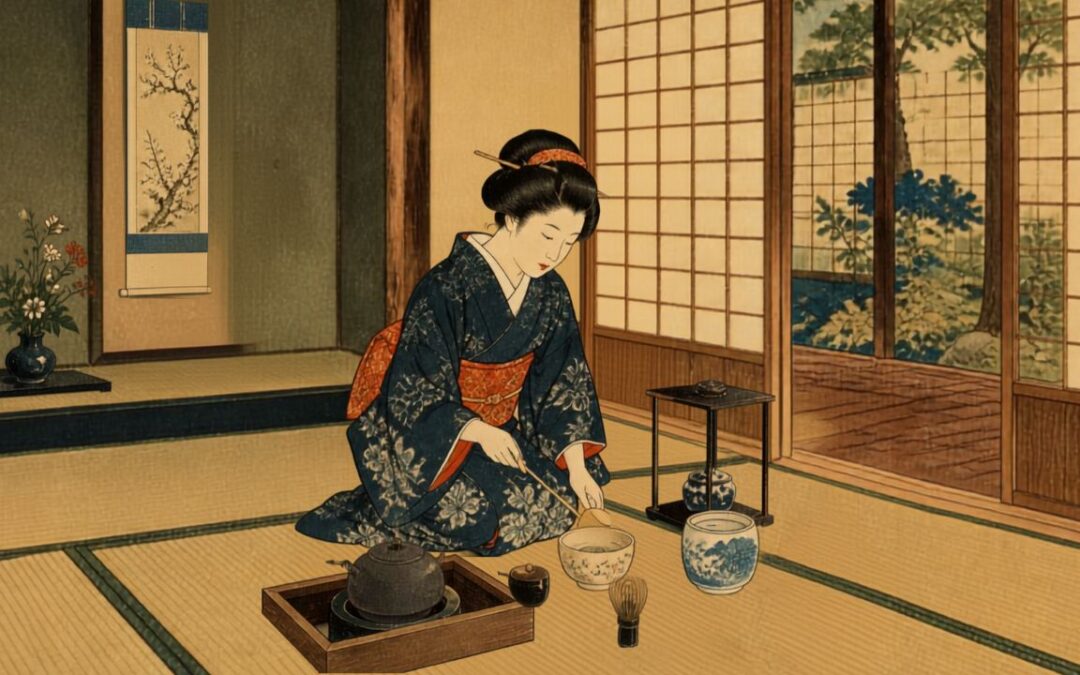
The Japanese tea ceremony, known as chanoyu (“hot water for tea”) or chadō (“the way of tea”), is much more than an aesthetic ritual or a social gathering. It is a profound spiritual discipline deeply rooted in the philosophy of Zen Buddhism. To truly understand the essence of this tradition, one must trace the historical journey of Zen, the evolution of powdered green tea (matcha), and the core principles that transform a simple cup of tea into a moving meditation.
The Journey of Zen: From India to Japan
Zen Buddhism traces its origins back over 2,500 years to the meditative awakening of Siddhartha Gautama under the Bodhi tree in India. Deriving its name from the Sanskrit word dhyāna (meaning “perfect contemplation”), the tradition was brought to China around 520 CE by the monk Bodhidharma, where it developed into Chan Buddhism.
Between the 12th and 13th centuries, Japanese Buddhist monks traveling to China—most notably the monk Eisai—brought these Zen teachings home to Japan. Eisai established the Rinzai school of Zen, which quickly gained favor among the samurai warrior class due to its emphasis on strict mental discipline, self-control, and direct focus on the present moment.
The Arrival of Matcha and Monastic Rituals
Along with Zen philosophy, Eisai introduced powdered green tea, or matcha, to Japan from Song Dynasty China in 1191. Initially, matcha was consumed within Zen monasteries as a medicinal remedy and as a practical aid to help monks remain alert during long hours of zazen (seated meditation).
Over time, this monastic practice expanded into broader feudal society. During the 14th and 15th centuries, tea tasting (cha-yoriai) became a lavish pastime among military lords and aristocrats, who competed to display their immense wealth using costly, pristine Chinese porcelain and bronze vessels.
The Wabi-Sabi Revolution and Sen no Rikyū
In response to this ostentatious display of luxury, tea masters began transforming tea preparation into an authentic spiritual practice. Murata Shuko (1422–1503), often regarded as the father of the tea ceremony, was the first to draw a direct parallel between tasting tea and practicing Zen meditation.
This movement culminated in the 16th century with the legendary tea master Sen no Rikyū. Rikyū revolutionized chanoyu by stripping away extravagant Chinese utensils and establishing the aesthetic philosophy of wabi-sabi—the appreciation of natural simplicity, humility, and the quiet beauty found in imperfection and age. Instead of perfect porcelain, Rikyū championed unadorned, rustic ceramic bowls (chawan) and simple bamboo tools, emphasizing that true refinement lies in extreme simplicity.
“The Way of Tea is nothing more than this: boil water, make tea, and drink it properly. That is all you need to know.”
— Sen no Rikyū
The Four Pillars of Chadō: Wa, Kei, Sei, Jaku
Sen no Rikyū codified the spiritual framework of the Way of Tea into four foundational principles that guide every movement and interaction in the tearoom:
- Wa (和 – Harmony): Achieving complete balance and alignment with nature, the changing seasons, the utensils, and fellow participants.
- Kei (敬 – Respect): Demonstrating profound reverence for all human beings present and handling every humble object with total care and mindfulness.
- Sei (清 – Purity): Cleansing both the physical environment and the inner mind, leaving ego, stress, and worldly anxieties at the threshold.
- Jaku (寂 – Tranquility): Entering a state of unshakeable inner peace and serenity, which arises naturally when harmony, respect, and purity are fully realized.
Cha Zen Ichi Mi: “Zen and Tea Have the Same Taste”
The intimate connection between Zen and tea is epitomized by the ancient Japanese proverb Cha zen ichi mi (“Zen and tea have the same taste”).
In Zen philosophy, ultimate spiritual reality is not found in abstract dogma, but in the direct experience of ordinary daily actions. Every movement in the tea ritual—heating water in an iron kettle (kama), whisking powdered matcha with a bamboo whisk (chasen), and presenting the bowl—becomes an active exercise in mindfulness and presence.
The Tearoom as a Sanctuary of Radical Equality
The architecture of the traditional tea pavilion (chashitsu) embodies the Zen requirement to surrender one’s ego. The entrance door (nigiriguchi) is constructed deliberately low, requiring every guest to bow deeply and crawl inside.
Historically, even high-ranking samurai warlords had to unbuckle their katana (swords), leave them outside on a rack, and bow down to enter. Inside the small, minimalist room, all social hierarchies dissolved, creating a sacred space of absolute equality and shared human connection. This mindset is closely linked to the concept of Ichi-go Ichi-e (“one time, one meeting”), which reminds participants that every gathering is unique and will never occur again in the exact same way.
The Way of Tea reveals that true mastery and peace of mind do not require grand gestures. By bringing full awareness, humility, and respect to our daily routines, we can transform even the simplest moments into a sanctuary of stillness and presence.
You can as well listen to the dedicated episode on our Podcast Liomugai The Way of Sword and Budo