
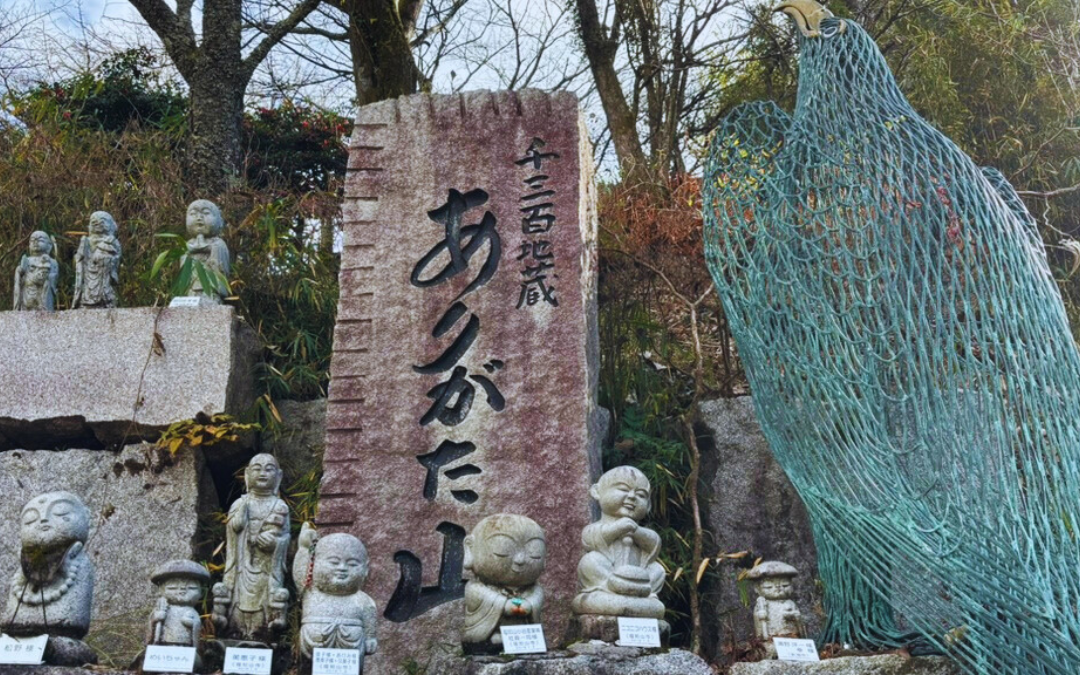
A Walk Through Arigatayama, the Mountain of Gratitude
Recently, I was in Gotemba in Shizuoka.
Most travelers passing there have one of two goals in mind.
Some come to shop at the vast Gotemba Premium Outlets, one of the largest outlet complexes in Japan, while others arrive to begin their ascent of the legendary Mount Fuji (in summer).
Yet just beyond the busy roads and shopping crowds, on the quiet southeastern slopes of the mountain, lies a place that offers something far more meaningful than a luxury bargain or a summit photograph.
Hidden among forests and gentle hills is Arigatayama, literally translated as the “Mountain of Gratitude.” It is not a typical tourist attraction, nor is it widely known outside Japan. Instead, it is a sanctuary—a place built around reflection, humility, and thankfulness. Walking through its sacred grounds is less like visiting a temple complex and more like entering a different state of mind.
During my recent walk there, I discovered that Arigatayama is the kind of place that quietly reshapes your perspective long after you’ve left the foothills of Shizuoka Prefecture.
The Spirit of “Arigato”
Arigatayama serves as the headquarters of Nenpoushinkyou, a modern Japanese religious movement founded in the early twentieth century. While it has an organized spiritual framework, visitors do not need to be followers to appreciate the philosophy that defines the site.
At the heart of everything here lies one simple word: Arigato.
In Japanese, arigato means “thank you,” but its deeper meaning suggests something even more profound—gratitude for life itself. The teachings associated with Arigatayama emphasize expressing thankfulness for nature, for the wisdom of ancestors, and even for hardships that shape us into stronger people.
As soon as I stepped onto the wide stone paths, the atmosphere felt different from other temple grounds I had visited in Japan. The air seemed quieter, softer somehow. Tall cedar trees formed natural corridors along the walkways, their trunks rising like pillars into the sky. Sunlight filtered through the branches in scattered patterns across the ground, and the only sounds were distant bells, rustling leaves, and the occasional call of birds.
The sense of gratitude the site promotes isn’t loudly preached—it’s felt in the stillness.
Walking in the Shadow of a Deity
postcards, usually as a distant and iconic silhouette.
At Arigatayama, however, Fuji is not just a backdrop.
Because the sanctuary sits directly on the mountain’s slope, the presence of the volcano feels immense and immediate. The landscape rises toward the peak with quiet authority, reminding visitors that this sacred mountain has shaped Japanese spirituality for centuries.
Within the traditions of Shinto, Fuji is often regarded as a shintai—the physical body of a deity. In other words, the mountain itself is divine. Standing here beneath it, that idea suddenly feels less symbolic and more tangible.
On clear mornings the view is extraordinary.
The perfect symmetry of Fuji’s snow-capped summit appears above the trees like a painting suspended in the sky. The most striking visual pairing is with the complex’s five-story pagoda, whose brilliant red structure rises above the surrounding forest.
The contrast is breathtaking:
- deep green cedar forests
- vivid red temple architecture
- the brilliant white peak of Fuji above
For photographers it is a dream composition. But even without a camera, the scene offers something more valuable: a moment of perspective. Under a mountain that has stood for hundreds of thousands of years, everyday worries suddenly feel small and temporary.
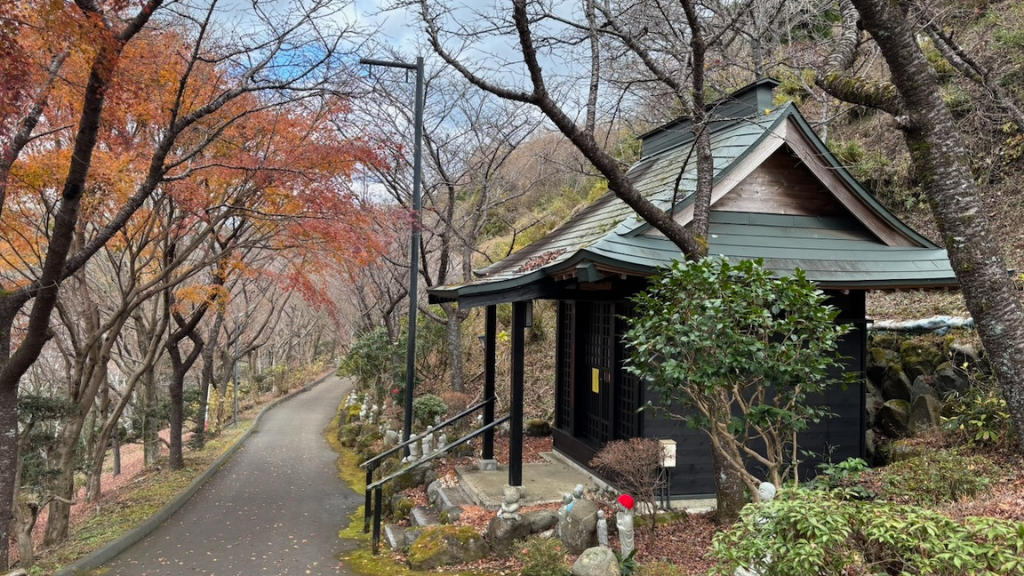
The Silent Crowd: 1,800 Jizo Statues
The most powerful moment of the walk comes gradually, as the path begins to fill with rows upon rows of stone statues.
Nearly 1,800 figures of Jizo line the trails of Arigatayama.
These statues represent Jizo Bosatsu, one of the most beloved protective figures in Japanese Buddhism. Jizo is traditionally considered the guardian of travelers, children, and souls moving through the afterlife. Throughout Japan, small Jizo statues often stand beside roads, rivers, and temple gates.
But seeing so many together is something entirely different.
At Arigatayama, the statues form what feels like a silent congregation, stretching along pathways and terraces among the trees. Each figure has its own posture and expression. Some appear peaceful, others contemplative. A few even seem to smile gently.
Walking among them feels like moving through a gathering of patient watchers.
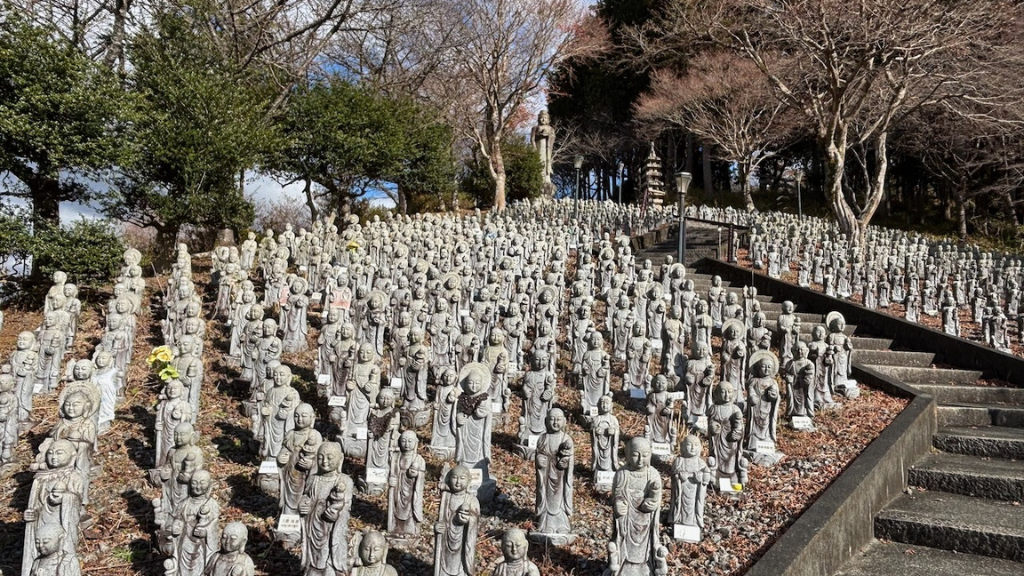
One detail immediately catches the eye: almost every statue wears a bright red knitted bib or cap.
These garments are not decorative. They are offerings placed by families and devotees as acts of care and devotion. In Japanese folk belief, the color red is associated with protection—it is thought to ward off illness, misfortune, and harmful spirits.
Traditionally, parents who have lost a child or who pray for a child’s safety may dress a Jizo statue in red clothing. By doing so, they symbolically entrust their love and concern to the compassionate protection of Jizo.
Seeing hundreds of these small hand-knitted garments is deeply moving. Each one represents a story—someone’s grief, hope, gratitude, or prayer.
The result is both quiet and powerful: a visual reminder that even anonymous statues can carry human emotion.
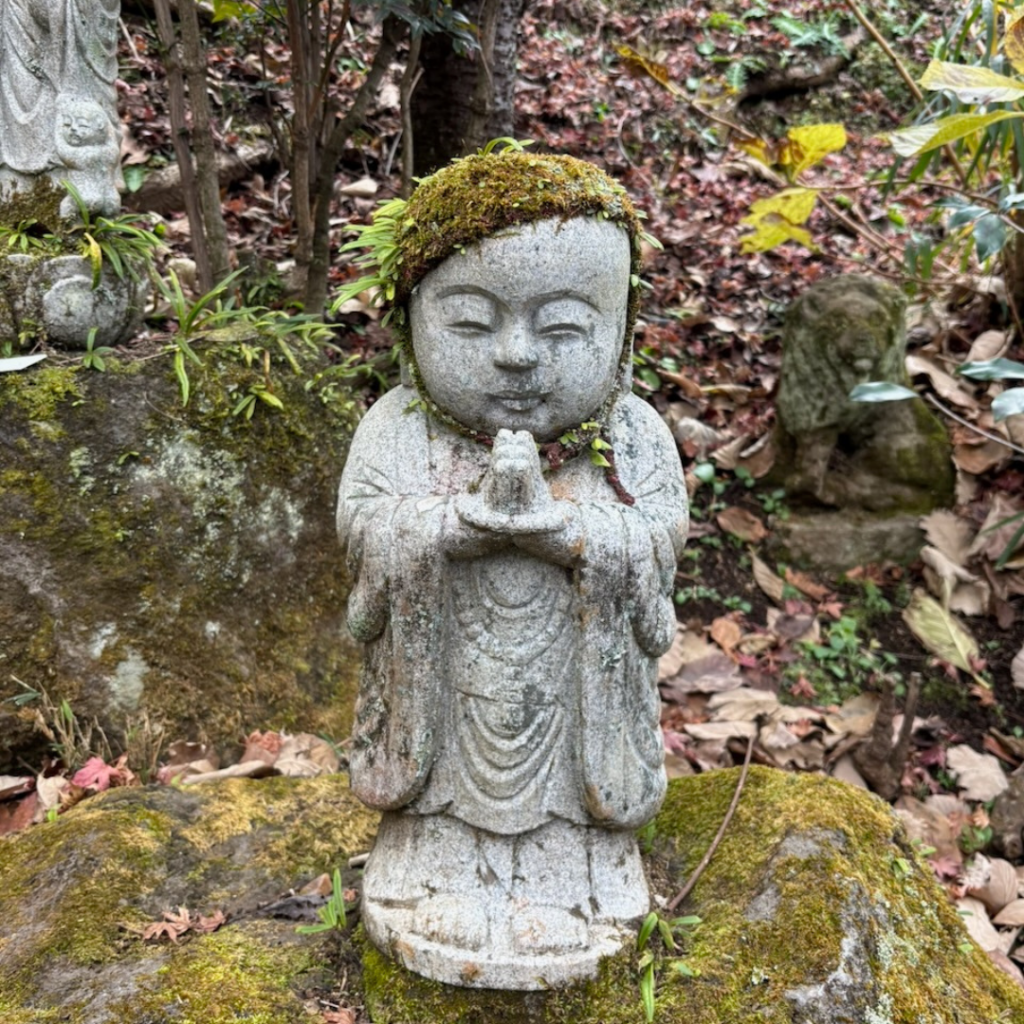
Another remarkable detail becomes clear when you look closely at the statues: no two faces are exactly the same.
Many of the Jizo figures here were donated by families or individuals as expressions of thanks. A recovered illness, a safe journey, a prayer answered—each statue can represent a moment of gratitude made permanent in stone.
The statues are often hand-carved and intentionally simple. Their material—stone from the earth—symbolizes the “Womb of the Earth,” a concept representing nature’s nurturing and enduring presence.
Over time, rain, moss, and mountain weather slowly soften the features of the statues. Instead of diminishing them, the aging process seems to deepen their presence, allowing them to blend naturally with the mountain landscape.
It is as if the mountain itself gradually adopts them.
Arigatayama is not simply a temple complex—it is a place intentionally designed to slow you down and shift your perspective.
By the time I finished my walk and began descending toward Gotemba, the noise of the modern world felt distant. The experience had quietly changed the rhythm of my thoughts.
In a world often defined by speed and achievement, Arigatayama offers a different message: pause, breathe, and be grateful.
And perhaps that is why the “Mountain of Gratitude” lingers in memory long after the journey ends. When you leave its cedar paths, you carry something small but meaningful with you—a little more arigato in every step.