
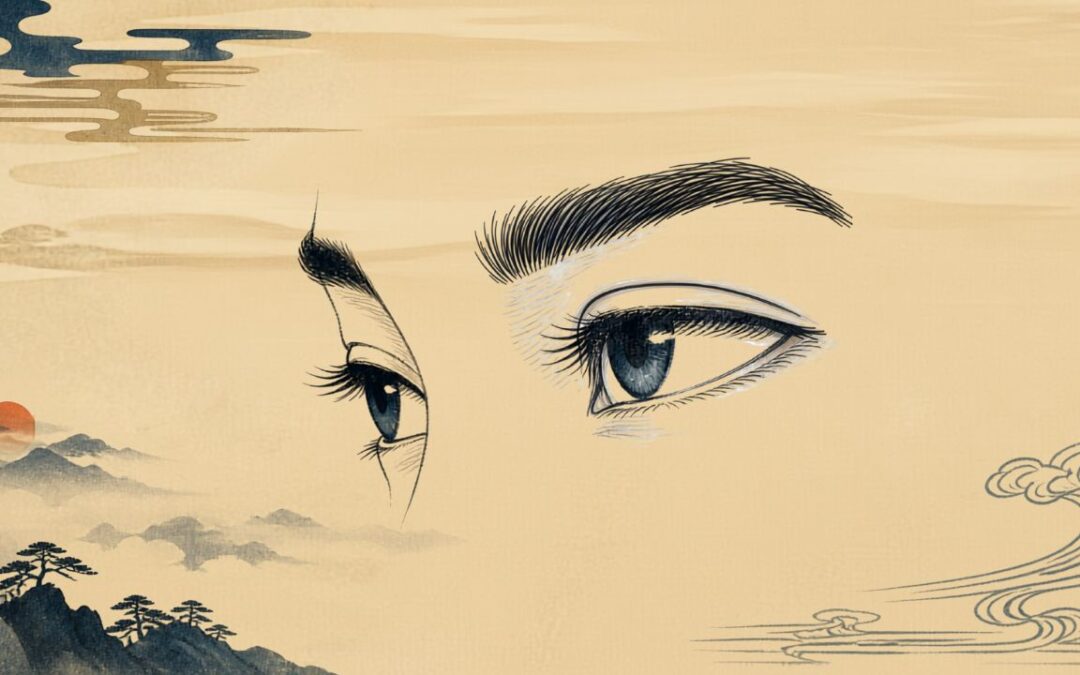
In martial arts, a practitioner’s earliest and most dangerous mistake rarely originates in the feet or the hands—it begins in the eyes.
Human instinct naturally drives us to fixate on immediate threats: the tip of a drawn blade, a cocked fist, or the exact target we intend to strike. Yet, whether engaging at blade’s length in classical swordsmanship or at chest-to-chest range in traditional karate, narrow focus is a fatal vulnerability. To fixate on a single point is to blind yourself to everything else.
1. Etymology and Meaning: What Is Metsuke?
The Japanese term Metsuke (目付) consists of two kanji:
- Me (目): the eye or vision.
- Tsuke (付): to attach, affix, or direct.
Literally translated, it means “fixing the eyes.”
However, reducing metsuke to a mechanical visual cue misses its deeper essence. In classical Budo, the term encompasses both physical gaze and total mental awareness directed toward an opponent. It is the outer physical manifestation of an internal state: mindfulness, calm focus, and complete situational readiness (zanshin).
2. Shiken: The Trap of Mechanical Vision
Fixating sharply on a single point is known as shiken (ordinary or analytical seeing). Beginners instinctively stare at whatever appears most dangerous—the sword blade, the staff, or the incoming fist. In doing so, they forget the person holding the weapon. A weapon is merely an inert tool; the real threat is the mind driving it.
This hyper-focus leads to what martial traditions call mental fixation (ittoku or shishin—the “captured mind”), resulting in three critical failures:
- Loss of Anticipation: Staring exclusively at a blade or fist blinds you to subtle hip rotations, shifts in the center of gravity, or an incoming sweep.
- Physical Tension: A rigid, tense gaze instantly locks the neck and shoulders, degrading fluid biomechanics and slowing overall reaction speed.
- Telegraphed Intentions: An experienced martial artist will read your eyes instantly, knowing where your strike will land before your body even begins to move.
3. From the Sword to Close-Quarters: Two Philosophies of the Gaze
Different combat ranges dictate distinctly different approaches to vision.
Long Range & Swordsmanship: Enzan no Metsuke
In traditional Japanese sword schools (Iaido, Kenjutsu, Mugai-ryu), engagement starts at middle or long distance (maai). Here, masters teach Enzan no Metsuke (遠山の目付)—”gazing at distant mountains.”
The practitioner views the opponent as one would gaze at a mountain range on the horizon: taking in the entire silhouette without fixating on any individual tree. By resting the gaze gently around the opponent’s eyes or solar plexus while relaxing focal depth, peripheral vision expands exponentially.
In The Book of Five Rings (Gorin no Sho), Miyamoto Musashi articulates this principle with precision:
“In strategy, it is important to see distant things as if they were close, and to take a distanced view of close things… Perception (Kan) must be strong, analytical sight (Ken) must be weak.”
Close Quarters & Okinawan Karate: The Kinesthetic Shift
In Okinawan traditions (Goju-Ryu, Uechi-Ryu), combat unfolds at extremely close range (chika-ma), involving joint locks (tuite), sweeps, and short-range impacts. At this distance, relying purely on visual cues is ineffective: an incoming strike covers the distance faster than the eye can process it.
- The Throat/Sternum Anchor: The gaze settles on the center of the chest or the base of the throat. Because the torso and hips act as the primary engine for all power generation, an extremity cannot strike forcefully without an initial rotation of the trunk.
- From Sight to Touch (Kakie): Visual metsuke yields to tactile awareness. During “sticky hands” drills (kakie), peripheral vision monitors the outer perimeter, while the forearms and skin feel incoming vectors of force and structural openings long before the visual cortex can register them.
4. The Dojo Debate: The Bridge of the Nose vs. Direct Eye Contact
Where should the eyes settle? Even within classical schools (koryu), two primary methods persist:
- The Bridge of the Nose: Many lineages instruct students to fix their gaze slightly above the bridge of the nose or between the eyebrows. This neutral focal point takes in the opponent’s entire frame while remaining immune to feints or deceptive facial cues.
- Direct Eye Contact: Traditions such as Shindo Muso-ryu Jodo or Naginatajutsu advocate looking directly into the opponent’s eyes. Proponents argue that the eyes betray underlying intention, hesitation, and fear, allowing a practitioner to exert immediate psychological dominance (ki-seme).
5. Fudoshin and Solo Training (Iaido)
Metsuke is inseparable from Fudoshin (不動心)—the immovable, unshakeable mind. It trains the martial artist not to blink, flinch, or avert their eyes during feints, sudden movements, or strikes to the face, preserving physical alignment and posture under threat.
This mental discipline is tested most severely in solo sword forms (Iaido). Without an actual opponent standing in front of you, you must generate 100% of your focus internally through visualization. The sharpness, intensity, and direction of your metsuke reveals the clarity and realism of your mental image.
6. Applying Metsuke to Daily Life
The principles of metsuke extend far beyond the walls of the dojo:
- De-escalating Conflict: In moments of acute stress or verbal confrontation, the nervous system triggers tunnel vision, locking attention onto the perceived threat and spiking adrenaline.
- Maintaining Composure: By consciously adopting a wide, soft, panoramic gaze, you trigger a parasympathetic response: shoulder tension drops, breathing deepens, and heart rate stabilizes.
True mastery of metsuke is not about how hard you look, but how much you are capable of perceiving. When the eyes are calm, the mind remains still.