
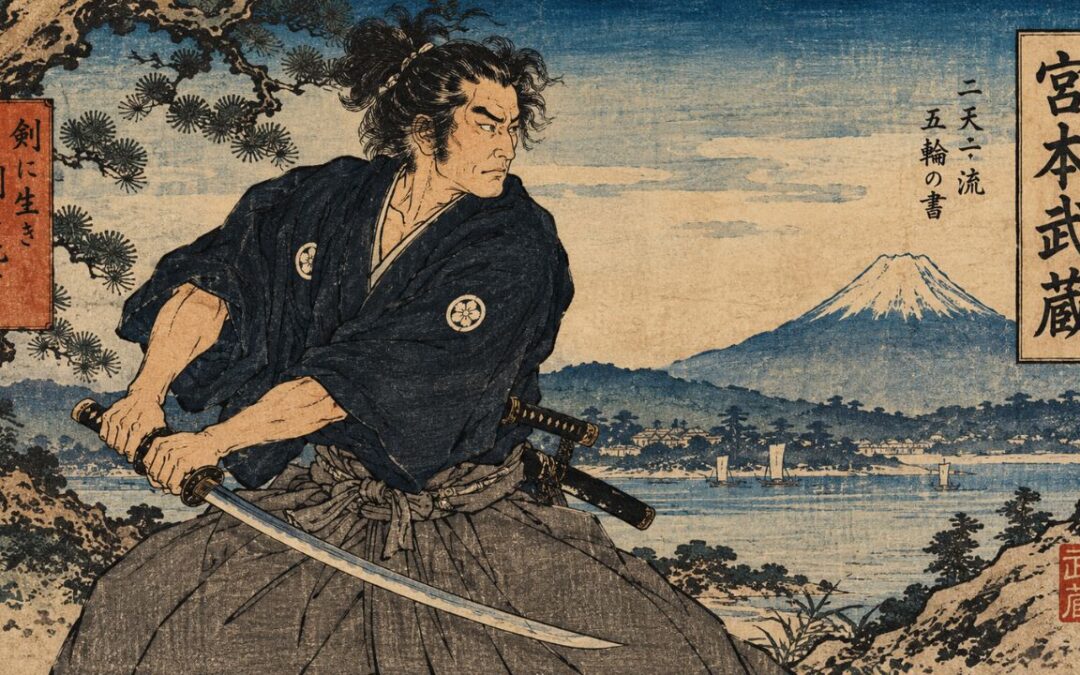
Miyamoto Musashi and The Book of Five Rings: Strategy, Zen, and the Mastery of Life
Miyamoto Musashi (c. 1583 – June 13, 1645) stands as one of the most enigmatic and revered figures in Japanese history. Celebrated as a kensei (“sword saint”), he was an undefeated rōnin, a master strategist, an accomplished ink painter, a calligrapher, and a philosopher. Over a lifetime spanning the turbulent late Sengoku and early Edo periods, Musashi fought in over sixty duels without suffering a single defeat.
Shortly before his death in 1645 inside the Reigandō cave, Musashi distilled his lifetime of experience into a seminal treatise on kenjutsu and strategy: Go Rin No Sho (The Book of Five Rings). Far from being a mere manual on swordplay, this text serves as a universal framework for discipline, adaptability, and psychological clarity.
The Legend of the Lone Samurai
Born Shinmen Bennosuke around 1583 in Mimasaka or Harima Province, Musashi was introduced to martial arts at a young age by his father, Shinmen Munisai, an accomplished swordsman and master of the jitte. Musashi’s martial journey began early: he fought and won his first duel at just twelve or thirteen years old against Arima Kihei, a swordsman of the Kashima Shintō-ryū style.
By the age of twenty-eight, Musashi had engaged in scores of life-or-death duels across Japan, including famous clashes against the Yoshioka clan in Kyoto and the staff master Musō Gonnosuke.
The Duel on Ganryū Island
Musashi’s most famous encounter took place on April 13, 1612, against Sasaki Kojirō on Ganryū Island off the coast of Shimonoseki. Kojirō was renowned for his skill with the nodachi—a particularly long sword.
Demonstrating his mastery of psychological warfare and improvisation, Musashi deliberately arrived late for the duel. During the boat ride to the island, he carved a custom wooden practice sword (bokken) out of a spare boat oar. When Kojirō confronted him in frustration, Musashi delivered a single, decisive vertical strike that crushed Kojirō’s skull, securing his place in martial legend.
Niten Ichi-ryū: Two Heavens as One
Musashi revolutionized Japanese swordsmanship by founding the Niten Ichi-ryū (or Ni-Ten Ichi-Ryu) school, which translates to “Two Heavens as One.” While traditional samurai held their long sword (katana) with both hands, Musashi advocated wielding both the katana and the short sword (wakizashi) simultaneously.
He believed that a warrior should train to be equally proficient with both hands, maximizing balance and efficiency while avoiding over-reliance on any single weapon.
Deciphering The Book of Five Rings
In 1643, suffering from failing health, Musashi retired to the Reigandō (Spirit Rock Cave) in Kumamoto to live as a hermit. There, he wrote The Book of Five Rings, dividing his strategic philosophy into five distinct volumes named after the classical Buddhist elements (godai): Earth, Water, Fire, Wind, and Void.
1. The Book of Earth (地の巻)
The Book of Earth lays the foundation of Musashi’s strategy. He compares mastering strategy to building a house, where one must understand the tools, materials, and structural principles.
Key insights from the Book of Earth include:
- Background Timing and Rhythm: Musashi notes that rhythm governs all human endeavors—from music and dancing to archery, commercial trading, and martial conflict. Discerning the “background timing” of an opponent or environment is essential for victory.
- Broad Knowledge: Musashi famously asserts: “If you know the Way broadly, you will see it in everything.” Mastering one discipline deeply illuminates the principles of all others.
- The Nine Core Principles: Musashi concludes this chapter with nine rules for practical living, starting with “Do not think dishonestly” and ending with his famous maxim: “Do nothing which is of no use.”
2. The Book of Water (水の巻)
Water symbolizes flexibility and adaptability. Water conforms to whatever vessel contains it—be it a pitcher, a riverbed, or a narrow channel.
Musashi teaches that a warrior’s mind and body must embody this fluid nature:
- Spiritual Balance: In the midst of combat, your spiritual bearing should be no different from normal life—determined yet calm, neither tense nor slack.
- The Five Attitudes: Musashi outlines five primary sword stances (Upper, Middle, Lower, Right Side, Left Side), but stresses that these must seamlessly transition into “No Attitude” or “Existing–Non Existing,” allowing actions to flow naturally without rigid adherence to form.
3. The Book of Fire (火の巻)
The Book of Fire addresses the heat and aggression of combat, applying equally to one-on-one duels and battles involving thousands of troops.
Musashi highlights tactical positioning and initiative:
- Taking the High Ground: Always position yourself where the sun, moon, or physical structures do not obstruct your sight or blind you, forcing your opponent into unfavorable terrain or shadows.
- Forestalling the Enemy (Sen): Musashi details three ways to take the initiative—attacking directly (Ken No Sen), waiting for the opponent to strike to exploit a opening (Tai No Sen), or engaging simultaneously to override their momentum (Tai Tai No Sen).
4. The Book of Wind (風の巻)
In Japanese, the character for “wind” (fū) also means “style” or “custom.” In this chapter, Musashi critiques contemporary schools of swordsmanship.
He warns against common pitfalls:
- Over-reliance on Weapons: Musashi criticizes schools that favor extra-long swords, pointing out that relying on length or specialized gear creates vulnerability when space is constrained.
- Avoidance of Rigid Technique: True strategy does not consist of flashy maneuvers or secret tricks; it relies on direct, efficient action aimed at achieving victory with minimum unnecessary risk.
5. The Book of Void (空の巻)
The final and most philosophical volume, the Book of Void (Ku), reflects Zen Buddhist influences regarding Śūnyatā (emptiness).
- Beyond Conscious Thought: The Void represents a state of absolute freedom where a master acts spontaneously through refined intuition, unburdened by hesitation, doubt, or ego.
- Perceiving the Unseen: Musashi writes: “By knowing things that exist, you can know that which does not exist.” In the Void lies ultimate clarity, where technique becomes second nature and action aligns perfectly with reality.
The Universal Legacy of Musashi
Beyond his swordsmanship, Musashi was a master of ink painting (sumi-e) and calligraphy, creating celebrated works such as Shrike Perched on a Withered Branch. In his final days, he also penned the Dokkōdō (“The Path of Aloneness”), twenty-one short precepts for self-reliant living.
Today, The Book of Five Rings is studied worldwide not only by martial artists, but also by business leaders, athletes, and strategists seeking timeless lessons on focus, situational awareness, and personal mastery.
> “Do nothing which is of no use.” — Miyamoto Musashi