
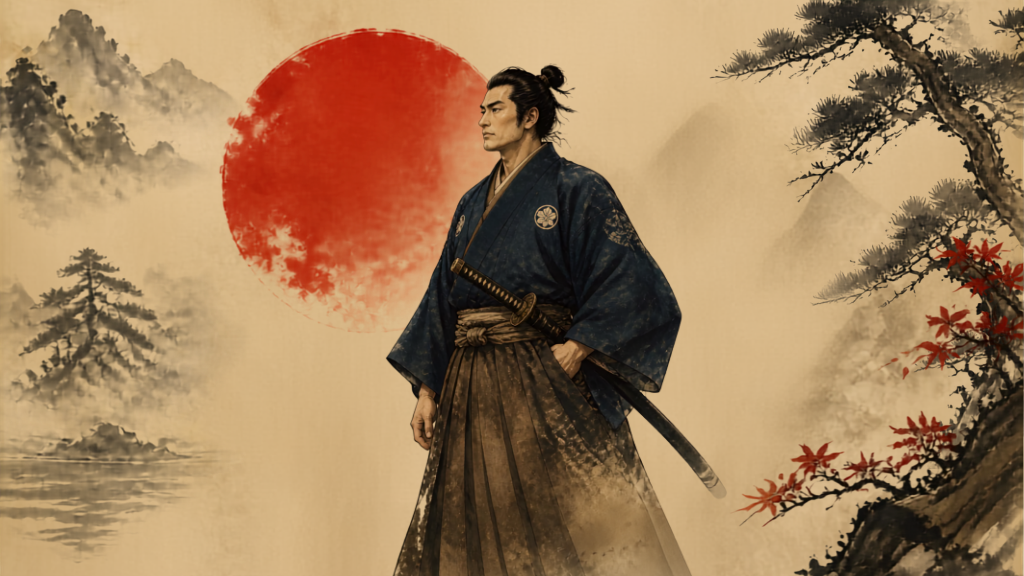
Why This Legendary Garment is Essential to Iaido
The hakama (袴) is one of the most iconic pieces of traditional Japanese clothing. This wide, pleated trouser-skirt immediately evokes images of samurai, Shinto priests, and martial artists. But for an iaidoka—a practitioner of Iaido, the art of drawing the Japanese sword—the hakama is far more than an aesthetic tradition. It is a masterpiece of physical engineering, historical preservation, and moral guidance.
1. Tactical Engineering on the Dojo Floor
In Iaido, where movements must be executed with absolute fluidity and split-second precision, every element of the uniform serves a physical and ergonomic purpose:
- Sword Stability (Saya): This is the most crucial daily technical function. The scabbard of the sword (saya) is slipped into the wide belt (obi), but it is the long cords (himo) of the hakama, tightly crossed and tied over it, that lock the assembly securely against the left hip. This layered system allows the practitioner to pivot the scabbard with high precision during drawing (nukitsuke) and sheathing (noto), preventing the weapon from slipping or wobbling.
- Postural Alignment (Koshiita): The rear of the hakama features a rigid, trapezoidal plate called the koshiita. Pressed firmly against the lower back, it acts as a physical brace. This forces the practitioner to tuck the pelvis and maintain a perfectly straight spine, encouraging the constant engagement of the hara—the body’s physical and energetic center of gravity located just below the navel.
- Freedom of Movement & Tactical Camouflage: The exceptionally wide cut of the hakama allows for complete freedom of movement during deep lunges and ground-based techniques, such as those starting from a kneeling position (seiza or tatehiza). Historically, the volume of the fabric also served a tactical purpose: it fully masked the samurai’s footwork, knee spacing, and weight transfers. To an opponent, it was nearly impossible to read the warrior’s stance or anticipate their first step.
2. A Millennial History: From Imperial Courts to the Samurai
Contrary to popular belief, the hakama’s origins are not strictly Japanese. Its evolution is the result of over a thousand years of cultural synthesis and adaptation:
- Imperial Beginnings: The garment was originally inspired by the trousers worn at the Chinese imperial court during the Sui and Tang dynasties. Introduced to Japan during the Asuka and Nara periods, it was quickly adopted by the local aristocracy. By the Heian period, it had become an indispensable court garment for both men and women to assert their noble status.
- The Warrior’s Shield: With the rise of the samurai class during the Kamakura period, the hakama transitioned from a courtly fashion into a functional asset. Crafted from durable fabrics like hemp, it protected the legs of horsemen from brush and friction during hunts and battles. This era saw the divergence of two primary styles: the umanori-bakama (divided trousers for riding horses) and the andon-bakama (an undivided lantern-skirt style).
- The Bureaucratic Uniform: During the long peace of the Edo period, the hakama became the official ceremonial dress of the samurai bureaucracy. When paired with a sleeveless, broad-shouldered jacket (kataginu), it formed the kamishimo—the mandatory formal attire for appearing before the Shogun. To prevent surprise attacks at court, high-ranking lords were sometimes required to wear naga-bakama—trousers so incredibly long they trailed one or two feet behind the wearer, making quick, aggressive movements virtually impossible.
3. The Meiji Era: A Symbol of Female Empowerment
At the end of the 19th century, the Meiji restoration brought rapid Westernization to Japan, and men began abandoning the hakama in daily life in favor of Western three-piece suits. The garment might have vanished entirely if not for an unexpected revival led by women.
As Japan modernized its educational system, the first generation of female students and teachers found the traditional kimono too restrictive for physical activity and academic settings. Western dress of the era was also rejected due to the health risks associated with tight corsets.
Utako Shimoda, a prominent educator, women’s activist, and former lady-in-waiting to Empress Shōken, intervened. She adapted imperial court attire to design a practical, skirt-style hakama for her students. This reform wear quickly became a powerful visual symbol of the modern, educated, and independent Japanese woman.
Today, this rich history is kept alive every spring as thousands of female university graduates wear the hakama for their graduation ceremonies. It also remains the daily attire for Shinto priests and shrine maidens (miko).
4. The Philosophy of the Seven Pleats and the Bushido Spirit
The martial arts hakama is distinguished by its unique structure of seven deep pleats—five in the front and two in the back. The asymmetrical arrangement of the front pleats (two on the right, three on the left) is a classic example of Japanese asymmetry aesthetics.
In martial arts like Iaido, these seven pleats serve as a constant physical reminder of the seven cardinal virtues of the Bushido code:
- Jin (Benevolence)
- Gi (Honor or Justice)
- Rei (Courtesy or Respect)
- Chi (Wisdom)
- Shin (Sincerity)
- Chu (Loyalty)
- Ko (Filial Piety)
Learning to fold the hakama properly after every training session is not merely a chore to preserve the fabric’s creases. It is considered an active extension of martial practice. The process teaches patience, mindfulness, and respect for one’s equipment. In many traditional schools, the highest-ranking student is even given the responsibility and honor of folding the teacher’s hakama as a deep token of respect.
If you want to know more you can our weekly podcast